The table
| Surface | Published mass | Time constant | 95% of oven temp | 99% |
|---|
| Lodge 15" cast iron pizza pan | 9.9 lb | 7.8 min | 23 min | 36 min |
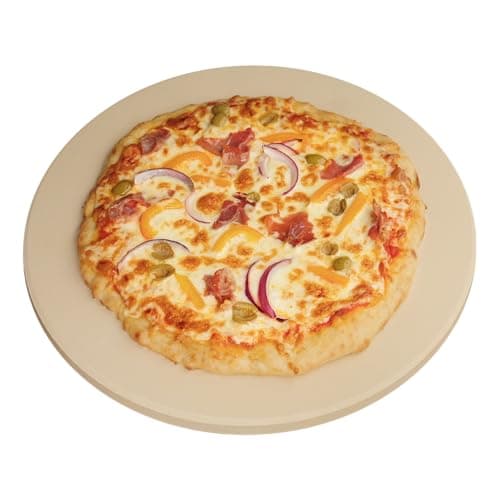
| Old Stone 16" cordierite round | 7.3 lb | 8.2 min | 25 min | 38 min |
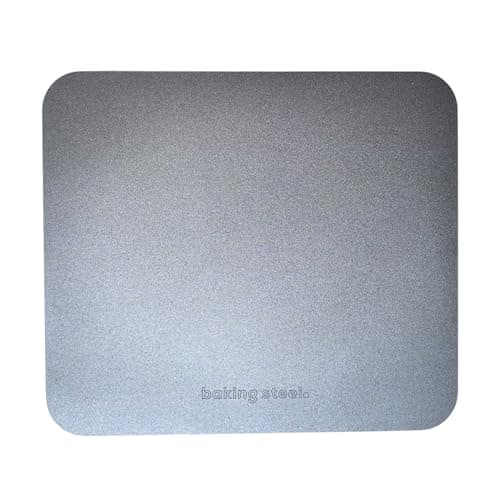
| Baking Steel Original, 1/4 in | 15 lb | 8.9 min | 27 min | 41 min |
| Baking Steel Pro, 3/8 in | 27 lb | 13.9 min | 42 min | 64 min |
| NerdChef Ultimate, 1/2 in | 32 lb | 18.4 min | 55 min | 85 min |
25 vs 27 min
A 16-inch cordierite stone against a quarter-inch steel, to 95 percent of oven temperature
The steel is two minutes slower. Its advantage over a stone is entirely in what happens after the base lands, and none of it is in the preheat.
Why conduction is not the bottleneck
The instinct is that steel conducts heat 30-odd times better than cordierite, so it must heat up faster. The reason that does not follow is the Biot number: the ratio of resistance to heat moving inside a body against resistance to heat crossing into it.
Below about 0.1, internal conduction is effectively free and the whole slab can be treated as one temperature. For the quarter-inch steel here the Biot number is 0.001. Even the worst case on this site - a thick cordierite stone - comes in around 0.09.
So conductivity, the property steel wins on overwhelmingly, is not the limiting factor for any of these. What limits them is how much heat has to go in, which is mass times specific heat capacity, divided by how fast it can cross the surface.
The model, in full
Lumped capacitance. The time constant is:
tau = m x cp / (h x A)
where m is mass, cp is specific heat capacity, h is the effective surface heat transfer coefficient and A is the exposed area. After one tau the surface has closed 63 percent of the gap to oven temperature; after 3 tau, 95 percent; after 4.6 tau, 99 percent.
Worked example - Baking Steel Original. Published mass 15 lb = 6.80 kg. Carbon steel cp = 470 J/kg.K. The plate is 16 by 14 inches, so two faces plus edges give 0.299 m2 of exposed area. With h = 20 W/m2.K: tau = 6.80 x 470 / (20 x 0.299) = 534 s = 8.9 minutes. 3 tau = 27 minutes. 4.6 tau = 41 minutes.
The one input that is an assumption rather than a published constant is h. We use 20 W/m2.K: a linearized radiative component near 21 for a 0.9-emissivity surface warming toward a 500 F cabinet, plus a few W/m2.K of still-air convection. Take h as 30 and every time above shortens by about a third.
The cross-check that makes us believe it
Baking Steel publish their own preheat guidance for the Original: 45 to 60 minutes at 500 to 550 F. Our model, built entirely from their published mass and a textbook specific heat capacity, gives 41 minutes to 99 percent.
Two completely independent routes landing on the same answer is the strongest validation available to a site that owns none of this equipment. It is also why we trust the model on the plates whose makers publish no guidance at all.
The exception runs the other way. FibraMent publishes a preheat procedure - 30 to 45 minutes from a room-temperature oven - but neither a weight nor a composition, so there is nothing for our model to work with and the maker's figure is the only one available. Why that board is the one we refuse to compute is in the FibraMent review.
What we did not do
We have not baked on any of these. Every guide in this category says it tested a dozen stones; we would rather say plainly that we did not. What we did instead is on this page in full: published specs with their sources, thermal arithmetic from material constants with the working shown, and the makers' own manuals read rather than paraphrased.
What this means in the kitchen
Do not shorten the preheat because you bought a steel. If anything, lengthen it.
Thickness costs preheat roughly in proportion to mass. Going from a quarter inch to three eighths adds about 15 minutes; to a half inch, about 28.
The way to know is to measure. Every figure above is a model with an assumed h. A twenty-dollar infrared thermometer replaces all of it with a number from your own oven, and that is the honest recommendation this whole page leads to.