Why "preheat for 45 minutes" is a guess
It is not a bad guess. It is just that nobody publishing it appears to have worked out where it comes from, which means nobody can tell you how it changes for a heavier plate, a thinner stone or a different oven.
Here is where it comes from. Every baking surface in a domestic oven has a Biot number at or below 0.1, so the whole slab can be treated as a single temperature rising toward the oven's. The time constant is mass times specific heat capacity divided by the effective surface heat transfer coefficient times the exposed area. After one time constant you have closed 63 percent of the gap, after three about 95 percent, after 4.6 about 99.
Run it, and a 7.3 lb cordierite round reaches 95 percent of oven temperature in about 25 minutes and 99 percent in about 38. A 15 lb quarter-inch steel: about 27 and 41 minutes. A 27 lb three-eighths steel: about 42 and 64. A 32 lb half-inch steel: about 55 and 85. So "45 minutes" is roughly right for the plates most people own, and badly wrong for the heaviest ones - which is exactly the case where a guess costs you the most.
Emissivity, and why a cheap infrared thermometer lies about steel
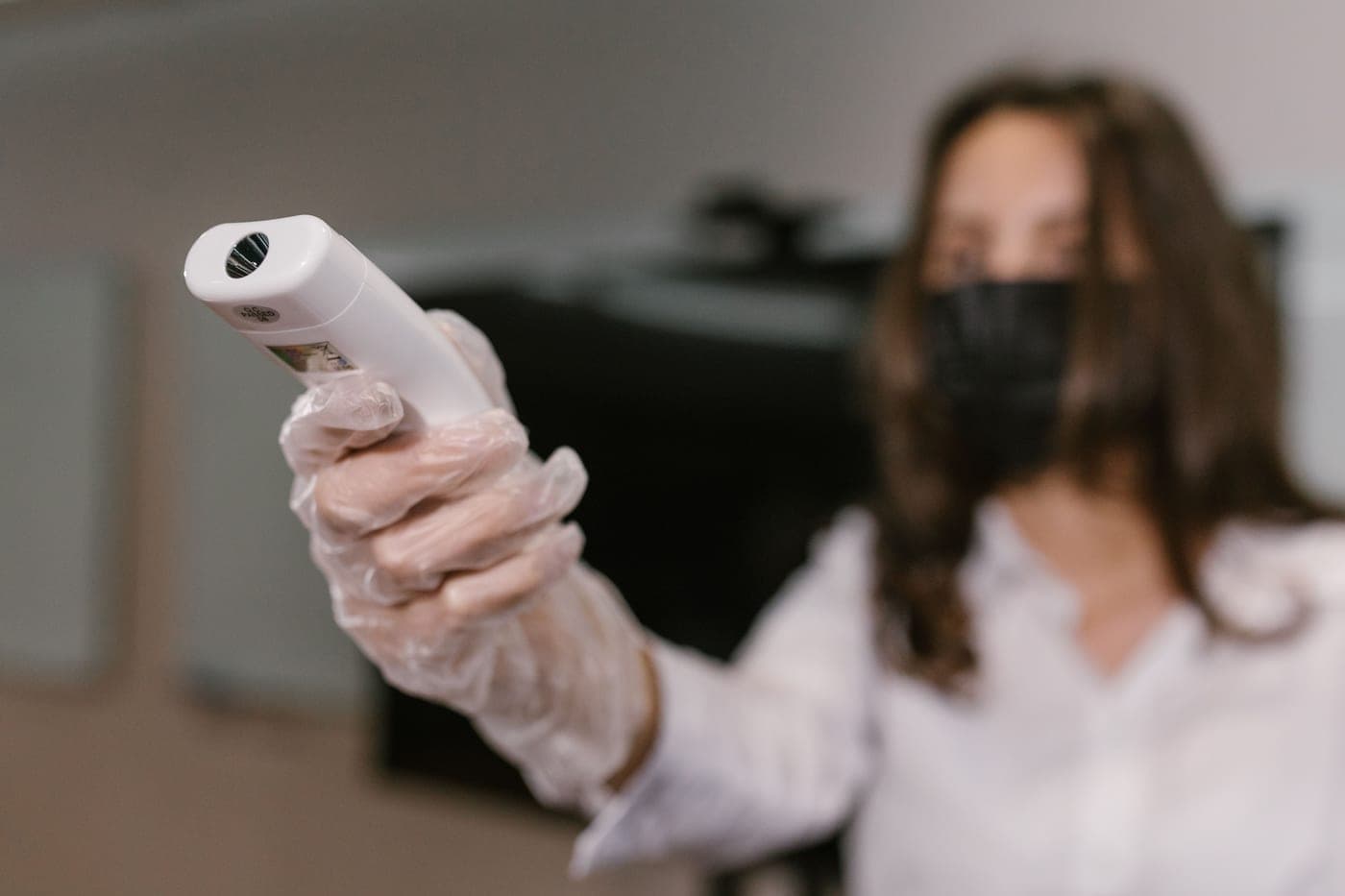
An infrared thermometer does not measure temperature. It measures radiance and infers a temperature, assuming a value for the surface's emissivity. Cheap instruments fix that assumption at 0.95. Published emissivity for oxidized or rolled steel is 0.66 to 0.80.
The error goes as the fourth root of the ratio, in kelvin. On a true 500 F seasoned steel, a 0.95-fixed instrument reads about 460 F if the real emissivity is 0.80, and about 417 F if it is 0.66. That is not a rounding error, it is the difference between waiting and baking. On a ceramic body - closer to the 0.90 to 0.95 published for common brick - the same instrument is out by only about 13 F.
So: on a stone, a fixed-emissivity gun is fine. On a steel, either buy an instrument with adjustable emissivity or know that your readings run cold and by roughly how much. We could not find a single competing guide in this category that mentions emissivity at all.
What a dial oven thermometer can and cannot tell you
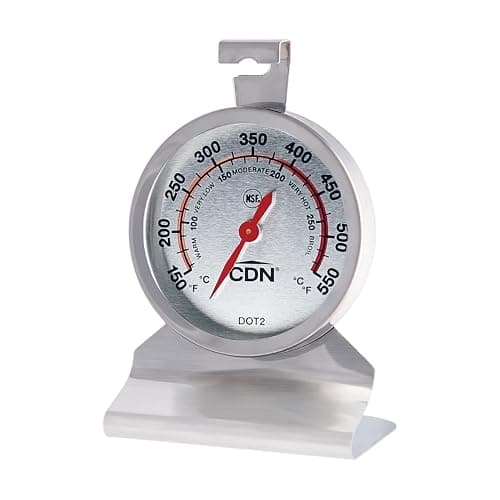
A good bimetallic dial thermometer publishes an accuracy of plus or minus 25 F. That is honest of the maker and it is a hard ceiling on the technology. It is enough to catch an oven that is running 75 F cold, which is a genuinely common fault and worth knowing. It is not enough to distinguish 475 F from 525 F, and it tells you nothing at all about the surface.
What the preheat costs
Nobody publishes this either, so we worked it out. A domestic electric oven's bake element is around 2.4 kW; assume it runs continuously for the first 15 minutes and then cycles at roughly 30 percent duty to hold. A 60-minute preheat is then about 1.14 kWh. At the current US average residential rate of 18.34 cents per kilowatt-hour that is about 21 cents. Extending a 15-minute preheat to a full hour costs about 10 cents.
Which is the answer to the question people are really asking when they search for it: the long preheat is not expensive, and you should stop rushing it. The full derivation, the assumptions, and a table across different electricity rates are on what preheating actually costs.