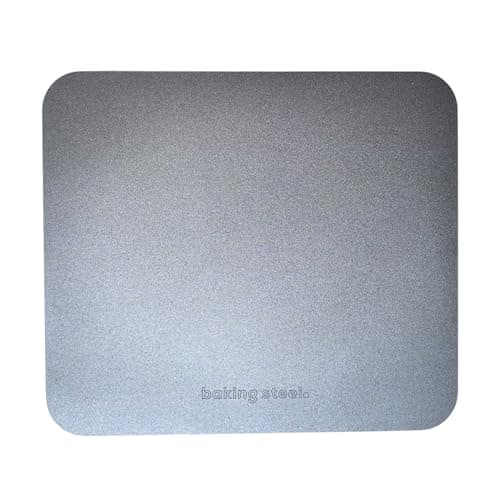
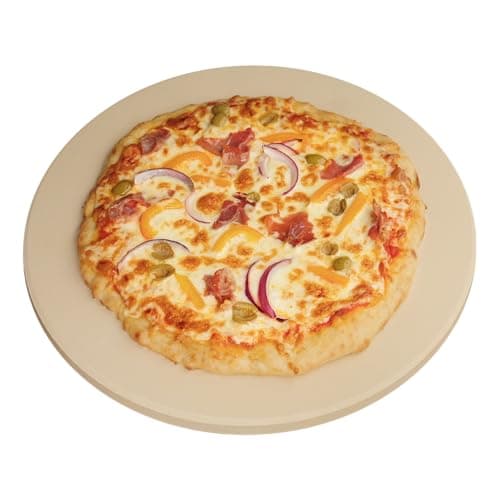
The comparison, on one screen
| | Cordierite stone | Carbon steel | Which wins |
|---|
| Thermal conductivity | 1.3-1.7 W/m.K | 50 W/m.K | Steel, by 29 to 38 times |
| Volumetric heat capacity | 1.73 MJ/m3.K | 3.71 MJ/m3.K | Steel, by 2.1 times |
| Thermal effusivity | 1,612 | 13,625 | Steel, by 8.5 times - this is the one for crust |
| Preheat to 95% of oven temp | 25 min (7.3 lb, 16in round) | 27 min (15 lb, 1/4in) | Stone, marginally |
| Energy stored, 68 to 500 F | 0.18 kWh | 0.21 kWh | Steel, by 15 percent |
| Weight | 7.3 lb | 15 lb | Stone |
| Can it break | Yes, thermal shock | No | Steel |
| Maintenance | None - it just stains | Seasoning, or it rusts | Stone |
| Absorbs moisture from the base | Yes | No | Stone |
Why effusivity is the row that matters
When two bodies at different temperatures touch, the temperature they settle at where they meet is set by their effusivities, not their conductivities. Put a 70 F wet base on a 500 F plate and the contact patch drops instantly; how far it drops, and how fast it recovers, is the whole game.
A steel's effusivity is 8.5 times a stone's, so the contact patch falls much less far and climbs back much faster. That is why a base on steel sets and blisters within the first minute while the same base on a stone spends longer wet.
Conductivity on its own is the wrong number: it describes heat traveling through the plate, and the plate is not what you are trying to heat. Stored energy on its own is also the wrong number, and it is the one that most embarrasses the marketing - a 16-inch stone and a quarter-inch steel are within 15 percent of each other on total stored energy. Almost identical fuel tanks, very different delivery.
0.18 vs 0.21 kWh
Energy a 16-inch stone and a quarter-inch steel hold at 500 F
A 15 percent gap. Anyone telling you a steel holds 18 times the energy of a stone has multiplied the wrong two numbers together.
Where the stone actually wins, and it is not a consolation prize
Bread. A 50-minute loaf on a steel takes a very aggressive base for a long time and the bottom crust can go from dark to bitter. A stone's gentler effusivity is more forgiving over a long bake. The four ways to make a steel work for a loaf anyway are in baking steel for sourdough and bread.
Moisture. Unglazed ceramic is porous and pulls water out of the base as it bakes. Steel does not - it drives moisture out as steam instead. For a wet dough on a long bake, the stone's route is kinder.
Handling. Half the weight, and no seasoning to keep up. If the practical reality is that a 15-pound plate will live in a cupboard, the stone is the better surface because it is the one that gets used.
Sweet and enriched doughs. Sugar and dairy brown early. A high-effusivity plate under a brioche-adjacent base scorches it before the top is done.
The honest recommendation
Buy the steel if your complaint is specifically pale, soft bottom crust on a 6 to 10 minute pizza bake, and you can comfortably move 15 pounds. That is the case it was made for and it solves it decisively.
Buy the stone if you bake bread as much as pizza, if 15 pounds is a problem, or if you have not yet ruled out the two cheaper explanations - an oven running cold, and a preheat that ends before the surface is up to temperature. Both of those cost nothing to test and both are more common than a surface problem.
And if you already own a large cast iron pan, you already own something with 95 percent of carbon steel's effusivity. See stone versus cast iron before you spend anything.
What we did not do
We have not baked on any of these. Every guide in this category says it tested a dozen stones; we would rather say plainly that we did not. What we did instead is on this page in full: published specs with their sources, thermal arithmetic from material constants with the working shown, and the makers' own manuals read rather than paraphrased.