Heads up: some links on this page are affiliate links. If you buy through one we may earn a commission at no extra cost to you. It never changes a ranking, and we accept no payment for placement. The full version.
The order almost everybody gets wrong
The usual sequence is: buy a stone, be slightly disappointed, buy a steel, be slightly disappointed, conclude that home ovens cannot make good pizza.
The sequence that works starts with a diagnosis, and the first three fixes on the list are free. Find your symptom below. If you have not bought a surface at all yet, start instead with whether a pizza stone is worth it - it measures a stone against the sheet pan you are probably using now.
"The base is pale and floppy while the top is done"
Not enough heat going into the base. Three causes, cheapest first.
1. The preheat ended too early - free. The oven's beep is about air. A 15 mm stone needs about 25 more minutes past that point, a quarter-inch steel about 27. This is the single most common cause and it costs nothing to rule out.
2. The oven is running cold - free to check. Domestic thermostats drift by 50 to 100 F. Put a thermometer in the middle at 450 F, wait 20 minutes, read it. Many ovens can be recalibrated from the control panel.
3. The surface is genuinely wrong for the job. Only after the first two. Carbon steel has 8.5 times a stone's thermal effusivity, which is the property that decides how far the contact patch cools when the base lands - the arithmetic is in stone versus steel.
Preheat, calibration, surface
In that order, because the first two are free and the third is not
A steel bought to solve a preheat problem solves nothing and costs the most of the three.
"It sticks to the peel and lands folded"
A handling problem, and it is the one that makes people give up. In order:
1. Change what you dust with - almost free. Semolina or fine cornmeal instead of plain flour. Coarse grains roll under the base; flour absorbs water and glues it down.
2. Change your sequence - free. Base on the peel first, then dress, and shake the peel every 20 seconds while you work. Launch inside a minute.
3. Buy a peel that suits how you build. Wood if you dress slowly, light perforated aluminum if you are fast. Wood versus metal.
"The middle is soggy and the edge is fine"
Moisture, not heat. No equipment fixes this.
Less sauce than feels right. Drain fresh mozzarella and let it sit on paper. Cook watery vegetables before they go on. If it is still soggy after all three, the base may simply be too thin in the middle - check your dough ball weight against the weight chart.
"It goes floppy two minutes after it comes out"
Steam condensing under the base. Move the pizza to a wire rack rather than a board or a plate, and cut it there. Free, immediate, and one of the most satisfying fixes on this page.
"The dough fights me when I stretch it"
Cold dough - free. Take balls out one to two hours before baking. Cold gluten will not extend, and no technique gets round it.
Underproofed dough - free. A ball that springs straight back from a poke needs more time.
Overworked dough - free. Rolling pins and heavy handling tighten the gluten. Press from the middle out with your fingertips and let gravity do the rest - stretching guide.
"I cannot make the same pizza twice"
Measurement. A scale is the cheapest thing on this list that changes outcomes permanently, because a repeatable dough is the precondition for learning anything at all. Weigh everything, use baker's percentages, and weigh the balls when you divide.
Change one variable at a time and you will find your problem in about three bakes. Change three and you will learn nothing.
The buying order, if you are starting from nothing
A scale. Cheapest, and it is what makes everything else measurable.
A bench scraper. Costs almost nothing and changes how dough handles.
A peel you can launch off. This is where most people are losing pizzas.
An infrared thermometer. Sounds like an indulgence, and it is the item most likely to produce an immediate visible improvement, because almost everyone is baking colder than they think.
The baking surface. Biggest single upgrade, most expensive, and only worth buying once you know the first four were not your problem.
What we did not do
We have not baked on any of these. Every guide in this category says it tested a dozen stones; we would rather say plainly that we did not. What we did instead is on this page in full: published specs with their sources, thermal arithmetic from material constants with the working shown, and the makers' own manuals read rather than paraphrased.
The picks
What we would buy
ThermoWorks
ThermoWorks Industrial IR Gun (IR-GUN-S)
The adjustable emissivity is the reason to buy this rather than a cheap gun. Fixed-emissivity instruments read a seasoned steel 40 to 80 F low, and that is the difference between a good bake and a pale one.
#ad We hold no verified live price for this product, so we show none. How this site is funded.
Baking Steel
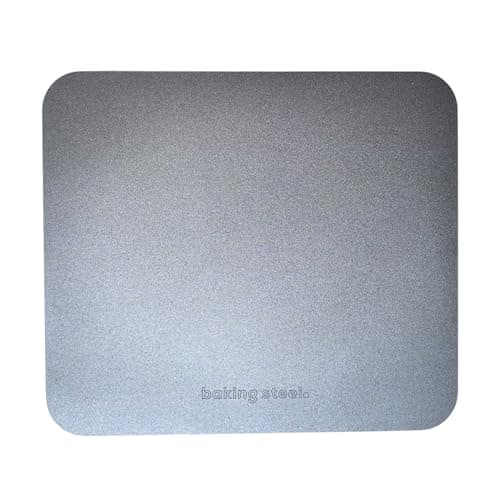
Baking Steel Original, 16 x 14 x 1/4
A quarter inch is the thickness where a steel stops being a novelty and stays a thing you can still lift. Its advantage over a stone is not preheat speed - it is what happens one second after the base lands.
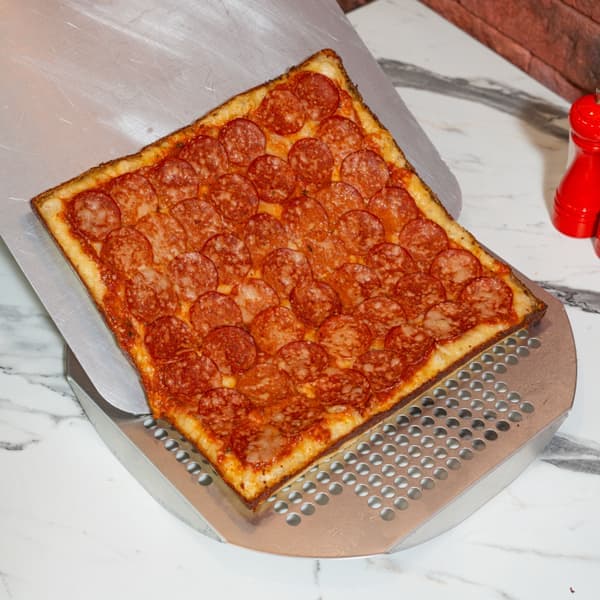
Perforations let flour fall off before the pizza does, and 610 grams across 14 inches is light enough to keep the launch steady. The best single peel for a home oven if you are only buying one.
#ad We hold no verified live price for this product, so we show none. How this site is funded.
Questions
Frequently asked
What is the single biggest upgrade for home pizza?+
The baking surface, if your problem is a pale base and you have already ruled out a short preheat and a miscalibrated oven. Those two are free to check and they are more often the cause.
Should I buy a pizza stone or a steel first?+
A steel if pale bottom crust is the specific complaint and you can lift 15 pounds. A stone if you bake bread too, or if weight is a concern. Neither, if you have not yet tried a longer preheat.
Is an infrared thermometer worth it for pizza?+
It is the item on this site most likely to change something immediately, because most people discover their surface is 60 to 100 F cooler than they assumed. It also costs less than any baking surface.
Do I need a pizza oven to make good pizza?+
No, but be honest about the ceiling. A domestic oven at 550 F with a good surface makes an excellent New York-style pizza. It cannot make a true Neapolitan, which needs 800 F plus, and no accessory changes that.
Sources
Every number on this page came from one of these, or from arithmetic on one of these that we showed in full.