The answer
| Preheat length | Energy | At 13 c/kWh | At 18.34 c/kWh (US average) | At 30 c/kWh |
|---|
| 15 min | 0.60 kWh | $0.08 | $0.11 | $0.18 |
| 30 min | 0.78 kWh | $0.10 | $0.14 | $0.23 |
| 45 min | 0.96 kWh | $0.12 | $0.18 | $0.29 |
| 60 min | 1.14 kWh | $0.15 | $0.21 | $0.34 |
| 90 min | 1.50 kWh | $0.20 | $0.28 | $0.45 |
10 cents
What extending a 15-minute preheat to a full hour costs, at the US average rate
Which is the answer to the question people are really asking. The long preheat is not expensive. Stop rushing it.
The derivation, in full
Step 1 - the element. A domestic electric range's bake element is typically around 2.4 kW. Yours will be on the appliance plate; substitute it if it differs.
Step 2 - the duty cycle. During bring-up the element runs continuously, which for a cold oven to 500 F is around 15 minutes. After that it cycles to hold the setpoint, at roughly 30 percent duty for a well-insulated oven. Both of these are assumptions, and they are the two numbers to challenge if you want to check this yourself with a clamp meter.
Step 3 - the arithmetic. For a 60-minute preheat: 0.25 h of continuous running at 2.4 kW = 0.60 kWh, plus 0.75 h at 30 percent of 2.4 kW = 0.54 kWh. Total 1.14 kWh.
Step 4 - the price. The US average residential retail price of electricity was 18.34 cents per kilowatt-hour in June 2026, published by the Energy Information Administration. 1.14 x 0.1834 = 21 cents.
What the surface itself costs
Only a small fraction of that goes into the baking surface. From mass times specific heat capacity times the temperature rise:
| Surface | Energy stored, 68 to 500 F | Share of a 1.14 kWh preheat |
|---|
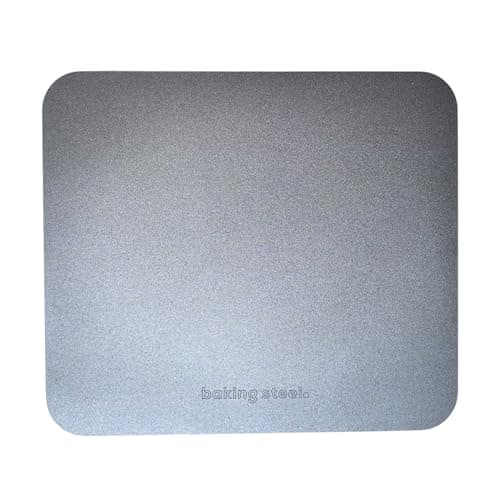
| 16" cordierite stone, 7.3 lb | 0.18 kWh | 16% |
| 1/4 in baking steel, 15 lb | 0.21 kWh | 18% |
| 3/8 in baking steel, 27 lb | 0.38 kWh | 33% |
| 1/2 in baking steel, 32 lb | 0.45 kWh | 39% |
The rest goes into the oven cabinet, the racks, the door glass and losses to the kitchen. Which is why adding a stone increases your preheat energy far less than its own stored energy suggests - the oven was already spending most of that heating itself.
Cost per pizza
Take a 45-minute preheat and 8 minutes of baking, on a 2.4 kW element at 30 percent hold duty: about 1.06 kWh, or roughly 19 cents at the US average rate. For four pizzas made in sequence, the preheat is shared, so the marginal cost of pizzas two through four is under two cents each.
Which is the practical conclusion. The preheat dominates, it is shared across everything you bake in that session, and it is cheap. Bake more than one thing.
What we did not do
We have not baked on any of these. Every guide in this category says it tested a dozen stones; we would rather say plainly that we did not. What we did instead is on this page in full: published specs with their sources, thermal arithmetic from material constants with the working shown, and the makers' own manuals read rather than paraphrased.
What we are assuming, stated plainly
2.4 kW element. Real domestic bake elements run roughly 2.0 to 3.0 kW. Yours is on the appliance plate.
15 minutes of continuous bring-up. Longer in a cold kitchen or a big oven.
30 percent hold duty. An older, less insulated oven might be 40 to 50 percent, which would raise the 60-minute figure to about 1.3 to 1.5 kWh.
18.34 cents per kWh. A national average. Your rate is on your bill and it is the number most worth substituting.
Electric oven. Gas is a different calculation with a different unit price and typically works out cheaper per bake.
Substitute your own figures into the same three steps and the arithmetic still works. That is the point of publishing it rather than just publishing an answer.