Heads up: some links on this page are affiliate links. If you buy through one we may earn a commission at no extra cost to you. It never changes a ranking, and we accept no payment for placement. The full version.
The answer, first
Pizza diameter
Area
Thin (TF 0.070)
Standard (TF 0.0885)
Thick (TF 0.105)
10 in
78.5 sq in
156 g
197 g
234 g
12 in
113.1 sq in
224 g
284 g
337 g
14 in
153.9 sq in
305 g
386 g
458 g
16 in
201.1 sq in
399 g
504 g
599 g
18 in
254.5 sq in
505 g
639 g
758 g
Where those numbers come from
They are pure geometry, and you can check every one of them on a calculator.
Dough weight is proportional to the area of the finished pizza. Area is pi times the radius squared. Multiply by a thickness factor - ounces of dough per square inch of pizza - and you have a weight. Multiply by 28.35 to get grams.
Worked example, 14 inches at standard thickness. Radius 7 inches. Area = pi x 7 x 7 = 153.94 square inches. Weight in ounces = 153.94 x 0.0885 = 13.62 oz. In grams = 13.62 x 28.35 = 386 g.
386 g
Dough for a 14-inch standard-thickness pizza
pi x 7^2 x 0.0885 ounces, converted to grams. Nothing about this is a matter of opinion, which is why forum answers to this question mostly agree with each other by accident.
The mistake almost everyone makes
Scaling dough by diameter instead of by area. Going from a 12-inch pizza to a 16-inch is a 33 percent increase in diameter and a 78 percent increase in dough, because area goes as the square of the radius.
Scale by diameter and your 16-inch pizza gets 378 g where it needed 504, which is why big pizzas made from a scaled-up small recipe come out thin in the middle and tear when you stretch them.
Choosing your thickness factor
0.060 to 0.070 - very thin, cracker-adjacent, or a Neapolitan-style base where a large share of the dough ends up in the cornicione and the middle is nearly translucent.
0.075 to 0.085 - thin New York style. Foldable, crisp at the edge of the slice.
0.085 to 0.095 - standard. If you have never thought about this, you are probably here.
0.10 to 0.12 - thicker, more bread-like, and the range for a pan pizza where the dough is pressed to the edges of a tin rather than stretched.
The useful move is to pick one, use it for every diameter, and only change it when you know what you want to change. It is the only way to make the same pizza twice.
Two adjustments worth making
Add 2 to 3 percent for handling loss. Some dough stays in the bowl and on the counter. If you want four 280 g balls, mix for 4 x 280 x 1.03 = 1154 g of finished dough.
Hydration changes weight but not thickness. A 70 percent hydration dough and a 60 percent one at the same ball weight give different finished thicknesses, because more of the wetter one is water that leaves as steam. If you move up in hydration and your bases feel thinner, add 3 to 5 percent to the ball weight.
Weigh the balls. A 40 g difference between two balls is a visibly different pizza, and 40 g is easy to miss by eye.
Why a scale is what makes this useful
A table of target weights only helps if you can hit them. Divide by eye and a four-way split of 1150 g routinely comes out 250, 280, 300, 320 - a 28 percent spread across the batch, which is more variation than any of the choices above.
Weigh the whole finished dough, divide by the number of balls, and cut to that number with a bench scraper. It takes 30 seconds and it is the difference between four pizzas and four different pizzas. The scale roundup covers what to weigh with.
This arithmetic also decides how much storage a batch needs, because proofing boxes quote their capacity in 250 g balls rather than in grams - and 250 g is a thin 12-inch base by the table above. The Ooni dough boxes review does that conversion.
The picks
What we would buy
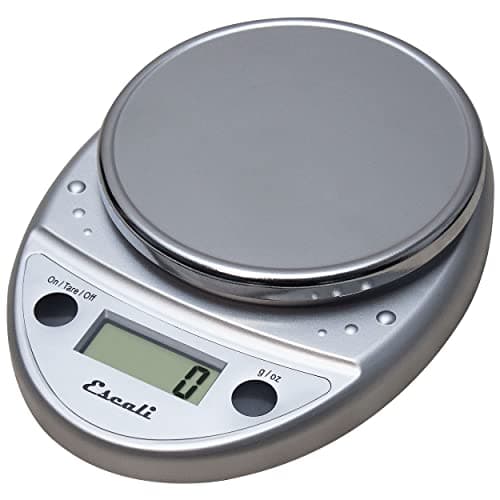
Escali
Escali Primo P115 Digital Kitchen Scale
Eleven pounds of capacity at one-gram resolution, which is exactly right for flour and dough balls and exactly wrong for yeast. Know which half of your recipe it is for.
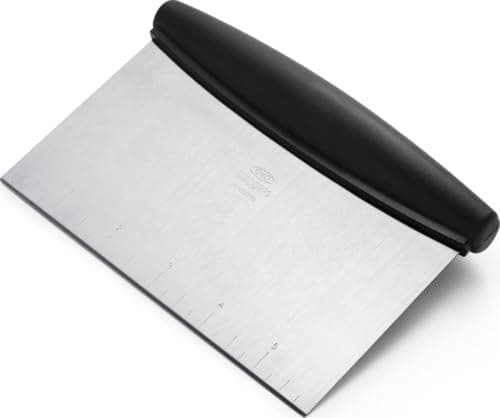
Six inches of stainless with inch markings etched into it. It divides dough, it lifts dough, and it measures the divisions - which is more than most single-purpose dough tools manage.
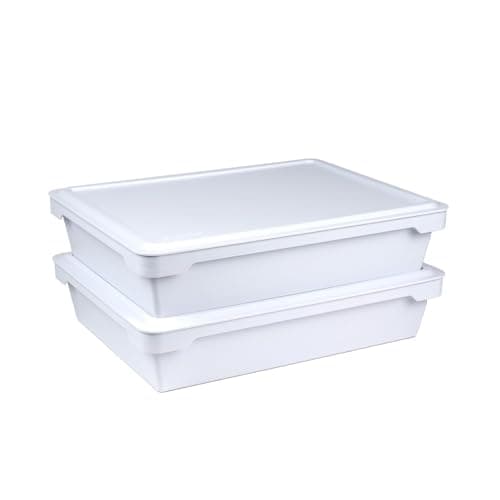
Shallow, stackable and 3.7 inches tall, which makes this the only dough box here that clears a domestic fridge shelf. The maker publishes both the dimensions and the dough-ball count, which is more than the restaurant-supply options manage.
About 386 g at standard thickness - pi times 7 squared times a 0.0885 thickness factor, converted to grams. Around 305 g for a thin base, 458 g for a thick one.
How much dough for a 12 inch pizza?+
About 284 g at standard thickness, 224 g thin, 337 g thick. That is 113.1 square inches of area times your chosen thickness factor.
What weight should pizza dough be?+
It depends entirely on the diameter, because dough scales with area. Pick a thickness factor, use it for every size, and let the arithmetic give you the weight - do not carry one number across different diameters.
Why does my 16 inch pizza come out thin?+
Almost certainly because it was scaled by diameter rather than area. A 16-inch pizza needs 78 percent more dough than a 12-inch one, not 33 percent.
Does hydration change the dough ball weight?+
It changes the finished thickness at a given weight, because more of a wet dough is water that leaves as steam. If you move up in hydration and the bases feel thinner, add 3 to 5 percent to the ball weight.
Sources
Every number on this page came from one of these, or from arithmetic on one of these that we showed in full.