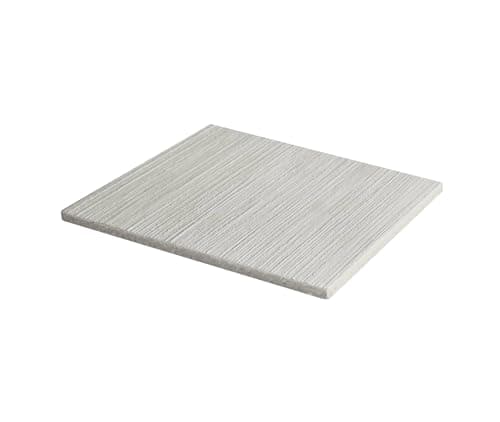
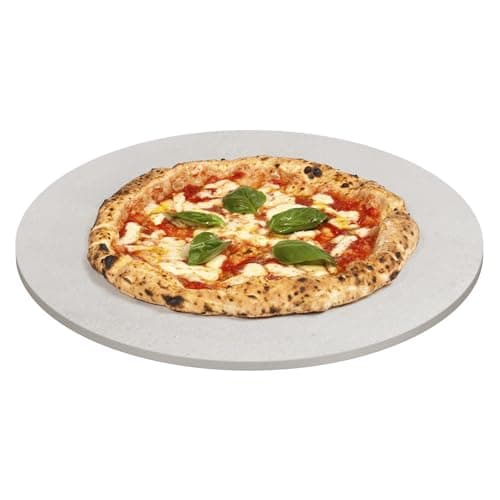
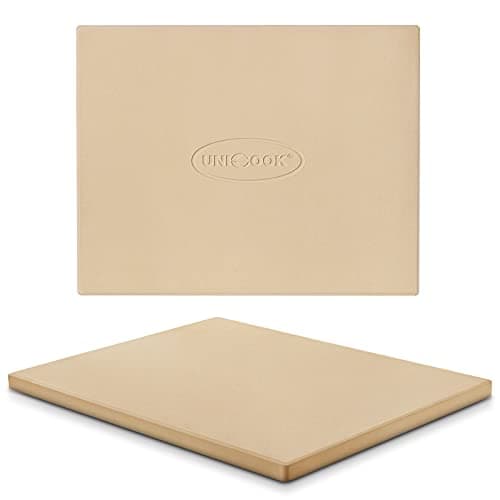
The only baking stone whose maker publishes laboratory data. It is also the one stone on this site we refuse to run our arithmetic on, and those two facts are connected.
Heads up: some links on this page are affiliate links. If you buy through one we may earn a commission at no extra cost to you. It never changes a ranking, and we accept no payment for placement. The full version.
What this review is
We have not baked on a FibraMent. What follows is every figure the maker and its Amazon listing publish, what those figures support, and the one marketing claim they do not. The standing method is on the methodology page.
What we did not do
We have not baked on any of these. Every guide in this category says it tested a dozen stones; we would rather say plainly that we did not. What we did instead is on this page in full: published specs with their sources, thermal arithmetic from material constants with the working shown, and the makers' own manuals read rather than paraphrased.
The published specification
This is the most complete spec sheet of any stone on this site, and it is worth seeing in full because almost nothing else in the category publishes a laboratory number at all.
Specification
Published figure
Dimensions
20" x 15" x 3/4" (also 13 5/8" round x 3/4")
Temperature limit
1000 F continuous, 1500 F intermittent
Compressive strength
9,363 PSI per ASTM C109
Moisture content
6-10 percent of dry weight
Certification
NSF/ANSI 4
Preheat
30-45 minutes from a room-temperature oven
Composition
"Engineered from a patented formula" - not disclosed
Weight
Not published
The two missing numbers, and why they matter here
Every preheat time on this site comes from mass times specific heat capacity divided by surface heat transfer. For cordierite stones we can run it because three unrelated makers publish weights, and those weights agree on an effective density near 1,700 kg/m3. For a steel we can run it because the plate is a known alloy of known thickness.
FibraMent publishes neither a weight nor a composition. So there is no honest route to a preheat curve, a stored-energy figure or an effusivity number for this board, and borrowing cordierite's constants for a body the maker explicitly says is not cordierite would produce a figure that looked precise and meant nothing.
30-45 min
The maker's own preheat guidance, from a room-temperature oven
Use this rather than our model. For context, our computed figure for a 15 mm cordierite stone is about 25 minutes to 95 percent of oven temperature - so FibraMent is asking for meaningfully longer, which is what you would expect from a board 25 percent thicker.
Note the shape of that instruction too: from a room-temperature oven. That is not a convenience note, and the published moisture content explains why.
6 to 10 percent moisture is the most interesting number here
FibraMent publishes a moisture content of 6 to 10 percent of dry weight. Almost nobody in this category publishes anything like that, and it tells you two useful things.
It is a porous body, by design. Drawing water out of the base while a pizza bakes is one of the two jobs a stone does - the other being heat - and a body that holds several percent water by weight is a body that can do it. Glazed stones cannot, which is the trade covered in cordierite versus ceramic.
It is why you must never rush it. Water inside a body becomes steam when heated, and steam inside a solid is pressure. A cold start is the standard rule for any stone - see why pizza stones crack - but on a board that publishes a moisture figure this high it is not advice, it is the operating procedure.
The durability claim, tested against its own numbers
The Amazon listing states that FibraMent stones are "thicker and more durable than other stones made from clay, ceramic, cordierite, soapstone, or granite that crack easily". Thicker is verifiably true: 3/4 inch against the 15 mm (0.6 inch) that is the category standard, which is about 25 percent more material. More durable is the part worth examining.
FibraMent
Cordierite
Compressive strength
9,363 PSI, which is 64.6 MPa
420 MPa
Coefficient of thermal expansion
Not published
2.9-4.8 micrometers per meter per kelvin
Continuous service temperature
1000 F
1150 C, which is 2102 F
On the one mechanical property both sides publish, cordierite is roughly six and a half times stronger. That does not make FibraMent fragile - and it does not settle the argument either, because compressive strength is not how baking stones fail. They fail in tension, when a hot face expands against a cooler core, and the property that governs that is thermal expansion.
Cordierite publishes an expansion figure. FibraMent does not. So the honest verdict on the durability claim is: unproven in the direction that matters, and contradicted in the one direction both parties measure. What FibraMent does have is thickness, which genuinely helps a stone survive ordinary handling, and a service temperature far above anything a domestic oven produces.
Stones break from a temperature difference across the body, not from absolute heat or from being squeezed. That is the number this spec sheet does not have.
NSF/ANSI 4, and what it does and does not tell you
FibraMent states it is certified to NSF/ANSI 4 and that it is the only commercially available baking stone holding that certification. NSF/ANSI 4 covers commercial cooking equipment for sanitation and food contact - it is a real, independently tested credential and it is the kind of thing a commercial kitchen buyer has to have.
What it is not is a baking claim. It says nothing about crust, heat transfer or how long the board lasts in your oven. Treat it the way we treat a temperature rating: reassuring, verifiable, and not the reason to buy.
Fitting one, which is the step people get wrong
The listing asks for approximately one inch of clearance on each side for air movement. Apply that to the 20 by 15 board and you need a rack at least 22 by 17 inches clear - which is a full-size 30-inch oven, not a compact one, and not an oven with a bowed or narrow rack.
That clearance rule is not FibraMent being fussy. A slab that covers the whole rack turns a convection oven into a sealed hotplate, and the same argument runs through the stone roundup. If your rack cannot take the big board, the 13 5/8 inch round is the same 3/4 inch thickness in a footprint a compact oven can actually use.
One more constraint worth knowing before you buy: the listing states that grill use requires a flame diverter. This is not a stone you drop onto a grate over live fire, which is exactly what a cordierite grill stone is for - those are ranked here.
The MicroLine version, and where to buy
The current retail 20 by 15 is sold as "Premium with MicroLine Technology", a dual-sided board whose MicroLine face the listing states is for high-heat cooking at 750 F and above. That is a surface treatment rather than a different material, and the underlying published figures - thickness, temperature limits, NSF listing - are the ones above.
FibraMent also sells direct as well as through the marketplace, and the two are not always the same price. We publish no prices in copy, so the practical advice is simply to check both before buying - the buy buttons here show whatever the marketplace price is today.
Who should buy it
Buy it if you want the largest, thickest surface a full-size domestic oven will take, you intend to leave it in permanently, and you value a maker that publishes engineering data over one that publishes a slogan.
Buy the 13 5/8 round instead if your oven is compact. Same thickness, same published temperature limits, a footprint that fits.
Buy cordierite instead if you want a published expansion figure behind the body, if you cook on a grill, or if you want the most surface per dollar. The Unicook rectangle publishes a thickness, a weight and a temperature rating for a fraction of the money.
Buy a steel instead if a pale base is the complaint. Every ceramic and composite board sits in the same low band on the property that decides bottom crust, and thickness does not change that - stone versus steel has the numbers.
The verdict
FibraMent is the most transparent maker in a category that mostly publishes adjectives, and it still withholds the two figures that would let anyone model its behavior. What you are buying is thickness, a genuine commercial certification, an unusually long and honest preheat instruction, and a durability claim that its own published strength number does not support. That is a better deal than most stones offer, at a price that means you should want the numbers - and on the one that matters most, expansion, there are none.
The picks
What we would buy
FibraMent
FibraMent Home Oven Baking Stone, 20 x 15 x 3/4
The only stone here whose maker publishes a service temperature, a thickness and its own preheat procedure, and the published limits are far beyond anything a domestic oven can do to it.
Unicook Heavy Duty Cordierite Pizza Stone, 15 x 12
A rectangle uses an oven rack better than a circle does, and at 6.6 published pounds this is the lightest surface here that still holds a useful amount of heat.
If you want the biggest, thickest board a full-size oven will take and you will leave it in permanently, yes. If you are buying it because the listing says it is more durable than cordierite, no - that claim is not supported by the one strength figure both materials publish.
How long do you preheat a FibraMent?+
The maker publishes 30 to 45 minutes from a room-temperature oven, and that is the figure to use. We cannot compute our own, because FibraMent publishes neither a weight nor a composition.
Is FibraMent better than cordierite?+
It is thicker - 3/4 inch against a 15 mm standard - and it carries an NSF/ANSI 4 certification no cordierite stone has. Cordierite publishes a low thermal expansion figure, which is the property that actually governs cracking, and FibraMent publishes none.
Can you use a FibraMent on a grill?+
The listing states that grill use requires a flame diverter, so it is not a drop-on-the-grate stone. For live fire, a cordierite grill stone is the right tool.
What size FibraMent fits my oven?+
Allow about an inch of clearance on each side, so the 20 by 15 board needs roughly 22 by 17 inches of clear rack - a full-size 30-inch oven. Below that, take the 13 5/8 inch round, which is the same thickness.
Sources
Every number on this page came from one of these, or from arithmetic on one of these that we showed in full.