Heads up: some links on this page are affiliate links. If you buy through one we may earn a commission at no extra cost to you. It never changes a ranking, and we accept no payment for placement. The full version.
The shortlist
Ranked, with the working
Ranked on published manufacturer specifications and, where the numbers exist, our own arithmetic on what each option does thermally. Tap any row for the full write-up, including who should skip it.
#
Product
Best for
Score
Price
01
Unicook Heavy Duty Cordierite Pizza Stone, 15 x 12Smaller ovens, and anyone who moves the stone in and out
Scores are ours and editorial. They are never published as review or rating markup, because we have not baked on these products - here is how we pick.
A grill is a harder environment than an oven, in one specific way
The temperatures are not the problem. Every cordierite stone here publishes a limit of 1450 F and a covered kettle running hard sits far below that. The problem is the gradient: a grill heats one face of the stone from a burner or coals a few inches away while the other face sits in comparatively cool air, and it does it fast.
Ceramic fails on differential expansion, not on absolute temperature. The hot face wants to grow and the cool face will not let it, and the resulting tensile stress is what cracks stones. Cordierite survives it as well as it does because its published coefficient of thermal expansion is very low - 2.9 to 4.8 micrometers per meter per kelvin - but low is not zero.
Slow and covered
The two words that decide whether your grill stone survives its first season
Put the stone on a cold grate, light the grill, and bring both up together with the lid down. Never place a cold stone onto a hot grate, and never put a hot stone down on a cold worktop.
What we rank on for grill use
Thermal shock tolerance first. Which in practice means cordierite, or metal. Any stone whose listing does not name cordierite is a gamble on a grill, and the published expansion figures behind that rule are worth two minutes before you buy.
Thickness second, and lower is better here. This is the opposite of the oven ranking. A thicker slab has a bigger temperature difference between its faces during the ramp, so it carries more differential stress. Around 15 mm is the sweet spot on a grill; three quarters of an inch is for an oven.
Weight third. You will be moving this one, often while it is warm, often outdoors. Under 8 pounds is a genuine convenience.
Size last, and constrained by the grate rather than by ambition. A stone needs clear air around its edge or the convection that browns the top of the pizza cannot circulate, and on a kettle that means leaving at least an inch to the wall.
A ceramic kamado - a Big Green Egg, a Kamado Joe - tightens that rule into arithmetic, because the grid is round, published to the tenth of an inch, and the maker's own stones all run smaller than it. Those numbers, and the diagonal trap that rules out rectangular stones on a round grid, are in the best pizza stone for a kamado or Big Green Egg.
Direct flame under a stone is what cracks it. Bank the coals to the sides, or run only the outer burners.
The setup that works, whatever you buy
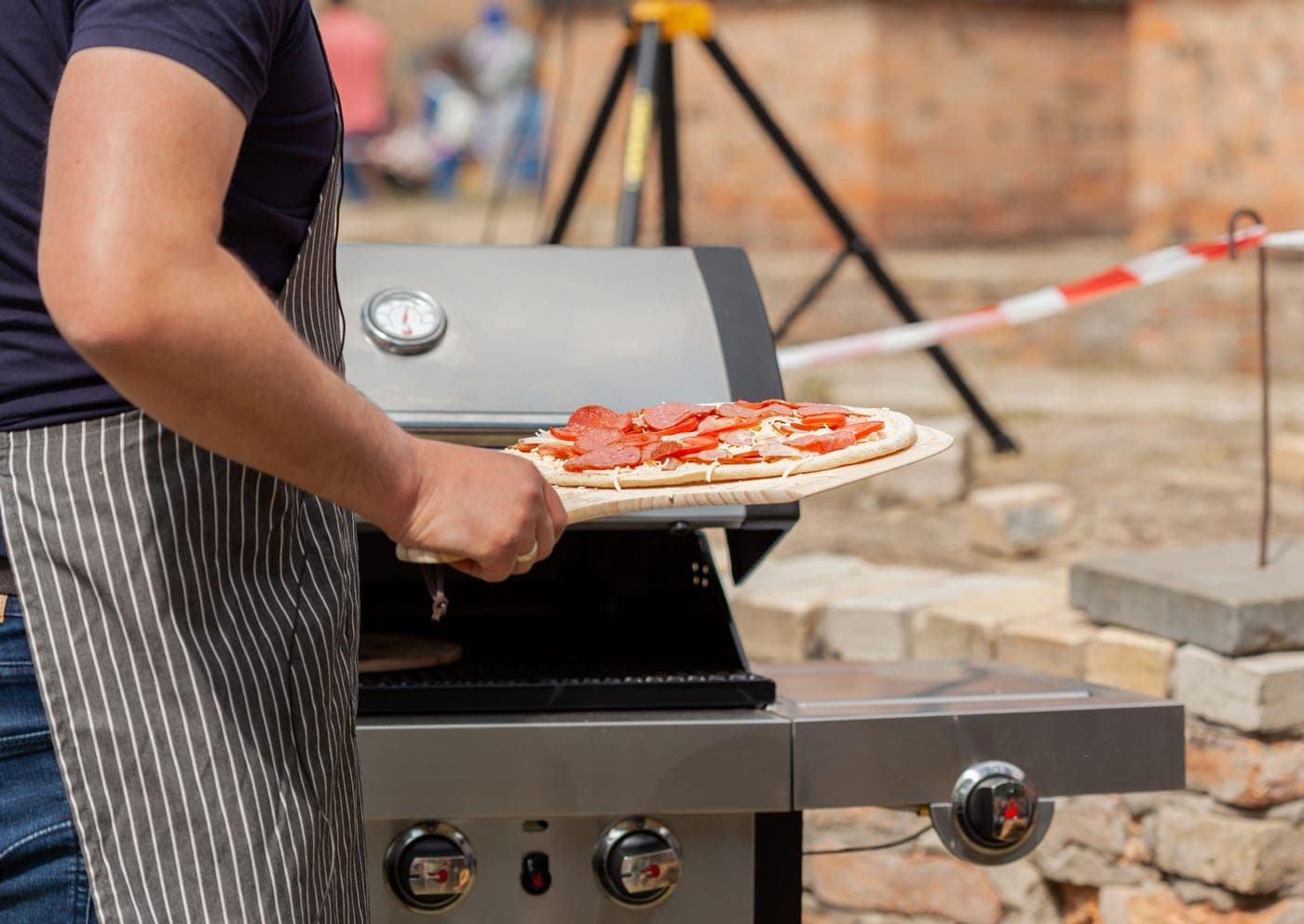
Indirect heat. Coals banked to the sides of a kettle, or only the outer burners lit on a gas grill, with the stone over the unlit middle. The lid stays down, because you are trying to make an oven, not a griddle - a pizza cooked over direct flame with the lid up burns underneath and stays raw on top.
Give it 25 to 30 minutes from cold with the lid closed, and check the surface with an infrared thermometer rather than the lid gauge, which reads air at the top of the dome and runs well above the stone. Somewhere between 550 and 700 F on the stone is the band where a home-grill pizza bakes in five to seven minutes.
What we would skip
Anything sold as a "pizza grill stone" that does not say cordierite. Generic ceramic on a grill is a matter of when, not whether.
Stones with a built-in metal frame or feet. Metal and ceramic expand at very different rates. A rigid frame around a stone that is trying to grow is a stress concentrator.
Three-piece grill sets. Same objection as the oven roundup: the stone is the part that has to be right and it is the part they saved money on.
If you crack one anyway, the reasons and how to avoid the next one are in why pizza stones crack.
In full
Every pick, with the specs and the sources
01 / Best all-round grill stone
Unicook
8.1/10
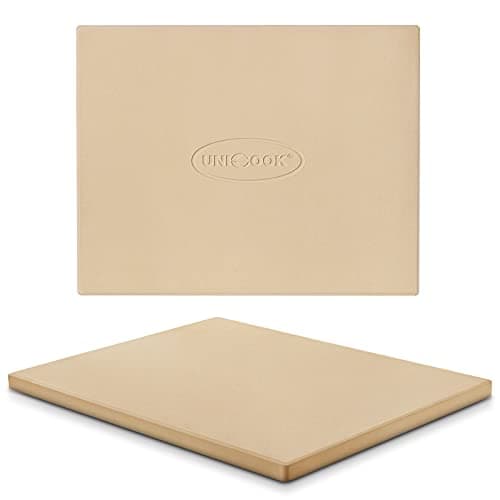
Unicook Heavy Duty Cordierite Pizza Stone, 15 x 12
A rectangle uses an oven rack better than a circle does, and at 6.6 published pounds this is the lightest surface here that still holds a useful amount of heat.
What it does well
Rectangular, so it uses the whole rack
6.6 lb is genuinely easy to handle
Published thickness and weight
Rated for a grill as well as an oven
What it does not
Twelve inches of width is the real ceiling on pizza size, not fifteen
The same 6.6 lb figure appears against more than one size in the maker's own listings, so check the box you receive
Thin enough that a heavy bake pulls the surface temperature down noticeably
Skip it if
You want a 14-inch pizza. Twelve inches of usable width means a 12-inch pie with nothing to spare, and a base overhanging the stone bakes pale at the edge.
The most useful stone shape for a home oven, at a weight one hand can manage, and one of the very few whose retailer publishes both a thickness and a weight.
What it does well
Published weight and thickness, which almost no stone maker bothers with
Light enough to lift one-handed once cool
Sixteen inches of round surface covers any pizza a home oven will take
The published 1450 F limit is roughly triple anything a domestic oven can reach
What it does not
0.59 inches is on the thin side for a stone you intend to leave in permanently
Round wastes the corners of a rectangular rack
Unglazed cordierite stains permanently on first use and there is no fixing that
Skip it if
Your oven is under 24 inches wide. A 16-inch round needs clearance on every side for air to move, and a stone wedged against the walls bakes unevenly.
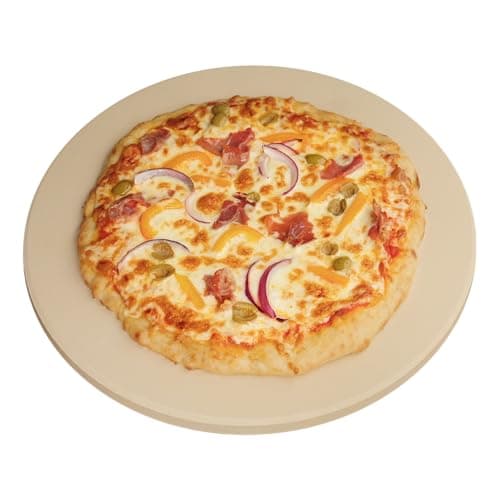
Stock photo of the product type, not this model. We publish no product photography we cannot source.
Lodge
8.3/10
Lodge 15-Inch Cast Iron Pizza Pan
Cast iron sits within about 5 percent of carbon steel on every thermal number that matters, costs a fraction of a steel, and has handles. The catch is that this is a pan with a rim, not a flat plate you can slide a pizza onto.
What it does well
Effusivity within about 5 percent of carbon steel, so the crust barely knows the difference
Handles, which no steel or stone has
Under 10 pounds
Published weight and dimensions from the maker
What it does not
A rim, so peel launching is awkward at best
Seasoning to maintain
Cast iron is brittle - drop it on a tile floor and it is done
Skip it if
You want to launch off a peel. The raised rim means you build the pizza on the pan or transfer it awkwardly - which changes how you make pizza, not just what you make it on.
#ad We hold no verified live price for this product, so we show none. How this site is funded.
04 / Best for a small gas grill
Stock photo of the product type, not this model. We publish no product photography we cannot source.
Ooni
7.2/10
Ooni Pizza Stone, 10 mm
Designed as a replacement floor for a 12-inch portable oven, not as a home-oven stone, and at 10 mm it behaves like one. Buy it for the oven it belongs to.
What it does well
Correct size and thickness for the oven family it is made for
Cordierite, so it tolerates the thermal shock of a gas-fired portable oven
Square, which suits a 12-inch pizza better than a 13-inch round
What it does not
Ten millimeters is thin for a domestic oven
No published weight, so its heat capacity can only be estimated from geometry
Sized around one oven family, which is both the point and the limitation
Skip it if
You are shopping for a domestic oven. Ten millimeters holds about a third less heat than a 15 mm stone of the same footprint, and an oven that cannot reach 900 F needs the mass.
No published weight for this one, so the mass is derived from the published dimensions and the dense-body density for cordierite. Treat it as an upper bound - across the stones here whose weight IS published, the real bodies come in around 20 percent lighter than the textbook figure, because bakeware cordierite is porous.
#ad We hold no verified live price for this product, so we show none. How this site is funded.
Questions
Frequently asked
Can you use a pizza stone on a gas grill?+
Yes, on indirect heat. Light the outer burners, leave the middle off, put the stone over the unlit section and bring it up from cold with the lid down. A stone placed directly over a lit burner takes intense heat on one small area and that is how they break.
How long should I preheat a stone on a grill?+
About 25 to 30 minutes from cold with the lid closed, which is broadly in line with the 25-minute figure our model gives for a 7-pound stone in an oven. A grill delivers more radiant heat than a domestic oven, so if anything it is quicker - but the only way to know is to point an infrared thermometer at it.
Can I put a hot stone straight onto the counter?+
No, and this is a more common way to break a stone than the grill is. A hot stone set on a cold stone or tile counter loses heat from one face fast, and that gradient is exactly the stress that cracks it. Leave it on the grate until it is cool, or move it to a wire rack.
Why is this list only four products?+
Because we only rank things we can source published specifications for, and grill stones are a category where most listings publish a size and nothing else. A shorter list of things we can stand behind beats a longer one padded with products we know nothing about.
Sources
Every number on this page came from one of these, or from arithmetic on one of these that we showed in full.