Heads up: some links on this page are affiliate links. If you buy through one we may earn a commission at no extra cost to you. It never changes a ranking, and we accept no payment for placement. The full version.
Cordierite is a ceramic, which is why the question is confusing
Every cordierite pizza stone is a ceramic pizza stone. The comparison people are actually making when they type this into a search box is between a body that has been named and a body that has not, and once you put it that way the market splits cleanly into three.
Named cordierite. The listing says cordierite, usually alongside a thickness and sometimes a weight. The Old Stone 16-inch round and the Unicook 15 by 12 both do this, and both carry a published temperature rating of 1450 F to go with it.
Unnamed clay. The listing says "ceramic", "natural clay", "all natural stone" or nothing at all about the body. There is no composition, no expansion figure, frequently no thickness, and the temperature rating, where one exists, is a number with no test method attached. This is most of what is on sale at the cheap end of the category.
A named proprietary body. A maker that will not tell you the composition but does publish a service temperature, a weight and a guarantee. FibraMent's board and Emile Henry's glazed Flame Ceramic are the two that matter in a home kitchen. They are not cordierite, and they are not the anonymous stone either - we took both apart on the spec sheet in the FibraMent review and the Emile Henry review.
The useful version of the question is therefore: does the body you are buying have published numbers behind it? Everything below is an attempt to show why that is the part of the decision worth thinking about, and why the part everyone argues over is not.
What we did not do
We have not baked on any of these. Every guide in this category says it tested a dozen stones; we would rather say plainly that we did not. What we did instead is on this page in full: published specs with their sources, thermal arithmetic from material constants with the working shown, and the makers' own manuals read rather than paraphrased.
Start here: neither one is going to change your crust
The property that decides what a raw base feels when it lands is thermal effusivity - the square root of conductivity times volumetric heat capacity - and it is the number nobody quotes because it is the number that ends the argument. Cordierite computes to 1,612 against carbon steel's 13,625. Any other clay-based ceramic body sits in the same low band, because they are all made of roughly the same light oxides at roughly the same density.
Cordierite
Carbon steel
Conductivity, W/m.K
1.3-1.7
50
Volumetric heat capacity, MJ/m3.K
1.73
3.71
Effusivity, W.s^0.5/m2.K
1,612
13,625
We cannot put a third column on that table for a glazed body such as Emile Henry's, because no conductivity, specific heat capacity or density is published for it, and we are not going to borrow cordierite's constants and present the result as a measurement. What can be said is directional and still useful: a fired clay body and a fired cordierite body are far closer to each other than either is to metal.
So if the complaint that brought you here is a pale, floppy base, changing which ceramic you own is not the fix. The fix is a different class of material entirely, which is the argument laid out in stone versus steel. Cordierite against ceramic is a durability question wearing a performance question's clothes.
What actually separates them: how much the body moves when it heats
A stone cracks because its hot face expands while its cooler core does not, and the resulting tension exceeds what a brittle material can take. How far the hot face wants to expand is set by the coefficient of thermal expansion, and this is the one property where cordierite is genuinely, publishably different from the ceramics it competes with.
Body
Expansion, micrometers per meter per kelvin
Fused silica
0.5
Silicon nitride
3.0
Cordierite
2.9-4.8
Silicon carbide
4.1-5.2
Aluminum silicate
5.7-6.3
Alumina
6.3-9.4
Magnesia
13.0
Cordierite's figure comes from the published material data we use everywhere on this site; the rest are a technical ceramics maker's own published values, measured from 20 to 1000 C. Take the midpoint of each published range and an alumina body moves about twice as far as cordierite does for the same temperature rise.
2.0x
How much more a common alumina ceramic body expands than cordierite, for the same temperature change
Midpoint of the published ranges: 7.85 against 3.85 micrometers per meter per kelvin. Twice the strain in a material that fails in tension is the whole reason cordierite is the default body for kiln shelves and pizza stones alike.
None of that is a claim that a non-cordierite stone will crack and a cordierite one will not. Thickness, how evenly the oven heats, whether the stone went in cold or hot and whether it was bone dry all matter as much - they are the subject of why pizza stones crack. What the expansion figure buys you is margin. Two stones treated identically badly, and the low-expansion one is the one more likely to still be flat next winter.
There is an independent demonstration of the same effect worth knowing about. A ceramics reference publishes a torch test on fired test bars, and the ranking is instructive: pure 200-mesh kaolin failed in about 2 seconds, vitreous porcelain in about 5, a halloysite-kaolin body at about 8, white stoneware at about 14, and a low-fired terra cotta survived 25 to 30 seconds - beating the far more vitrified porcelain, because its porosity gives the stress somewhere to go. That is test bars under a flame rather than a stone in a domestic oven, so treat it as a demonstration of the mechanism and not as a product test. The mechanism is the point: expansion and porosity decide survival, and neither one is printed on the box.
Whatever the body is made of, the failure mode is the same: a hot face expanding against a cooler core. Low expansion buys margin, it does not buy immunity.
Why any of this matters: ceramics are weak in exactly one direction
Published strength figures for cordierite make the whole argument in two numbers. Its compressive strength is 420 MPa. Its flexural strength - roughly, what it can take in bending and tension - is 17 to 32 MPa. The material is somewhere between 13 and 25 times stronger being squeezed than being pulled.
A thermal gradient does exactly the wrong thing to a body with that profile. The hot face expands and is held back by the cooler material behind it, which puts the cool side into tension - the one loading a ceramic has almost no capacity for. This is why a stone that happily supports 20 lb of dough and cast iron will split from a temperature difference that sounds trivial, and why the expansion coefficient is the property to shop on rather than the strength figure. Strength is not the variable you can change by buying a different stone. Expansion is.
It is also why thickness cuts both ways. In an oven, thicker is better, because more mass holds surface temperature under the pizza. On a grill, thicker is worse, because a thicker slab holds a bigger temperature difference between its two faces during the ramp. Same material, opposite advice, and the reason is this one property.
The porosity fork, and what each side costs you
The second real difference is one you can derive rather than take on trust. Published density for a dense cordierite body is 2.0 to 2.2 g/cm3, but run the published dimensions and published weights of actual bakeware and the arithmetic lands somewhere else entirely.
Stone
Published size and weight
Derived density
Mass per unit area
Old Stone 16" round, unglazed cordierite
16" x 0.59", 7.3 lb
1,703 kg/m3
25.5 kg/m2
Unicook 15 x 12, unglazed cordierite
15" x 12" x 0.6", 6.6 lb
1,692 kg/m3
25.8 kg/m2
Emile Henry square, glazed Flame Ceramic
14" x 14" x 3/8", 6.0 lb
2,260 kg/m3
21.5 kg/m2
Two unglazed cordierite stones from different makers agree with each other to within one percent at about 1,700 kg/m3, roughly a fifth below the textbook figure for the material. The glazed body computes a third denser than that, at 2,260. That is what vitrified means, and it is the fork in the road for everything you will actually notice day to day. The cheapest of those two unglazed stones gets the full treatment in our Unicook review.
Unglazed and porous stains permanently on the first bake and there is no reversing it, drinks any oil you put on it, must never meet soap, and has to be bone dry before it goes near heat because trapped water turns to steam inside the body. In exchange it wicks moisture out of the base while the pizza bakes, which is one of the two things a stone does for you.
The far end of that fork is Neapolitan biscotto clay, chosen precisely because it drinks dough moisture faster than cordierite does - which is useful at 850 F and pointless at 500. Our biscotto review covers what its sellers publish and, more tellingly, what they do not.
Glazed and vitrified does not stain, does not absorb anything, and in Emile Henry's case goes in the dishwasher - a genuine convenience nobody selling cordierite can offer. The cost is that a sealed face cannot pull water out of the dough, because that is what sealing a surface means, and a glaze is a coating that can chip where a homogeneous body cannot. What the glazed option is actually like to own is in our Emile Henry pizza stone review.
Note the last column too. The glazed stone carries about 84 percent of the mass per square inch that the cordierite stones do, because it is thinner. Whether that translates into less stored heat depends on a specific heat capacity nobody publishes for that body, so we are leaving the sentence unfinished rather than completing it with a number we invented. The day-to-day cleaning consequences of each are in how to clean a pizza stone.
Why the temperature rating on the box decides nothing
It is the most prominent number in most listings and it is very close to useless. A domestic oven runs to roughly 500 to 550 F. Here is what the various bodies claim against that:
Body
Published rating
Cordierite, material data
1150 C, which is 2102 F
Old Stone and Unicook cordierite stones
1450 F
Emile Henry Flame Ceramic
500 C / 930 F
Unnamed ceramic stone
Usually a number with no test method, sometimes nothing
Every one of those clears a home oven with enormous room to spare, including the lowest. Absolute temperature is not what breaks stones - the rate of change across the body is, and that is governed by expansion, thickness and how fast you heated it. A listing that leads with "heat resistant to 1450 F" is answering a question nobody needed answered, and a listing that publishes that number while refusing to name the body is doing it deliberately.
How to read a listing in ten seconds
Does it name the body? Cordierite, mullite or a maker's named proprietary blend are all fine answers. "Ceramic", "natural clay" and "stone" are not answers, and at the cheap end silence usually means the cheapest body that survives the product photograph.
Does it publish a thickness? Thickness is the single most useful number in a stone listing and the one most often missing. Under about half an inch you are buying a stone that will drop a lot of surface temperature under the first pizza.
Does it publish a weight? A weight plus a thickness lets you derive the density yourself, exactly as we did above, and catch a listing whose own numbers do not multiply out.
Is there a guarantee? Emile Henry's ten years is not a physical property, but it is a maker putting money behind a claim about thermal shock, which is more than an anonymous listing ever does.
If you already own an unnamed ceramic stone
Nothing above is an argument for replacing a stone that works. An unnamed clay body is not doomed; it has less margin, which means the handling rules that are merely sensible for cordierite are worth actually following for it.
Start it in a cold oven, every time. Stone in, oven on, both come up together. Sliding a room-temperature slab onto a 500 F rack is the single most common way these die.
Never take it from cold storage to heat. No fridge-to-oven, and give a frozen pizza ten minutes on the counter before it meets a hot surface.
Keep it dry. No soaking, no soap, no running it under a tap. Water inside a porous body becomes steam on the next heat, and that is an internal pressure the body never signed up for. The full routine is in how to use a pizza stone for the first time.
Leave it in the oven. A stone that lives on the middle rack sees fewer and gentler thermal cycles than one that comes out after every bake, which is the opposite of most people's instinct.
So what should you actually buy
Default: named cordierite, as thick and as wide as your oven takes. It is the low-expansion body, it is the cheap one, and it wicks moisture. The ranked options are in the pizza stone roundup.
Buy the glazed ceramic if cleaning is the thing you care about. If a permanently stained slab living in your oven bothers you, or you want to put the thing in the dishwasher, Emile Henry is the one we would pick - accepting that you are paying several times cordierite money for convenience rather than for crust.
Buy neither if your complaint is a pale base. Both ceramics sit around an eighth of steel's effusivity. No ceramic will fix that, and swapping one ceramic for another is the most common wasted purchase in this category.
On a grill, cordierite or nothing. A grill applies fierce heat to one face while the other stays comparatively cool, which is the exact loading the expansion figure governs. That is covered in the grill stone roundup.
The picks
What we would buy
Old Stone
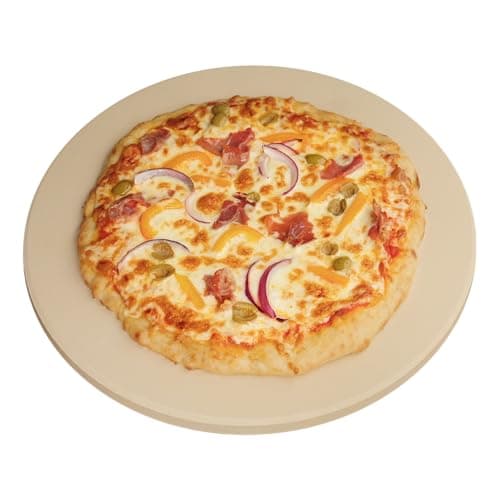
Old Stone 16-Inch Round Cordierite Pizza Stone
The most useful stone shape for a home oven, at a weight one hand can manage, and one of the very few whose retailer publishes both a thickness and a weight.
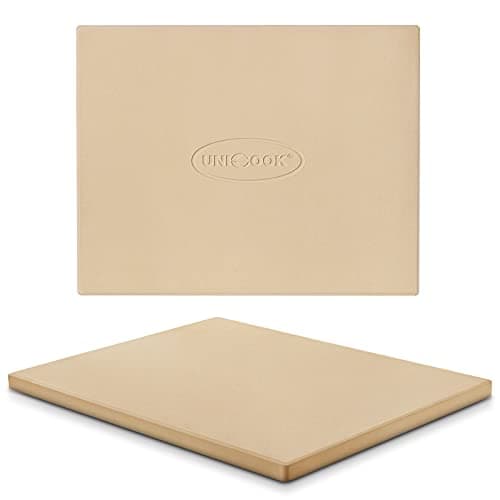
Unicook Heavy Duty Cordierite Pizza Stone, 15 x 12
A rectangle uses an oven rack better than a circle does, and at 6.6 published pounds this is the lightest surface here that still holds a useful amount of heat.
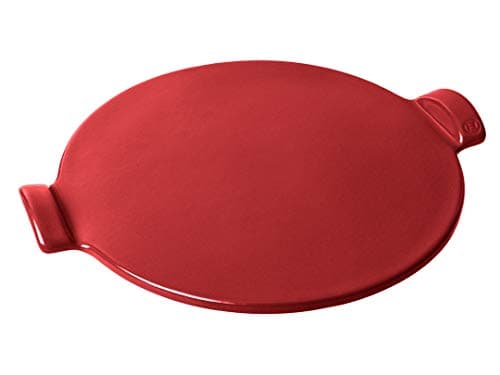
The one non-cordierite ceramic stone we would put beside a cordierite one, because its maker publishes a temperature rating, a weight and a ten-year guarantee instead of the word ceramic and nothing else.
Is cordierite better than ceramic for a pizza stone?+
Cordierite is a ceramic, so the honest comparison is against other ceramic bodies. Against those it has a published coefficient of thermal expansion of 2.9 to 4.8 micrometers per meter per kelvin, roughly half a common alumina body's 6.3 to 9.4. Less expansion means less internal tension for the same temperature swing, which is why it is the default body for anything heated and cooled repeatedly.
Will a cordierite stone give me a crispier crust than a plain ceramic one?+
No, or at least not for any reason anyone publishes. Both are fired ceramic bodies of similar density, so both sit near cordierite's effusivity of 1,612 against carbon steel's 13,625. If the base is your complaint, the answer is a different material class, not a different ceramic.
How do I find out what my existing stone is made of?+
If the box or the listing does not say, you cannot, and you should treat it as an unnamed clay body: preheat it in the oven from cold rather than sliding it into a hot one, keep it dry, and never take it from the fridge to the oven. That costs you nothing if it turns out to have been cordierite all along.
Is a glazed stone better than an unglazed one?+
It is a trade, not an upgrade. Glazed means no staining, no absorbed oil and sometimes dishwasher safe. Unglazed means the surface can wick moisture out of the base while it bakes, and it costs a fraction as much. Neither changes heat transfer enough to notice.
Do I need to worry about a stone rated to only 930 F?+
Not in a domestic oven, which runs to roughly 500 to 550 F. Every body discussed here clears that with a wide margin. Ratings become interesting only if you intend to use the stone in a portable pizza oven or over live fire, where floor temperatures run far above anything a kitchen range produces.
Sources
Every number on this page came from one of these, or from arithmetic on one of these that we showed in full.