Ranked on what the makers actually publish, plus preheat arithmetic we worked out from material constants. Two of these have no published weight, and we say which.
Heads up: some links on this page are affiliate links. If you buy through one we may earn a commission at no extra cost to you. It never changes a ranking, and we accept no payment for placement. The full version.
The shortlist
Ranked, with the working
Ranked on published manufacturer specifications and, where the numbers exist, our own arithmetic on what each option does thermally. Tap any row for the full write-up, including who should skip it.
#
Product
Best for
Score
Price
01
FibraMent Home Oven Baking Stone, 20 x 15 x 3/4The largest surface a standard 30-inch oven will take
Scores are ours and editorial. They are never published as review or rating markup, because we have not baked on these products - here is how we pick.
What actually separates one stone from another
Almost nothing about the marketing. Every cordierite stone on the market is the same material, fired the same way, with the same 1450 F headroom that no domestic oven will ever approach. What genuinely differs, in the order it will affect your pizza:
Usable area. The single biggest upgrade almost nobody makes. A base that overhangs the stone bakes pale at the edge, and a stone wedged tight against the oven walls bakes unevenly because air cannot move around it. Measure your rack, subtract an inch on each side, and buy the biggest thing that fits.
Thickness. More thickness means more mass, which means more stored heat and a longer preheat. Three quarters of an inch is the point at which a stone stops caring that a cold base landed on it. Ten millimeters, which is what portable-oven floor stones are, is genuinely thin for a domestic oven.
Whether the maker publishes anything at all. This is our tiebreaker and it is not arbitrary. A maker who publishes a thickness, a weight, a temperature limit and a preheat procedure is a maker who has measured their own product. Two of the five stones below publish no weight, which means we cannot compute their preheat behavior, and we say so on their cards rather than filling the gap in.
What we did not do
We have not baked on any of these. Every guide in this category says it tested a dozen stones; we would rather say plainly that we did not. What we did instead is on this page in full: published specs with their sources, thermal arithmetic from material constants with the working shown, and the makers' own manuals read rather than paraphrased.
The finding that changed our ranking: bakeware cordierite is porous
Published density for a dense cordierite body is 2.0 to 2.2 g/cm3. Run that against the published dimensions of the two stones here that also publish a weight, and the arithmetic does not close.
The Old Stone 16-inch round is 0.59 inches thick, giving a volume of 1.94 liters. At a dense-body 2100 kg/m3 that would be 9.0 lb. The retailer publishes 7.3 lb. The Unicook 15 by 12 at 0.6 inches works out to 8.2 lb derived against 6.6 lb published. Solve backwards and both land on an effective density near 1700 kg/m3 - about 20 percent below the textbook figure, and the two agree with each other to within one percent.
~1,700 kg/m3
Effective density of bakeware cordierite, derived from two independently published stone weights
Against a published dense-body figure of 2,000 to 2,200. The gap is porosity, and porosity also drags thermal conductivity toward the bottom of the published 1.3 to 1.7 W/m.K band.
Which matters practically in two ways. A real stone stores about a fifth less heat than its dimensions suggest, so it recovers between pizzas slightly worse than the textbook would say. And it is lighter than you expect, which is genuinely good news if you were worried about lifting it.
How we computed the preheat figures on each card
Every card below carries a preheat time, and it is ours. The method, in short: check the Biot number to confirm the whole slab can be treated as one temperature (every stone here comes in at or under 0.1, so it can); compute the time constant as mass times specific heat capacity divided by the effective surface heat transfer coefficient times the exposed area; then read off 3 time constants for 95 percent of the way to oven temperature and 4.6 for 99 percent.
The one input that is an assumption rather than a published constant is the surface heat transfer coefficient, which we take as 20 W/m2.K - the sum of a linearized radiative component near 21 for a 0.9-emissivity surface warming toward a 500 F cabinet and a few W/m2.K of still-air convection. Take it as 30 instead and every time below shortens by about a third. The full derivation is on the methodology page.
Every unglazed stone stains permanently on its first bake. That is not damage, and there is no cleaning method that reverses it.
What we would skip
Any stone under about 0.4 inches thick sold for a domestic oven. Thin stones exist because they are cheap to ship, not because thin is good. There is a real use for a 10 mm stone - it is the floor of a portable gas oven that reaches 900 F, where you do not need the mass - and there is almost none in a 500 F domestic oven. The one other exception is an oven too small to take anything thicker, which is its own problem: stones for toaster and countertop ovens has the three that fit and the arithmetic on what the thin body costs.
Three-piece gift sets built around a stone. The stone is the part that needs to be good and it is the part they economize on, because the cutter and the peel make the box look fuller.
Glazed stones. A glaze stops the stone absorbing moisture from the base, which is one of the two things a stone does. If it looks like a ceramic dish, it will bake like one.
Neapolitan biscotto clay, if this is for a kitchen oven. It is the real thing and Naples bakes on it, but its whole advantage is not burning bases above 800 F, and a domestic oven cannot get there. The published case for and against is in our biscotto stone review.
Who should not buy a stone at all
If your bottom crust is your only complaint, and you can lift 15 pounds, a steel does the same job with 8.5 times the thermal effusivity - see stone versus steel. If you already own a large cast iron pan, you already own something within 5 percent of a steel on every thermal number that matters, and the only thing you are missing is a flat surface to launch onto.
In full
Every pick, with the specs and the sources
01 / Best overall
FibraMent
8.9/10
FibraMent Home Oven Baking Stone, 20 x 15 x 3/4
The only stone here whose maker publishes a service temperature, a thickness and its own preheat procedure, and the published limits are far beyond anything a domestic oven can do to it.
What it does well
Published continuous service temperature of 1000 F, roughly double what an oven's clean cycle reaches
Three quarters of an inch thick, which is the thickness that survives living in the oven permanently
The maker publishes an actual preheat procedure rather than a slogan
Rectangular, so the usable area matches an oven rack instead of wasting the corners
What it does not
No published weight or composition, so its preheat curve cannot be computed the way cordierite and steel can
Big and heavy enough that it becomes permanent furniture
Nothing about it is cheap
A flame diverter is required for grill use, so it is not a drop-on-the-grate stone
Skip it if
Your rack is narrow or bowed, or you need to lift the stone in and out. Three quarters of an inch of dense board across 20 by 15 inches is a fixture, not a tool.
We cannot compute this one, and we would rather say so.
Every preheat and stored-energy figure on this site comes from mass times specific heat capacity. FibraMent publishes neither a weight nor a composition, so there is no honest way to run the arithmetic. Assuming a cordierite density we have no reason to believe would produce a number that looked precise and was not. The published 1000 F continuous limit and the maker's own 30-45 minute preheat guidance are what we rank it on instead.
The most useful stone shape for a home oven, at a weight one hand can manage, and one of the very few whose retailer publishes both a thickness and a weight.
What it does well
Published weight and thickness, which almost no stone maker bothers with
Light enough to lift one-handed once cool
Sixteen inches of round surface covers any pizza a home oven will take
The published 1450 F limit is roughly triple anything a domestic oven can reach
What it does not
0.59 inches is on the thin side for a stone you intend to leave in permanently
Round wastes the corners of a rectangular rack
Unglazed cordierite stains permanently on first use and there is no fixing that
Skip it if
Your oven is under 24 inches wide. A 16-inch round needs clearance on every side for air to move, and a stone wedged against the walls bakes unevenly.
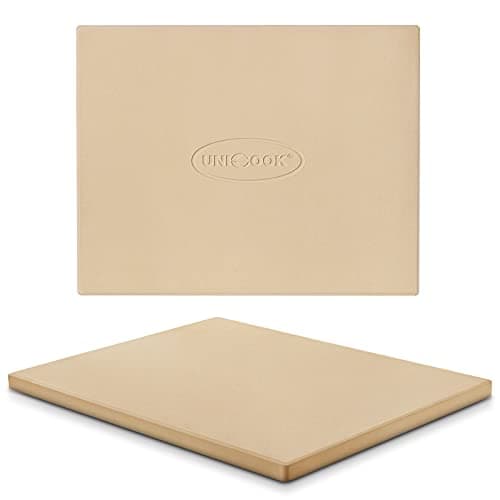
Unicook Heavy Duty Cordierite Pizza Stone, 15 x 12
A rectangle uses an oven rack better than a circle does, and at 6.6 published pounds this is the lightest surface here that still holds a useful amount of heat.
What it does well
Rectangular, so it uses the whole rack
6.6 lb is genuinely easy to handle
Published thickness and weight
Rated for a grill as well as an oven
What it does not
Twelve inches of width is the real ceiling on pizza size, not fifteen
The same 6.6 lb figure appears against more than one size in the maker's own listings, so check the box you receive
Thin enough that a heavy bake pulls the surface temperature down noticeably
Skip it if
You want a 14-inch pizza. Twelve inches of usable width means a 12-inch pie with nothing to spare, and a base overhanging the stone bakes pale at the edge.
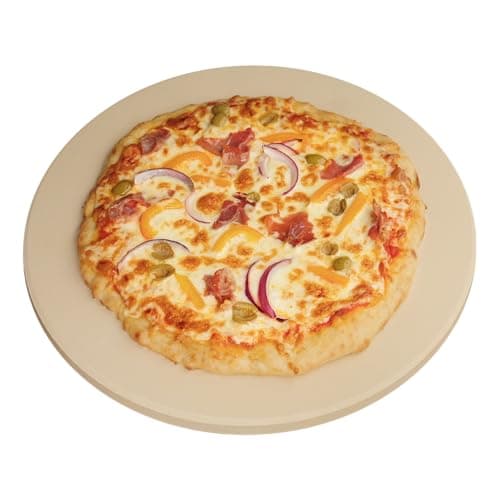
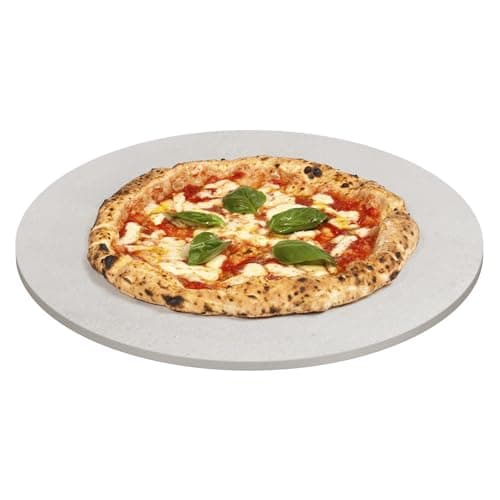
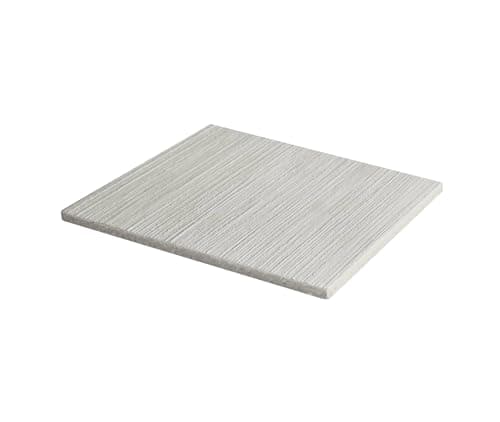
Stock photo of the product type, not this model. We publish no product photography we cannot source.
Ooni
7.2/10
Ooni Pizza Stone, 10 mm
Designed as a replacement floor for a 12-inch portable oven, not as a home-oven stone, and at 10 mm it behaves like one. Buy it for the oven it belongs to.
What it does well
Correct size and thickness for the oven family it is made for
Cordierite, so it tolerates the thermal shock of a gas-fired portable oven
Square, which suits a 12-inch pizza better than a 13-inch round
What it does not
Ten millimeters is thin for a domestic oven
No published weight, so its heat capacity can only be estimated from geometry
Sized around one oven family, which is both the point and the limitation
Skip it if
You are shopping for a domestic oven. Ten millimeters holds about a third less heat than a 15 mm stone of the same footprint, and an oven that cannot reach 900 F needs the mass.
No published weight for this one, so the mass is derived from the published dimensions and the dense-body density for cordierite. Treat it as an upper bound - across the stones here whose weight IS published, the real bodies come in around 20 percent lighter than the textbook figure, because bakeware cordierite is porous.
#ad We hold no verified live price for this product, so we show none. How this site is funded.
Questions
Frequently asked
Are pizza stones any good?+
Yes, with a caveat. A stone raises bottom-crust heat far above what an oven rack or a sheet pan delivers, and it absorbs moisture from the base as it bakes. What it will not do is match a steel: cordierite's thermal effusivity is about an eighth of carbon steel's, so the contact patch cools further when the base lands. A stone is a large improvement over nothing and a modest step behind a steel. The measured case for and against, against the sheet pan it replaces, is in are pizza stones worth it.
How thick should a pizza stone be?+
Three quarters of an inch is the thickness at which a stone stops noticing the pizza. Around 15 mm - the most common size sold - is a reasonable compromise between mass and weight. Below about 10 mm you are into portable-oven floor stones, which are thin on purpose because those ovens run at 900 F.
Can you leave a pizza stone in the oven all the time?+
You can, and for a thick stone it is the sensible thing to do, because it is heavy and you do not want to handle it hot. Two consequences: everything else you bake will get more bottom heat, and your oven will take longer to reach temperature because it is now heating an extra 7 pounds of ceramic every time.
Does a pizza stone need to be seasoned?+
No. Seasoning is for iron and steel, where a polymerized oil layer prevents rust. Oil on an unglazed ceramic stone soaks in, does not polymerize usefully, and eventually goes rancid or smokes. Wash it with water, never soap, and let it stain.
Cordierite or ceramic - does it matter?+
Yes. Cordierite has a very low coefficient of thermal expansion, published at 2.9 to 4.8 micrometers per meter per kelvin, which is what lets it survive going from a cold kitchen into a hot oven. Generic ceramic or clay bodies expand more and crack. If a listing does not say cordierite, assume it is not. The published figures for both, and what a glazed ceramic body changes, are in cordierite versus ceramic.
Why is there no price on this page?+
Because a price typed into a page decays into a false statement the moment it changes, and we would rather show none than a stale one. Every buy button here goes straight to the current listing. Here is how prices work on this site.
Sources
Every number on this page came from one of these, or from arithmetic on one of these that we showed in full.