Skip to content
Peel & Flame
Head to head

Pizza Screen vs Stone vs Perforated Pan

Screens and perforated pans exist to solve a handling problem. Understanding that is the whole answer, because they are worse than a stone at everything else.

By Scooter M./Published September 1, 2026

A perforated metal baking surface photographed close up

Heads up: some links on this page are affiliate links. If you buy through one we may earn a commission at no extra cost to you. It never changes a ranking, and we accept no payment for placement. The full version.

These three things are not competitors

They are answers to different questions, and most of the confusion comes from comparing them as if they were interchangeable.

A stone or steel answers "how do I get more heat into the base". A screen answers "how do I get the pizza into the oven without a peel and without a disaster". A perforated pan answers the same question as a screen, slightly more rigidly and with slightly more contact.

What a screen costs you, physically

A screen is an open mesh, so the base touches metal only along the wires. Whatever fraction of the base is actually in contact is the fraction that gets conductive heat; the rest is heated by air and radiation from below, which is far slower.

Which is not to say it produces a bad pizza. It produces a different pizza: dry and evenly crisp rather than blistered and spotted, because the base dries in hot air rather than searing against a hot solid. That is exactly the texture a lot of American takeaway pizza has, and it is not an accident - screens are what most pizzerias use for exactly that style, at exactly that speed, in exactly that kind of deck oven.

Contact area

The single variable that separates a screen, a perforated pan and a solid surface

Not temperature, not material. A screen touches the base along wires, a perforated pan along everything except the holes, and a stone or steel along all of it.

The honest ranking, for a home oven

 Bottom crustEase of launchPreheat neededBest for
SteelBestNeeds a peel25-30 minThin, blistered, fast bakes
StoneVery goodNeeds a peel25 minPizza and bread both
Perforated panFairEasyNone requiredEven, dry crispness without a peel
ScreenFair, and evenly soEasiestNone requiredTakeaway-style bases, big pizzas, no peel

The combination that gets you both

Build and launch on a screen, onto a preheated stone or steel, and pull the screen out after two or three minutes once the base has set. You get the easy launch of a screen and most of the direct contact of a solid surface, at the cost of one extra oven-door opening.

This is the answer for anyone whose actual problem is launching rather than heat - which, honestly, is most people who come to this comparison. The other answer is to fix the launch properly, and that is what the launching guide is for.

Why we are not recommending a specific screen

Because we could not find one whose maker publishes anything beyond a diameter. No material specification, no wire gauge, no temperature limit. We are not going to rank products we know nothing about, so the picks below are the surfaces we can stand behind - and the honest recommendation on this page is that a screen is a launching aid, not a baking surface, and you should still own one of these underneath it.

The picks

What we would buy

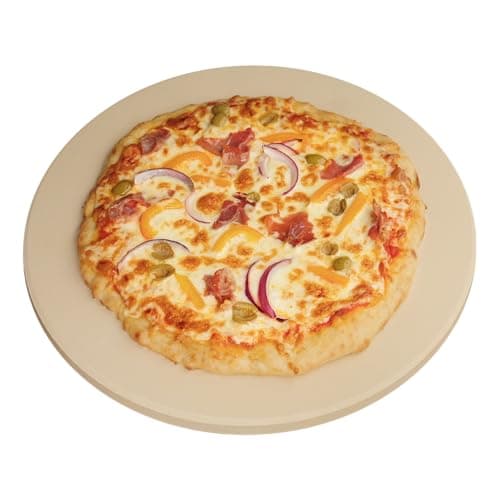
A ceramic baking stone - a stand-in for the Old Stone 16-Inch Round Cordierite Pizza Stone, not a photograph of this model

Old Stone

Old Stone 16-Inch Round Cordierite Pizza Stone

The most useful stone shape for a home oven, at a weight one hand can manage, and one of the very few whose retailer publishes both a thickness and a weight.

Check price on Amazon

#ad We hold no verified live price for this product, so we show none. How this site is funded.

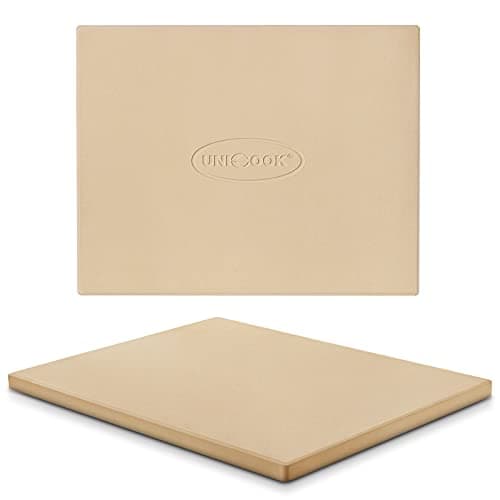
A ceramic baking stone - a stand-in for the Unicook Heavy Duty Cordierite Pizza Stone, 15 x 12, not a photograph of this model

Unicook

Unicook Heavy Duty Cordierite Pizza Stone, 15 x 12

A rectangle uses an oven rack better than a circle does, and at 6.6 published pounds this is the lightest surface here that still holds a useful amount of heat.

Check price on Amazon

#ad We hold no verified live price for this product, so we show none. How this site is funded.

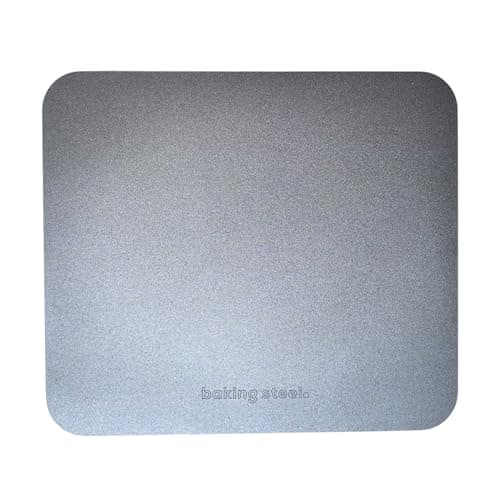
A flat steel baking plate - a stand-in for the Baking Steel Original, 16 x 14 x 1/4, not a photograph of this model

Baking Steel

Baking Steel Original, 16 x 14 x 1/4

A quarter inch is the thickness where a steel stops being a novelty and stays a thing you can still lift. Its advantage over a stone is not preheat speed - it is what happens one second after the base lands.

Check price on Amazon

#ad We hold no verified live price for this product, so we show none. How this site is funded.

Questions

Frequently asked

Is a pizza screen better than a stone?
Not for bottom crust - it has far less contact area, so far less conductive heat reaches the base. It is better at exactly one thing, which is getting a pizza into the oven without a peel, and that is a real problem worth solving.
Can you use a screen on top of a stone?
Yes, and it is the best of both. Launch on the screen onto the hot stone, then slide the screen out after two or three minutes when the base has set enough to hold itself.
Do perforated pans actually work?
They work at what they are for: an evenly dry, crisp base with no peel and no preheat. The holes let steam escape from under the base, which is the mechanism, and they give up some contact area to do it.
What do pizzerias actually use?
Both, for different products. Deck ovens bake directly on stone or refractory for Neapolitan and New York styles; conveyor ovens and high-volume takeaway operations use screens because they stack, launch instantly and produce a consistent, dry crust.

Sources

Every number on this page came from one of these, or from arithmetic on one of these that we showed in full.