Heads up: some links on this page are affiliate links. If you buy through one we may earn a commission at no extra cost to you. It never changes a ranking, and we accept no payment for placement. The full version.
Buy a pan if you want Detroit, Sicilian, deep dish or any style with a fried, cheese-crusted edge - a stone physically cannot make those, because they need sides that hold oil against the dough. Buy a stone if you want thin, round, peel-launched pizza with a crisp base. Most kitchens that take pizza seriously end up owning one of each, and they cost less together than one baking steel.
The distinction that makes the rest obvious
A stone is a surface: a hot floor that a bare base sits on, in direct contact, with nothing between the dough and the heat. A pan is a vessel: it holds the dough, and usually oil, and it shapes the edge.
That means they are not competing on the same axis. You do not buy a pan because it bakes better than a stone; you buy it because the pizza you want has sides. And you do not buy a stone because it is a better pan; you buy it because the pizza you want has none.
Style
What it needs
Buy
Neapolitan, New York, thin and round
Direct contact with a hot floor, launched from a peel
Stone or steel
Detroit, Sicilian, grandma
Sides, oil held against the dough, a fried edge
Deep rectangular pan
Chicago deep dish
A deep round vessel and a long, gentler bake
Deep dish pan
Pan pizza, focaccia-style
Oil, sides, and a base that fries rather than bakes
Pan or cast iron
Frozen pizza
Anything preheated - the base is already formed
Whichever you own
What we did not do
We have not baked on any of these. Every guide in this category says it tested a dozen stones; we would rather say plainly that we did not. What we did instead is on this page in full: published specs with their sources, thermal arithmetic from material constants with the working shown, and the makers' own manuals read rather than paraphrased.
What a thin pan gives up, in one number
Where the two do overlap - a round pizza that could go on either - the stone wins clearly, and the reason is stored heat rather than conductivity. A 15 mm cordierite stone carries about 21,000 J/m2.K of heat capacity per unit of surface. A thin aluminum pizza pan carries roughly 2,600.
~8x
Heat held per unit of surface by a stone against a thin aluminum pan
Aluminum actually conducts better than steel, let alone stone. It just has almost nothing stored to conduct, so its surface collapses to dough temperature within seconds of the base landing. The full derivation is in are pizza stones worth it.
This is why a round pizza baked directly on a thin pan comes out pale underneath while the same dough on a stone sets and crisps. It is not that the pan is a poor conductor - it is that it is a small reservoir. The arithmetic, including where the numbers come from, is in are pizza stones worth it.
For pan styles that same low mass stops being a problem, because the pan is not trying to set a base by contact. It is holding oil, conducting the oven's heat into that oil, and frying the bottom. Different job, different requirement.
Usable area, which is closer than it looks
A 10 by 14 inch Detroit pan gives 140 square inches of pizza. A 14-inch round stone gives 154. The rectangle you thought was small is within 10 percent of the round you thought was big, and it uses an oven rack far better - which is the same argument that runs through the stone roundup.
The third option, and a good one: cast iron is a pan with a stone's thermal mass. It is the only vessel here that also stores serious heat.
Cast iron is the hybrid, and it is genuinely good
A cast iron pizza pan has the sides of a pan and roughly eight times the effusivity of a stone - it is the only option here that does both jobs. The Lodge 15-inch pan is 9.91 published pounds and reaches 95 percent of oven temperature in about 23 minutes.
What it gives up is the launch. A rimmed vessel cannot take a base slid off a peel without fuss, so you either build in the pan or lower a dressed base into a hot dish. For pan styles that is exactly right. For round peel-launched pizza it is the wrong shape - the full comparison is in stone versus cast iron.
What about perforated pans and screens?
Different question again, and a common source of confusion. A perforated pan or a screen exists to solve a launching problem: you build on it and put the whole thing in the oven, so there is no peel work at all. They cost you contact area, which costs you base crispness - the trade is set out in screen versus stone versus perforated pan.
A deep pan for Detroit or Chicago is not that. It is not a compromise on a stone; it is the only correct tool for its style.
The honest recommendation
If you are buying one thing and you make round pizza: the stone, every time. It is the larger upgrade over a sheet pan and it does bread as well.
If you are buying one thing and you love a thick, oily, cheese-edged square: the Detroit pan. A stone will never produce that pizza, no matter how hot you run it.
If you are buying two things: a stone and one pan. Between them they cover every style a home oven can produce, and the pan is the cheaper half.
If you already own a large cast iron skillet: you already own the pan half. Preheat it, bake a pan pizza in it, and spend your money on the surface for the round ones instead. The technique that makes either work is in how to get a crispy crust.
The picks
What we would buy
LloydPans
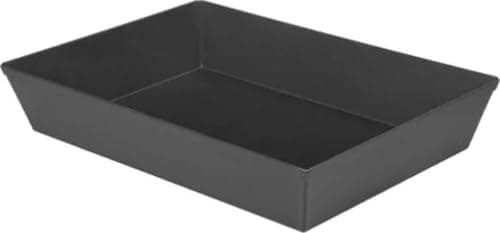
LloydPans Detroit Style Pizza Pan, 10 x 14 x 2.5
The pan that makes the case for pans. Detroit style needs a vessel with sides that holds oil against the dough, and no stone can do that at any price.
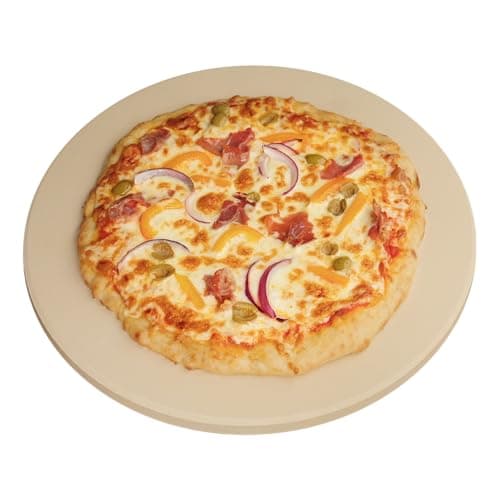
The most useful stone shape for a home oven, at a weight one hand can manage, and one of the very few whose retailer publishes both a thickness and a weight.
Cast iron sits within about 5 percent of carbon steel on every thermal number that matters, costs a fraction of a steel, and has handles. The catch is that this is a pan with a rim, not a flat plate you can slide a pizza onto.
#ad We hold no verified live price for this product, so we show none. How this site is funded.
Questions
Frequently asked
Is a pizza stone better than a pizza pan?+
For thin round pizza, yes - a stone holds roughly eight times the heat per unit of surface that a thin aluminum pan does, so the base sets instead of steaming. For Detroit, Sicilian or deep dish, a pan is not worse, it is the only tool that works.
Can you make Detroit-style pizza on a stone?+
No. The style is defined by an oiled pan with sides that fry the edge of the dough and let cheese caramelize against the wall. A flat surface has nowhere for that to happen.
Can you put a pizza pan on top of a pizza stone?+
Yes, and it is a genuinely good trick for pan styles: the stone acts as a heat reservoir under the pan and steadies the base. It will not turn a thin pan into a stone for round pizza, because the pan still sits between the dough and the heat.
Which is easier for a beginner?+
A pan, comfortably. You build in it, you put it in the oven, and there is no launch to go wrong. A stone is the better result and the harder skill.
Do I need both?+
Only if you want both kinds of pizza. They are different tools rather than competing versions of one tool, and together they cost less than a single baking steel.
Sources
Every number on this page came from one of these, or from arithmetic on one of these that we showed in full.