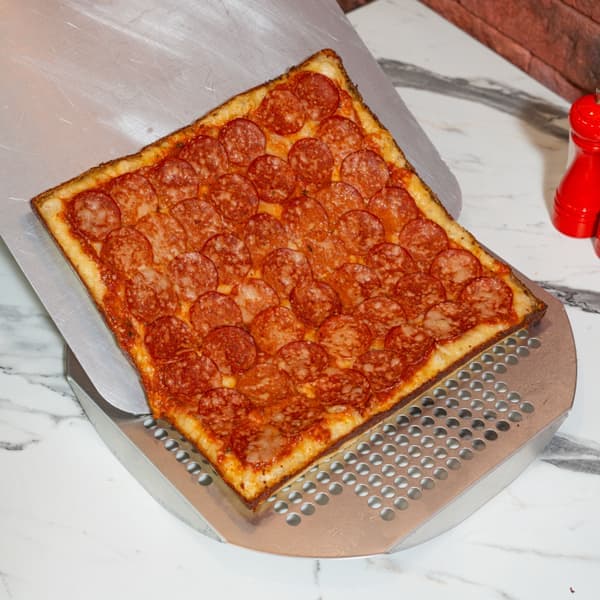
What the holes are actually for
The common assumption is that perforations reduce friction, or let the base breathe, or help it release. They do none of those to any useful degree - the base is resting on flour, not on the metal.
What they do is let the excess flour or semolina fall off before the pizza does. You launch on a dusting of something coarse; nearly all of it is surplus; and whatever rides in with the pizza sits on a 500 F surface for the length of the bake. Plain flour scorches in under a minute, smokes, and leaves the black burned-flour smell that people wrongly blame on the stone.
Flour, not friction
What perforations solve
Give a perforated peel a couple of shakes before launching and most of the loose flour drops through. That is the whole feature, and it is worth more than it sounds.
The trade-offs, honestly
Rigidity. A perforated blade has less material, so it flexes marginally more under a heavily loaded 14-inch pizza. In practice, at the thicknesses these are pressed at, it is barely detectable.
Cleaning. Holes catch dough scraps and baked-on cheese. A stiff brush under running water sorts it in a few seconds; a solid blade wipes clean.
Retrieving. This one is real. A solid blade supports the entire baked base, so a floppy center-heavy pizza is less likely to sag through as you carry it. If you are buying two peels, the retrieving one should be solid.
Serving. A solid blade can be set down with the pizza on it. A perforated one drips.
The comparison
| | Perforated | Solid |
|---|
| Sheds excess flour | Yes, most of it | No - it all goes on the stone |
| Launching | Better | Fine |
| Retrieving a baked pizza | Fine | Better |
| Weight, same size | Lighter | Heavier |
| Cleaning | Needs a brush | Wipes |
| Serving on it | No | Yes |
At 14 inches, the published weights make the point: 610 g perforated against 1.5 lb - about 680 g - solid. Same brand, same size, same materials, and the perforated one is lighter, which also helps you keep it level.
The recommendation
One peel: perforated. Shedding flour is worth more day to day than the marginal support advantage, and the weight saving helps the launch.
Two peels: a wooden or composite board to build on, and a perforated metal blade for everything else. That combination handles launch, turn and retrieval, and it is what we would buy.
Three peels: add a solid metal blade for retrieving and serving, if you make big pizzas that sag.
Note that this is a different question from screens
A perforated peel is a transfer tool with holes. A perforated pan or a screen is a baking surface with holes, and the holes cost you contact area with the base. Those are covered separately in screen versus stone versus perforated pan.
What we did not do
We have not baked on any of these. Every guide in this category says it tested a dozen stones; we would rather say plainly that we did not. What we did instead is on this page in full: published specs with their sources, thermal arithmetic from material constants with the working shown, and the makers' own manuals read rather than paraphrased.