Heads up: some links on this page are affiliate links. If you buy through one we may earn a commission at no extra cost to you. It never changes a ranking, and we accept no payment for placement. The full version.
What this review is
We have not cut a hundred pizzas with this. What follows is the published specification, what a 14-inch blade does that a wheel cannot, and the one habit that turns this tool into an expensive mistake. The method is on the methodology page.
What we did not do
We have not baked on any of these. Every guide in this category says it tested a dozen stones; we would rather say plainly that we did not. What we did instead is on this page in full: published specs with their sources, thermal arithmetic from material constants with the working shown, and the makers' own manuals read rather than paraphrased.
The published specification
Specification
Published figure
Dimensions
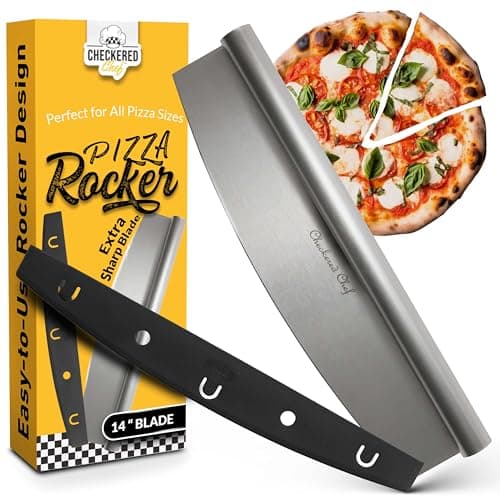
14.3" long x 3.5" wide
Material
Stainless steel blade and handle
Included
Plastic blade sheath
Care
Dishwasher safe
Four rows, and the first one is the entire argument for owning it.
Why 14.3 inches is the specification that matters
A wheel cuts by rolling: you push it across the pizza, it drags toppings ahead of itself, and on a soft base it can push the cheese into a ridge rather than cut through it. A rocker cuts by pressing: the blade spans the whole pizza, you push down once, and everything under the blade is severed where it lay.
That only works if the blade is longer than the pizza. At 14.3 inches this one spans a 14-inch pizza, which is the largest a domestic oven normally bakes. A 12-inch rocker on a 14-inch pizza is two presses and a misaligned cut, which is most of the way back to a wheel.
One press
What a full-span rocker buys, and the only thing it buys
Toppings stay where they were put, the cut is straight, and a whole pizza is quartered in four movements. Everything else about this tool is a compromise in service of that.
The habit that ruins things
A rocker presses its full 14 inches straight down into whatever is beneath the pizza. On a board that is fine. On the thing you baked on, it is not.
On an unglazed cordierite stone it scores the surface and grinds steel across a porous body that cannot be scrubbed clean - the reason soap and abrasives are banned is in how to clean a pizza stone.
On a seasoned steel or cast iron it cuts through the polymerized oil layer you have spent months building.
On a non-stick pan it does exactly what you would expect.
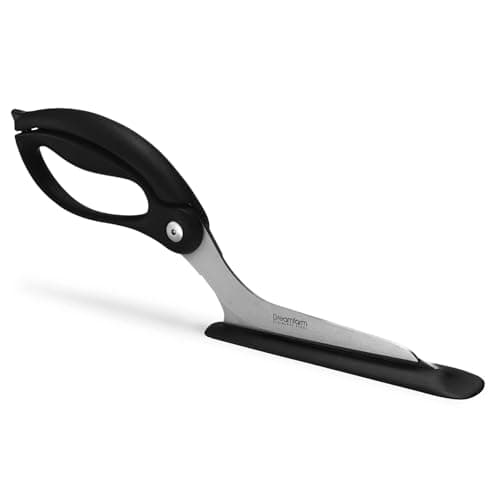
So this is a tool that requires a board, which means moving the pizza off the baking surface first. If your habit is to cut in the pan or on the stone, buy the Scizza instead - scissors with a spatula base that never touches the surface, reviewed in full here, with its own published limit of 401 F on the nylon base.
The all-steel handle, and the sheath
The handle is the same stainless as the blade. That makes it dishwasher-proof and indestructible, and it also makes it slippery once your hands have been near an oily pizza - which is precisely when you are applying downward force to a sharp 14-inch edge. Dry your hands first. It is not a design flaw so much as a consequence of one-piece stainless.
The included plastic sheath is not a nicety. Fourteen inches of exposed blade in a kitchen drawer is a genuine hazard, and the sheath is the only thing making drawer storage sane. Keep it.
The last tool in the chain, and the one most likely to damage the most expensive tool in it. Cut on a board.
Where a wheel still wins
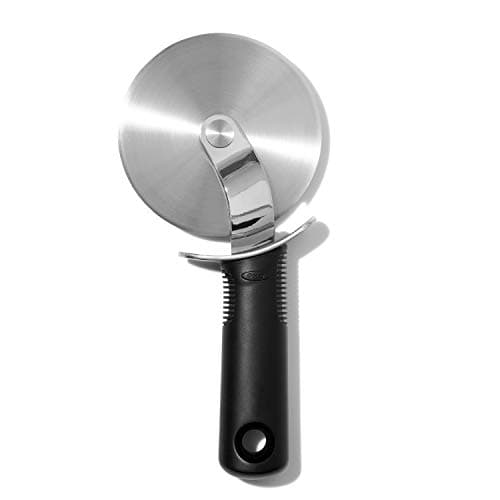
Storage. A 4-inch wheel lives in a drawer without ceremony. This does not.
Small and awkward shapes. Cutting a couple of slices off a half-eaten pizza, or trimming something in a pan, is wheel work.
Thick pan pizza. A rocker handles deep crust well, but so does a wheel, and the wheel does not need the full span of clear board that a rocker press requires.
The category-level comparison, including why topping displacement is the real difference between the two, is in rocker versus wheel.
Who should buy it
Buy it if you make 12 to 14 inch pizzas, you already move them to a board to cut, and you are tired of a wheel dragging your toppings into a heap.
Buy the wheel instead if drawer space matters, or if you cut irregular portions more often than whole pizzas.
Buy the Scizza instead if you cut on the pan or straight off the surface, because that is the only tool here that does not touch what is underneath.
Buy all three and you have still spent less than one baking steel, which is the honest scale of this whole category - the ranked set is in the cutter roundup.
The verdict
A blunt, cheap, effective tool that does one thing better than anything else: cutting a whole pizza without moving the toppings. It demands a cutting board, a dry hand and a place to store fourteen inches of steel. Accept those three things and it is the best value on this site.
The picks
What we would buy
Checkered Chef
Checkered Chef 14-Inch Rocker Pizza Cutter
Fourteen inches of blade cuts a 14-inch pizza in one press, which is the only real argument for a rocker. It also means 14 inches of blade pressing straight down onto whatever the pizza is sitting on.
A big wheel with a thumb guard. The cheapest competent cutter here, and the one most likely to drag a hardened edge across a surface you did not want marked.
Scissors with a spatula base, so the blade never touches the surface underneath. On a stone or a seasoned steel, that is the whole argument - a wheel drags across the surface, and this does not.
For a domestic oven, yes. At 14.3 inches the blade spans a 14-inch pizza, which is about the largest a home oven bakes. A shorter rocker on a larger pizza means two presses and a crooked cut.
Can you use a rocker on a pizza stone?+
You should not. It presses its full length into the surface, which scores unglazed cordierite and cuts through the seasoning on a steel or cast iron. Move the pizza to a board first.
Rocker or wheel?+
Rocker for whole pizzas cut on a board, because one press keeps toppings in place. Wheel for storage, for odd shapes and for cutting in a pan.
Is the Checkered Chef rocker dishwasher safe?+
Yes, per the listing - blade and handle are both stainless. Keep the plastic sheath for drawer storage, because fourteen inches of loose blade in a drawer is a real hazard.
Does the metal handle get slippery?+
One-piece stainless is easy to clean and offers no grip when your hands are oily, which is exactly when you are pressing down on a long blade. Dry your hands before you cut.
Sources
Every number on this page came from one of these, or from arithmetic on one of these that we showed in full.