A rocker blade, yes - it is a straight edge and it sharpens like a knife. A wheel, in practice no: the trade replaces the wheel rather than sharpening it, and no consumer wheel we rank sells a replacement.
Heads up: some links on this page are affiliate links. If you buy through one we may earn a commission at no extra cost to you. It never changes a ranking, and we accept no payment for placement. The full version.
The answer depends entirely on which shape you own
There are three cutting shapes in this category and the sharpening answer is different for each one, which is why a single yes or no has never been useful.
Shape
Can it be sharpened?
What we would actually do
Rocker blade (a long straight edge)
Yes - it is a knife
Hone it like any kitchen knife; a few passes restores it
Wheel (a rolling disc)
In theory, poorly in practice
Commercial kitchens swap the wheel. Consumer wheels have none to swap
Scissors (the Scizza type)
Like scissors - a specialist job
Nothing. The blades outlast the household's interest in them
If you are here because a wheel has gone dull and you are dragging it through the crust twice, the honest conclusion at the bottom of this page is that the fix is a different tool rather than a sharper version of the one you own. The shape comparison that sits behind that is in rocker vs wheel pizza cutter.
Why a rocker sharpens and a wheel fights you
Sharpening is the business of presenting a cutting edge to an abrasive at a consistent angle, repeatedly, along its whole length. A rocker blade gives you all three for free: a long straight edge, a fixed handle to hold the angle with, and nothing in the way. It is a chef's knife with handles at both ends, and every knife technique applies.
A wheel takes all three away. The edge is a circle, so holding one angle means rotating the disc under the stone rather than drawing it along. The axle and the thumb guard sit immediately behind the edge on both faces, so a flat stone cannot reach most of the bevel. And the wheel itself turns while you push, which is the opposite of what you want from the thing you are trying to hold still.
None of that makes it impossible. Pull-through sharpeners exist for exactly this - DMT sell one specifically described for pizza wheels, where the wheel is rolled forward against an abrasive wall and the motion repeated. It works. It also costs more than the cutter.
What we did not do
We have not baked on any of these. Every guide in this category says it tested a dozen stones; we would rather say plainly that we did not. What we did instead is on this page in full: published specs with their sources, thermal arithmetic from material constants with the working shown, and the makers' own manuals read rather than paraphrased.
What commercial kitchens do instead, which settles the question
The most useful evidence here is not an opinion about technique. It is what the professional supply chain sells. Both of the main commercial cutlery makers publish a replacement wheel as a stocked part:
Part
What it is
Fits
American Metalcraft PCW4
4" stainless steel pizza cutter replacement blade
Their PIZG3, PIZR2 and PPC4 cutters
Dexter-Russell 18010
4" pizza cutter replacement blade
Their 4" pizza cutters
A kitchen cutting several hundred pizzas a week does not sharpen the wheel. It unbolts it and fits a new one, for a few dollars, in a minute. That is the industry's answer to this exact question, and it is a stronger signal than any amount of advice about mugs and whetstones.
2
Commercial makers that stock a replacement pizza cutter wheel as a standard part
American Metalcraft PCW4 and Dexter-Russell 18010, both 4 inches, both stainless. Neither publishes sharpening instructions - because replacing is the procedure.
The part that applies to the cutter you probably own
Here is the gap. The commercial route works because those cutters are built around a bolted, serviceable wheel. The consumer cutters are not, and we checked: of the three cutters we rank, none publishes a replacement blade, a sharpening instruction or a serviceable wheel. What they publish instead is a lifetime guarantee on the OXO and the Checkered Chef, and dishwasher safety on all three.
That turns the question into arithmetic rather than technique. A pull-through sharpener is a real purchase. A new 4-inch wheel cutter is around the same money or less, arrives sharp, and carries a lifetime guarantee - which, on a tool whose maker says it is guaranteed for life, is the first thing to try before buying anything. Contact the maker before you buy an abrasive.
The axle and thumb guard sit directly behind the edge on both faces. That is good for your fingers and the reason a flat stone cannot reach the bevel.
Three things that look like a dull blade and are not
Before you sharpen anything, rule these out, because all three are more common than a genuinely worn edge.
Baked-on cheese in the axle. A wheel that will not spin freely tears rather than cuts, and it feels exactly like bluntness. The rolling axle traps cheese and needs a proper clean, not a rinse.
You are cutting on the wrong surface. Cutting on a stone or a seasoned steel wrecks the edge quickly - a hardened edge dragged across cordierite loses its geometry and leaves gray metal marks on the stone into the bargain. If that is your habit, the tool to own is the Scizza, which is the subject of our Scizza review, and the surface cost is covered in how to clean a pizza stone.
The wheel is too small for the pizza. A small wheel stalls on a thick crust and has to be forced, which reads as dull. A 4-inch wheel rolls over a deep crust that a 2.5-inch one climbs. Diameter, not sharpness.
If you are going to sharpen it anyway
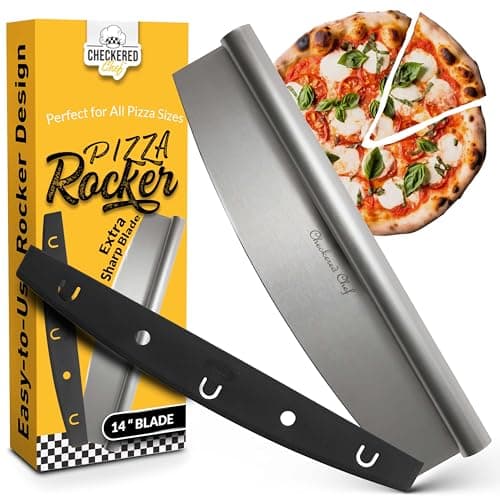
For a rocker: treat it as a knife. A honing rod or a fine stone, a consistent shallow angle, the same number of passes on each side, working along the whole length. The Checkered Chef blade is stainless and published as dishwasher safe, so dry it properly afterwards and keep the blade cover on - the cover is the thing that actually preserves the edge between uses.
For a wheel: use a pull-through designed for the job rather than a flat stone, go slowly, and accept that you are restoring a usable edge rather than a factory one. Do not take a bench grinder to it. Thin hardened stainless overheats in seconds and loses its temper, and a wheel that has been softened will not hold an edge at all after that.
What to buy instead, by what your problem actually is
Best for someone whose wheel went dull on a board: the Checkered Chef 14-inch rocker. A long straight stainless edge that one press puts through a whole pizza without dragging toppings, and the only cutter here you can genuinely sharpen at home for the next decade. It comes with a blade cover, which is the single best edge-preservation feature in the category. It demands a board and somewhere to store 14 inches of blade - the full assessment is in our rocker review.
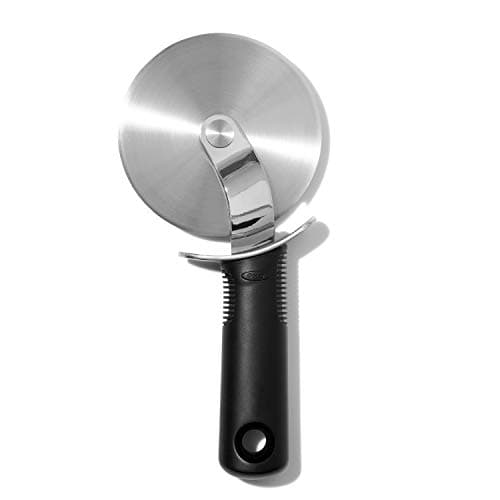
Best for the simplest replacement: the OXO Good Grips 4-inch wheel. Stainless wheel, die-cast zinc thumb guard, dishwasher safe, and large enough that thick crust does not stall it. There is no replacement wheel and no sharpening guidance, so treat it as a consumable with a lifetime guarantee behind it. Our full review is in the OXO pizza wheel review.
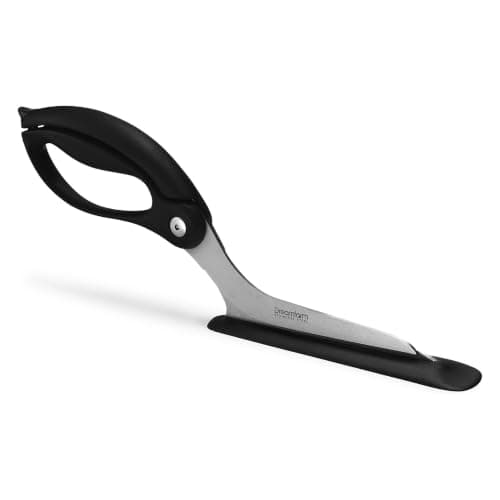
Best for anyone who cuts on the stone or in the pan: the Dreamfarm Scizza. It sidesteps the whole question. Scissors lift the slice as they cut, so there is no hardened edge dragged across a 500 F surface and nothing getting blunted on ceramic. It is the most expensive of the three and the fiddliest to clean.
The picks
What we would buy
Checkered Chef
Checkered Chef 14-Inch Rocker Pizza Cutter
Fourteen inches of blade cuts a 14-inch pizza in one press, which is the only real argument for a rocker. It also means 14 inches of blade pressing straight down onto whatever the pizza is sitting on.
A big wheel with a thumb guard. The cheapest competent cutter here, and the one most likely to drag a hardened edge across a surface you did not want marked.
Scissors with a spatula base, so the blade never touches the surface underneath. On a stone or a seasoned steel, that is the whole argument - a wheel drags across the surface, and this does not.
You can, with a pull-through sharpener made for the shape, but it is rarely worth it. The axle and thumb guard block a flat stone from reaching the bevel, the disc rotates while you push, and the sharpener usually costs more than the cutter. The commercial answer is to fit a new wheel instead - both American Metalcraft and Dexter-Russell stock 4-inch replacement blades.
Can you sharpen a pizza cutter with a knife sharpener?+
On a rocker blade, yes - it is a straight edge and a normal sharpener works. On a wheel, a standard V-notch or pull-through knife sharpener will touch only part of the circle at a time and may not clear the thumb guard at all, so you end up with an uneven edge. Sharpeners described specifically for pizza wheels exist for that reason.
How do you know if a pizza cutter needs sharpening?+
Check three other things first. A wheel that does not spin freely has cheese in the axle. A cutter used on a stone or a steel has had its edge dragged across ceramic, which is damage rather than wear. And a small wheel stalling on a thick crust is a diameter problem. If the wheel spins, the surface is a board, and it still tears rather than cuts, the edge has genuinely gone.
Are pizza cutter blades replaceable?+
On commercial cutters, yes - American Metalcraft publish the PCW4 4-inch stainless replacement blade for their PIZG3, PIZR2 and PPC4 cutters, and Dexter-Russell publish their own 4-inch equivalent. On the consumer cutters we rank, no: none of the three publishes a replacement blade or a sharpening instruction. Two of them do carry a lifetime guarantee, which is the first thing to use.
Does cutting on a pizza stone dull the cutter?+
Yes, quickly, and it damages the stone too - a hardened edge dragged across cordierite scores the surface and leaves gray metal marks, and on a seasoned steel it drags through the seasoning. Cut on a board, or use scissors if cutting in place is the habit you are not going to break.
Can you sharpen a plastic or ceramic pizza wheel?+
No. A plastic wheel has no metal edge to re-form, and a brittle ceramic one chips rather than taking a bevel. Both are replace-only items. Neither appears in our picks for that reason.
Sources
Every number on this page came from one of these, or from arithmetic on one of these that we showed in full.