Heads up: some links on this page are affiliate links. If you buy through one we may earn a commission at no extra cost to you. It never changes a ranking, and we accept no payment for placement. The full version.
What this review is
We have not cut a hundred pizzas with this to tell you how it feels. What follows is what Dreamfarm publishes, what that implies about how the tool can be used, and where two much cheaper cutters do the job better. The standing method is on the methodology page.
What we did not do
We have not baked on any of these. Every guide in this category says it tested a dozen stones; we would rather say plainly that we did not. What we did instead is on this page in full: published specs with their sources, thermal arithmetic from material constants with the working shown, and the makers' own manuals read rather than paraphrased.
The published specification
Specification
Published figure
Blade
15 cm, hardened German stainless steel
Overall length
29.5 cm
Base
Nylon spatula, heat resistant to 205 C (401 F)
Three rows, and the third one is the whole review.
The problem it actually solves
Every wheel and every rocker cuts by pressing a blade through the pizza and into whatever is underneath. On a board that is fine. On a seasoned steel it drags through the seasoning you have spent months building. On an unglazed cordierite stone it scores the surface and grinds grit into a porous body that cannot be washed with soap - which is the whole argument of how to clean a pizza stone.
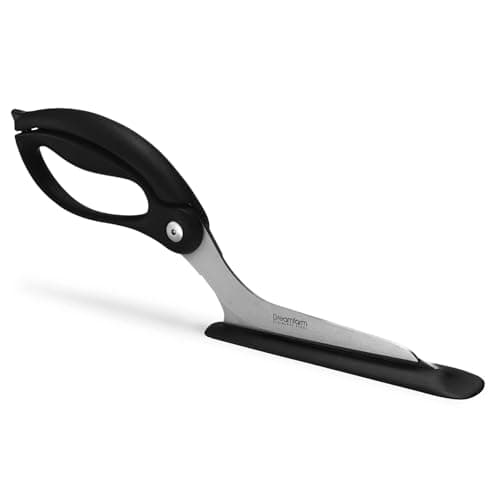
The Scizza's answer is geometry rather than technique. It is a pair of scissors with a flat nylon spatula as the lower jaw: the base slides under the pizza, the blade closes onto the base, and nothing sharp ever reaches the surface below. It also lifts the slice as it finishes the cut, so serving and cutting are one movement.
That is a real solution to a real, repeated annoyance, and no wheel or rocker offers it at any price.
The 401 F problem
Here is the constraint the marketing does not lead with, and it changes how you use the tool. The spatula base is nylon, published as heat resistant to 205 C - 401 F. A pizza stone at launch temperature is 500 to 550 F.
401 F
The published limit of the nylon base, against a 500-550 F baking surface
So the one thing the tool is designed for - sliding under a pizza without touching the surface - is not something to do on a stone straight out of the oven. Move the pizza to a board first, or give the stone a few minutes.
This is not a defect so much as a design boundary that buyers should know before they spend. In practice it means: take the pizza out onto a board or a cooling rack, then cut. That is what most people do anyway, and on a board the Scizza is at its best, because a board is exactly where a wheel would otherwise be dragging.
If your habit is to cut on the stone in the oven, this is the wrong tool and a rocker used on a board is the better answer - rocker versus wheel covers that decision.
A cutter is the last tool in the chain and the one most likely to damage the most expensive tool in it.
What it is good at, and what it is not
Good: thin and crisp. Scissors go through a crisp base cleanly and cut through toppings rather than dragging them into a heap ahead of a wheel. A well-baked thin pizza is the ideal case.
Good: not scratching things. Stones, seasoned steel, non-stick pans - the blade never reaches any of them.
Poor: thick pan pizza. A deep, bready Detroit or Sicilian slice fights scissors. The blade has a lot of crumb to work through and the base has to lift a heavy slice. A rocker is faster and cleaner there.
Poor: speed across many pizzas. A 14-inch rocker halves a pizza in one press. Scissors are a sequence of cuts. If you are feeding a party, the rocker wins on throughput even though it needs a board.
Fiddly: cleaning. Two moving parts and a joint. It is not difficult, it is just more than a wheel asks.
How it compares with the two cutters we rank alongside it
Scizza
4-inch wheel
14-inch rocker
Safe on a stone or steel
Yes, below 401 F
No
No
Speed
Moderate
Moderate
Fastest
Thick pan pizza
Struggles
Fine
Best
Topping displacement
Least
Most
Low
Storage
Drawer
Drawer
Awkward, needs a sheath
Who should buy it
Buy it if you bake thin pizza, you cut on a board or a cooled surface, and you are tired of choosing between a clean cut and a scratched pan.
Buy the rocker instead if you make thick pizza or you make several at once. It is faster, it handles crumb better, and it costs a fraction as much.
Buy the wheel instead if you want the cheapest thing that works and you already cut on a board. It is the default for a reason.
Do not buy it expecting to cut on a 500 F stone. The published rating says otherwise, and nylon does not recover from being melted.
The verdict
A genuinely clever tool with one honest constraint. Within its band - thin pizza, on a board, below 401 F - it does something no other cutter can do, and it does it while protecting the most expensive surface in your kitchen. Outside that band it is the wrong shape, and the two cheaper cutters in the cutter roundup are better buys.
The picks
What we would buy
Dreamfarm
Dreamfarm Scizza Pizza Scissors
Scissors with a spatula base, so the blade never touches the surface underneath. On a stone or a seasoned steel, that is the whole argument - a wheel drags across the surface, and this does not.
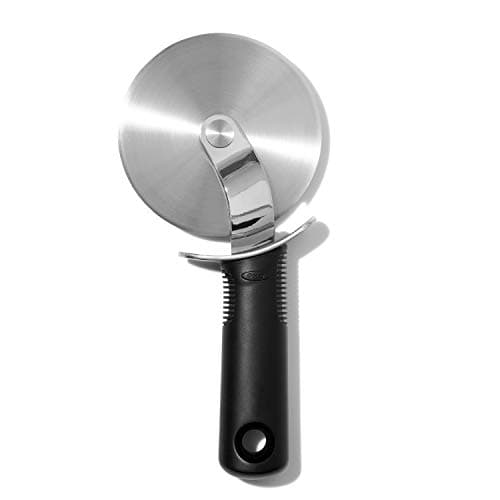
A big wheel with a thumb guard. The cheapest competent cutter here, and the one most likely to drag a hardened edge across a surface you did not want marked.
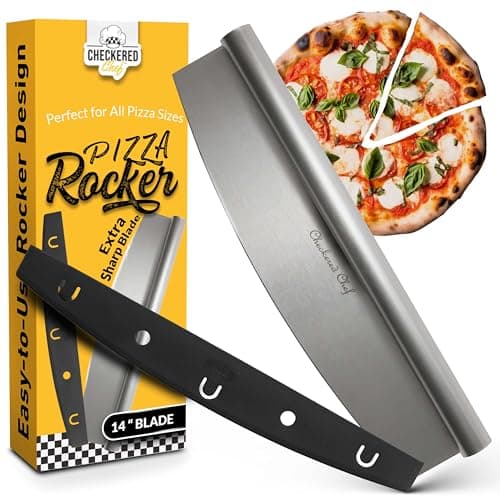
Fourteen inches of blade cuts a 14-inch pizza in one press, which is the only real argument for a rocker. It also means 14 inches of blade pressing straight down onto whatever the pizza is sitting on.
Not straight out of the oven. Dreamfarm publishes the nylon base as heat resistant to 205 C (401 F) and a baking surface at launch is 500 to 550 F. Move the pizza to a board, or let the surface cool first.
Is the Scizza better than a pizza wheel?+
For thin pizza and for protecting surfaces, yes - the blade never touches what the pizza is sitting on, and it displaces fewer toppings. For thick pan pizza and for speed, a wheel or a rocker beats it.
Does it work on deep dish or Detroit-style pizza?+
Poorly. Scissors have to work through a lot of crumb and then lift a heavy slice on the spatula base. A 14-inch rocker is the right tool for thick styles.
Is it dishwasher safe?+
Dreamfarm's published specification we rely on here covers the blade material, overall length and the base's 205 C rating; check the maker's current care guidance for washing. What we can say is that it has a joint and two moving parts, so it asks more of cleaning than a one-piece wheel.
What is the blade made of?+
Hardened German stainless steel, 15 cm long, per Dreamfarm's published specification. The lower jaw is the nylon spatula rather than a second blade, which is what keeps metal away from your stone.
Sources
Every number on this page came from one of these, or from arithmetic on one of these that we showed in full.