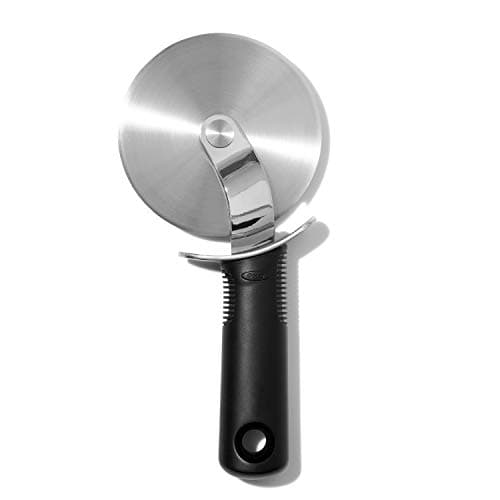
Worth buying, with one condition: get the 4-inch stainless wheel, not OXO's non-stick-bladed one, and never use it on a stone. Four inches of diameter is the whole reason it beats the cutter in your drawer.
Heads up: some links on this page are affiliate links. If you buy through one we may earn a commission at no extra cost to you. It never changes a ranking, and we accept no payment for placement. The full version.
The verdict
Buy it, if you cut on a board and you want to stop thinking about this. The OXO 4-inch wheel is the cheapest competent cutter we rank, the 4-inch diameter is a real functional advantage over the 2.5-inch wheel most households own, and OXO stand behind it with a lifetime guarantee. Two conditions attach, and both matter: make sure you are buying the stainless 4-inch wheel rather than OXO's separate non-stick-bladed one, and do not use it on a stone or a seasoned steel.
It ranks third on our cutter roundup, behind the Scizza and the rocker. This page is about whether it is the right third - what the published specification actually commits to, and where it quietly does not.
What this review is
We have not cut a year of pizza with this wheel. What follows is its published specification, drawn from OXO's own product page and from retailer listings where OXO publishes nothing, plus the arithmetic and the surface-compatibility reasoning that specification implies. Where two published sources disagree we say so rather than picking the flattering one. The method is on the methodology page.
What we did not do
We have not baked on any of these. Every guide in this category says it tested a dozen stones; we would rather say plainly that we did not. What we did instead is on this page in full: published specs with their sources, thermal arithmetic from material constants with the working shown, and the makers' own manuals read rather than paraphrased.
The published specification
Specification
Published figure
Published by
Wheel diameter
4 in (10 cm)
OXO
Wheel material
Stainless steel
OXO
Thumb guard
Die-cast zinc
OXO
Care
Dishwasher safe, BPA free
OXO
Overall dimensions
9 x 4 x 1 in, or 26.5 x 10.7 x 3.4 cm elsewhere
Retailer listings only
Weight
10 oz (284 g) on one listing, 335 g on another
Retailer listings only - they disagree
Warranty
Limited lifetime guarantee
Retailer listings
Replacement wheel
None published
-
Maximum surface temperature
None published
-
Two things in that table are worth more than the rest. The weight is published twice and the two figures differ by about 18 percent - 284 g against 335 g - which on a hand tool is the difference between listings describing different revisions and one of them simply being wrong. We quote both and we are not going to average them into a number nobody published.
The empty cells are the more useful finding. There is no published replacement wheel and no published sharpening guidance, which puts this firmly in the consumable category - the full argument, including what commercial kitchens do instead, is in can you sharpen a pizza cutter. And there is no published temperature limit, which is the specification you would want before touching a 500 F stone with it.
The variant trap, which is the single most useful thing on this page
OXO sell more than one pizza wheel and the listings look nearly identical in a search result. There is the 4-inch stainless Good Grips wheel reviewed here; there is a smaller 3.5-inch SoftWorks non-stick wheel; and there is a separate wheel OXO describe for non-stick pans, whose blade is coated so melted cheese does not stick to it.
Buy the 4-inch stainless one. The non-stick-bladed version exists to protect a non-stick pan's coating, which is a real problem if you bake in a coated pan and an irrelevance if you cut on a board. What a coating costs you is edge life: a coated blade cannot be honed and the coating is the first thing to go. The 3.5-inch version simply gives up the diameter, which is the one thing this cutter is for.
Check the model number on the listing you are about to buy. The US item is 11300900G, which replaced the earlier 26681; the Australian listing is 48152.
What four inches of diameter actually buys
This is the whole case for the product, and it is geometric rather than metallurgical. A rolling wheel has to climb onto whatever it meets. The steeper the approach angle, the more the wheel wants to skid and push the topping ahead of it rather than cut through. A larger wheel meets the same obstacle at a shallower angle.
In practice that is the difference between rolling over the raised cornicione of a deep-crust or Sicilian pizza and stalling on it, having to lift off and start the cut again from the other side. Every retailer listing makes the same claim - large enough for Sicilian and thick-crust pizza - and it is the one marketing claim in the category that follows directly from the shape.
4 in
Wheel diameter, against the 2.5 inches of the cutter most households already own
A bigger wheel meets a thick crust edge at a shallower angle, which is why it rolls through instead of climbing and skidding. The only specification on this tool that changes the result.
Where it is the wrong tool, in its own words
OXO publish no temperature limit for the wheel, which is a gap rather than a permission. Our position across the site is unchanged: a wheel drags a hardened edge across whatever sits under the pizza, and on unglazed cordierite that scores the surface and leaves gray metal marks, while on a seasoned steel it drags through the oil film you maintain. The one exception we have found is a maker who explicitly invites cutting on the surface, covered in the Emile Henry review.
The second limitation is intrinsic to the shape rather than the brand. A wheel cuts by rolling across the pizza, so it pushes toppings toward the far side of every cut. On a heavily loaded pizza that is visible in the finished slices. A rocker presses straight down through the whole line at once and does not - the shape comparison is in rocker vs wheel.
The third is the axle. The rolling joint traps cheese, and a wheel that no longer spins freely tears rather than cuts. Dishwasher safe helps, but a dishwasher cycle does not reliably clear a packed axle; a brush does.
Die-cast zinc thumb guard, stainless wheel, no published temperature limit. The guard is why this is a safe tool and part of why it is a hard one to sharpen.
Scores, and what each one is measuring
Our scores for this cutter are 3.5 for surface safety, 7.8 for cut quality, 5.5 for topping displacement and 9.4 for value, giving 7.6 overall. The surface-safety figure is the lowest of the three cutters we rank and it is not a criticism of build quality - it is the rolling-hardened-edge problem above, and it applies to every wheel ever made. The value figure is the highest of the three and is doing most of the work in the total.
Read those two together and you have the product: the best cutter here for anyone whose habit is a board, and the worst of the three for anyone whose habit is cutting in place.
Buy it, or buy one of these instead
Best for a board-cutting household on a budget: the OXO itself. Buy it if you cut on a board or a cooled surface, you want a tool that disappears into a drawer and a lifetime guarantee behind it, and your pizza is not loaded so heavily that drag is the thing you notice. It is the default for a reason.
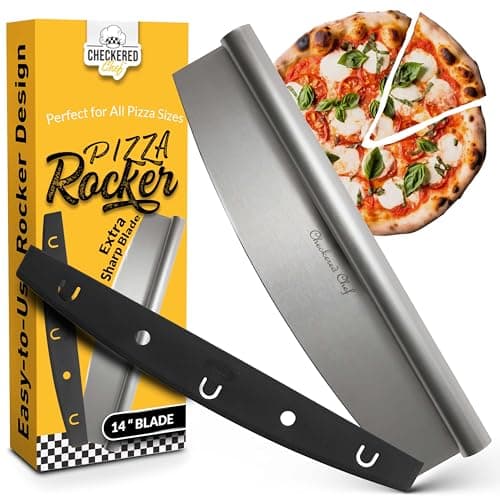
Best for whole pizzas and heavy toppings: the Checkered Chef 14-inch rocker. Buy it instead if you cut whole pizzas on a board and toppings staying where you put them matters to you. One press per cut, no drag, and a straight edge you can genuinely sharpen for years - with the trade that it needs a board, a dry hand and 14 inches of storage.
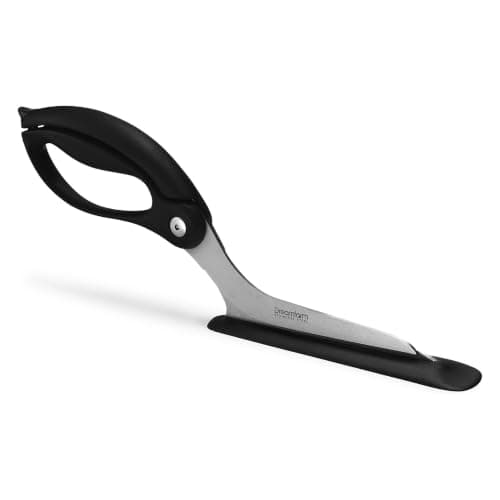
Best for anyone who cuts in place: the Dreamfarm Scizza. Buy it instead if your habit is cutting on the stone or in the pan. Scissors lift as they cut, so nothing hardened is dragged across a hot surface. It is the most expensive of the three and the fiddliest to clean.
Do not buy any of them expecting to sharpen a wheel back to new. That is the subject of its own page, and the short version is that the trade replaces wheels and consumer wheels have none to replace.
The picks
What we would buy
OXO
OXO Good Grips 4-Inch Pizza Wheel
A big wheel with a thumb guard. The cheapest competent cutter here, and the one most likely to drag a hardened edge across a surface you did not want marked.
Fourteen inches of blade cuts a 14-inch pizza in one press, which is the only real argument for a rocker. It also means 14 inches of blade pressing straight down onto whatever the pizza is sitting on.
Scissors with a spatula base, so the blade never touches the surface underneath. On a stone or a seasoned steel, that is the whole argument - a wheel drags across the surface, and this does not.
Yes, for anyone who cuts on a board. It is the cheapest cutter we rank, the 4-inch wheel rolls through a thick crust that a smaller wheel stalls on, the thumb guard is die-cast zinc rather than plastic, and OXO back it with a lifetime guarantee. It is the wrong buy if you cut directly on a stone or a steel.
Which OXO pizza wheel should I buy?+
The 4-inch Good Grips stainless wheel - US item 11300900G, which replaced 26681. OXO also sell a 3.5-inch SoftWorks wheel and a separate non-stick-bladed wheel intended for coated pans. The non-stick blade protects a pan's coating at the cost of edge life, and the 3.5-inch gives up the diameter that makes the 4-inch worth owning.
Is the OXO pizza wheel dishwasher safe?+
Yes - OXO publish it as dishwasher safe and BPA free. One caution from the shape rather than the claim: a dishwasher does not reliably clear cheese packed into the rolling axle, and a wheel that will not spin freely tears instead of cutting. Brush the axle out by hand.
How much does the OXO 4-inch pizza wheel weigh?+
OXO do not publish a weight. Two retailers do and they disagree: one lists 10 oz (284 g) and another 335 g. We quote both rather than splitting the difference, because neither figure comes from the maker.
Can you use the OXO pizza wheel on a pizza stone?+
We would not. OXO publish no temperature limit for it, and the general problem with any wheel is that it drags a hardened edge across the surface underneath - scoring unglazed cordierite, leaving gray metal marks, and pulling through the seasoning on a steel. If cutting in place is your habit, the Scizza is the tool designed for it.
Can the OXO pizza wheel be sharpened or the blade replaced?+
OXO publish neither a sharpening instruction nor a replacement wheel. The lifetime guarantee is the route to take first. Commercial cutters from American Metalcraft and Dexter-Russell do stock 4-inch replacement blades, which is the industry's answer to a dull wheel and is not available here.
Sources
Every number on this page came from one of these, or from arithmetic on one of these that we showed in full.