Every rule this site publishes about stones - never soap, never scrub, expect stains - is a rule about unglazed cordierite. This stone breaks all three on purpose.
Heads up: some links on this page are affiliate links. If you buy through one we may earn a commission at no extra cost to you. It never changes a ranking, and we accept no payment for placement. The full version.
What this review is
We have not baked on this stone. What follows is every figure the maker and its retailers publish, the arithmetic those figures allow, and where a cordierite stone at a quarter of the price does the same job. The standing method is on the methodology page.
What we did not do
We have not baked on any of these. Every guide in this category says it tested a dozen stones; we would rather say plainly that we did not. What we did instead is on this page in full: published specs with their sources, thermal arithmetic from material constants with the working shown, and the makers' own manuals read rather than paraphrased.
The published specification
Specification
Published figure
Baking surface
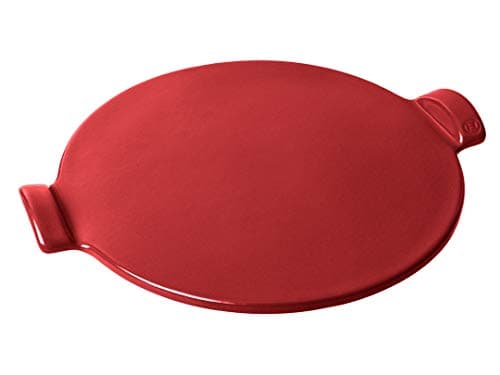
14.5" round
Overall size
16.5" x 14.5" x 1.5", including the handles
Weight
5.5 lb, 5.7 lb or 6.4 lb depending on which source you read
Body
Glazed Flame ceramic, made in France
Temperature
900 F on the listing and at Sur La Table, 500 C / 930 F from the maker
Use
Oven, broiler, and gas, charcoal or wood grills
Care
Dishwasher safe, washable with soap
Guarantee
10 years against manufacturing defects in household use
Thickness
Not published for the round
Three published weights for one stone
Start here, because it tells you how much of the rest to trust. The Amazon listing says 5.5 lb. Sur La Table says 5.7. Emile Henry's own page for the round stone says 6.4. That is a spread of nearly a pound - about 16 percent - on a figure that should not be in dispute.
It is not fatal, and it is not unusual in this category. It does mean any arithmetic built on the weight carries that error, which is why the numbers below are stated as a band rather than a point.
~23 kg/m2
Mass per unit of baking surface, using the listing's 5.5 lb over a 14.5 inch round
Against 25.5 for the Old Stone 16-inch, 25.8 for the Unicook 15 by 12 and 27.8 for the ROCKSHEAT. It carries slightly less heat per square inch than the unglazed cordierite stones it competes with, not more.
We cannot take that further into a preheat time, because the round's thickness is not published anywhere and no specific heat capacity is published for the body. The square version of this stone does publish all three figures - 14 by 14 by 3/8 inches and 6.0 lb - and computes to an effective density of about 2,260 kg/m3, roughly a third above the 1,700 kg/m3 we derive for bakeware cordierite. That is what vitrified means, and it matters below.
What the glaze actually fixes
Nearly every handling rule this site publishes exists because unglazed cordierite is porous. It stains permanently on the first bake. It must never meet soap, because soap soaks into the body and comes back out when hot. It has to be bone dry before heating, because trapped water becomes steam inside the stone. All of that is in how to clean a pizza stone.
A vitrified glazed body has none of those problems, and Emile Henry publishes the consequences plainly: dishwasher safe, washable with soap, and scratch resistant enough that the maker says you can cut directly on the stone without damaging it.
That last one is genuinely unusual. On every other stone and steel on this site, cutting on the surface is a mistake - it scores ceramic and drags through seasoning, which is the entire argument for a tool like the Scizza. Here the maker invites it. If a permanently stained slab that cannot be washed properly is the thing that has always bothered you about stones, this is the stone that answers it.
The glaze is not a finish. It is the whole product decision: it trades the one thing an unglazed body does for you against every annoyance an unglazed body causes.
What the glaze costs
A sealed surface cannot wick moisture out of the base while the pizza bakes, because that is what sealing a surface means. Drawing water out of the dough is one of the two things an unglazed stone does for you - the other being heat - and this stone does only one of them.
How much that shows up in a finished pizza is not something we can quantify without testing it, and we are not going to pretend a number here. What can be said from published figures is that the trade is real and it runs in one direction: you gain cleaning and lose wicking.
The second cost is that it is still a ceramic. Thermal effusivity - the property that decides how hard a surface pushes heat into a base - puts cordierite at 1,612 against carbon steel's 13,625, and a fired clay body sits in the same low band as cordierite rather than anywhere near metal. Nobody publishes an effusivity figure for Flame ceramic, so we treat it as a ceramic. Buying this expecting a steel's crust is the one way to be disappointed by it - see stone versus steel.
The 900 F rating, the grill and the guarantee
The listing rates it to 900 F and states gas, charcoal and wood grills plus broiler use. As always on this site: absolute temperature is almost never what breaks a stone. What breaks stones is a temperature difference across the body, governed by thermal expansion - the mechanism in why pizza stones crack, and the reason cordierite versus ceramic spends its length on expansion coefficients rather than on heat ratings.
Emile Henry publishes no expansion figure, no composition and no density for the body, so that margin cannot be checked the way cordierite's can. What it publishes instead is a ten-year guarantee against manufacturing defects in household use. That is not a physical property, but it is a maker putting money behind the claim, which is more than an unnamed ceramic stone ever does.
One practical note for grill owners: the 16.5-inch overall width includes the handles. Measure your grate and your oven rack against 16.5 inches, not 14.5.
Against the two stones we would compare it with
Emile Henry 14.5"
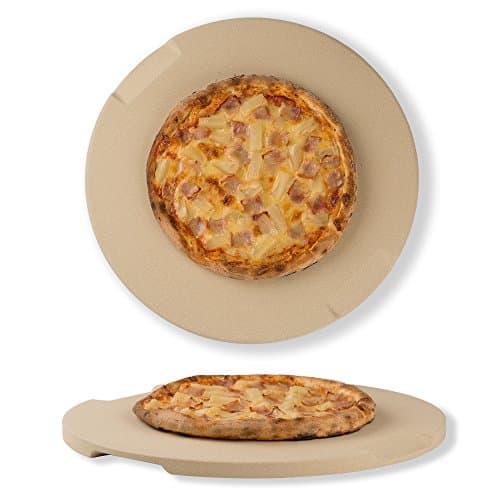
ROCKSHEAT 15"
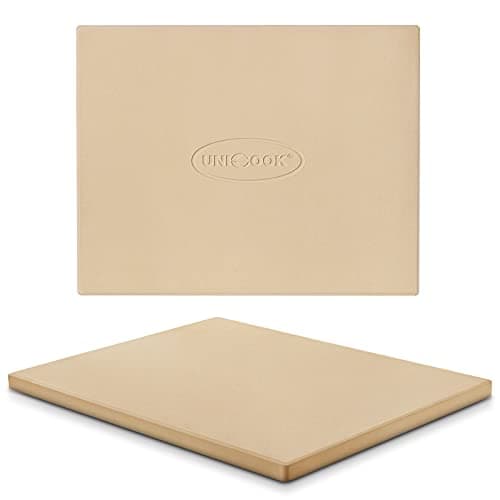
Unicook 15 x 12
Body
Glazed Flame ceramic
Unglazed cordierite
Unglazed cordierite
Handles
Yes, molded
Yes, cut into the body
No
Soap and dishwasher
Yes
No
No
Stains
No
Permanently, on the first bake
Permanently, on the first bake
Wicks moisture from the base
No
Yes
Yes
Published thickness
No
Yes, 0.63"
Yes, 0.6"
Price bracket
Several times the others
Mid
Lowest
Read across that table and the decision is not about crust at all. It is about whether you are buying a baking surface or a piece of kitchenware you will keep on the counter, cut on, and put in the dishwasher.
Who should buy it
Buy it if the staining and the no-soap rule are what have always put you off owning a stone, if you want to cut and serve on the same object, or if you want something that looks like tableware rather than like a paving slab.
Buy the ROCKSHEAT instead if you want handles on a cordierite body at a fraction of the price, and you can live with stains - our review is here.
Buy the Unicook instead if you want the most baking surface per dollar and a rectangle that uses the whole oven rack. The ranked alternatives are in the stone roundup.
Buy a steel instead if a pale base is the complaint. No ceramic of any kind fixes that, and this one costs steel money.
The verdict
A genuinely different product rather than a nicer version of the same one. The glaze removes every irritation unglazed stones cause and removes one of the two jobs they do, and Emile Henry is honest enough to publish a temperature rating, a guarantee and its care instructions while being vague about the body itself. Buy it for how it lives in your kitchen. Do not buy it for the crust, because on that it is an ordinary ceramic at an extraordinary price.
The picks
What we would buy
Emile Henry
Emile Henry Flame Top Pizza Stone, 14.5 Inch
The one non-cordierite ceramic stone we would put beside a cordierite one, because its maker publishes a temperature rating, a weight and a ten-year guarantee instead of the word ceramic and nothing else.
The only stone here with handles cut into the body, and the only one whose listing publishes a thickness AND a weight - which is how we know it is ordinary bakeware cordierite priced sensibly.
Unicook Heavy Duty Cordierite Pizza Stone, 15 x 12
A rectangle uses an oven rack better than a circle does, and at 6.6 published pounds this is the lightest surface here that still holds a useful amount of heat.
If cleaning is what you care about, yes - it is the only stone here you can wash with soap, put in a dishwasher and cut directly on, all stated by the maker. If crust is what you care about, no: it is a ceramic body in the same low effusivity band as cordierite, at several times the price.
Can you really cut on an Emile Henry stone?+
The maker states the glaze is scratch resistant and that you can cut directly on it without damaging the surface. That is the opposite of the advice for every unglazed stone and steel, where cutting scores the surface or drags through seasoning.
Does a glazed stone make a worse crust?+
It cannot wick moisture out of the base the way a porous unglazed body does, which is one of the two things a stone does for you. We have not measured how much that shows in a finished pizza and will not invent a figure, but the trade only runs one way.
How much does it weigh?+
Depends who you ask: 5.5 lb on the Amazon listing, 5.7 lb at Sur La Table and 6.4 lb on Emile Henry's own page. Using the lightest, it carries about 23 kg per square meter of baking surface - slightly less than the unglazed cordierite stones it competes with.
Can it go on a grill?+
The listing states gas, charcoal and wood grills up to 900 F, plus broiler use. Measure your grate against the 16.5 inch overall width, which includes the handles, rather than the 14.5 inch baking surface.
Sources
Every number on this page came from one of these, or from arithmetic on one of these that we showed in full.