Skip to content
Peel & Flame
Guide

How to Use a Pizza Stone for the First Time

There is no seasoning step, no soaking step and no curing step. There are two mistakes that break new stones, and they both happen in the first week.

By Scooter M./Published September 1, 2026

A stone sitting on an oven rack

Heads up: some links on this page are affiliate links. If you buy through one we may earn a commission at no extra cost to you. It never changes a ranking, and we accept no payment for placement. The full version.

The routine, in order

  1. Wipe it, do not wash it. A damp cloth, no soap, no soaking. Unglazed cordierite is porous and it will drink whatever you put on it, which then bakes out as smoke and smell. If it arrived dusty, a dry brush and a damp wipe is the whole job.
  2. Let it dry completely before its first heat. Overnight if you washed it at all. Water trapped in the pores turns to steam, and steam expanding inside a ceramic body is one of the two ways new stones break.
  3. Put it in a cold oven, on the rack you intend to use. Lower-middle for pizza. Leave at least an inch of clearance to the oven walls so air can move around it - a stone wedged in tight bakes unevenly and blocks the convection that browns the top.
  4. Heat the oven and the stone together, to the oven's maximum, and give it 25 to 45 minutes past the point the oven says it is ready. The oven reaches temperature long before the stone does; that gap is the single most common reason a first pizza disappoints.
  5. Check the surface if you can. An infrared thermometer pointed at the stone tells you the one number that matters. Without one, use time: 25 minutes past the preheat beep for a 15 mm stone, 40 for a three-quarter-inch one.
  6. Launch, bake, and leave the stone in. Do not take a hot stone out to put the next pizza on. Slide the baked pizza off with a thin peel and leave the stone where it is.

The two mistakes that break new stones

Putting a cold stone into a hot oven. The face nearest the element expands before the rest of the body does, and cordierite is strong in compression and weak in tension. Always start the stone in a cold oven.

Putting a hot stone onto a cold counter, or anything cold onto a hot stone. Same mechanism in reverse. That includes frozen pizza dropped straight onto a preheated stone, which is a genuinely common way to hear a crack.

Things you do not need to do

Season it. Oil on ceramic soaks in, does not polymerize usefully, and eventually smokes or goes rancid.

Soak it. This advice circulates and it is the opposite of correct. Water in the pores becomes steam.

Line it with foil or parchment for the whole bake. Both put a layer between the base and the stone, which forfeits the contact that is the entire reason you bought it. Parchment for the first 90 seconds to make a launch survivable is a fair compromise; leaving it there for six minutes is not.

Worry about the staining. It will go brown and then black in patches within a few bakes. That is normal, permanent, and has no effect on how it works. More on that in cleaning a stone.

Flour, semolina, and what actually burns

Whatever you launch on ends up on the stone. Plain flour burns quickly and smokes; semolina and fine cornmeal are coarser, roll under the base like tiny bearings, and take longer to scorch. Use as little as will let the base slide - a shake of the peel before launching tells you whether you have enough.

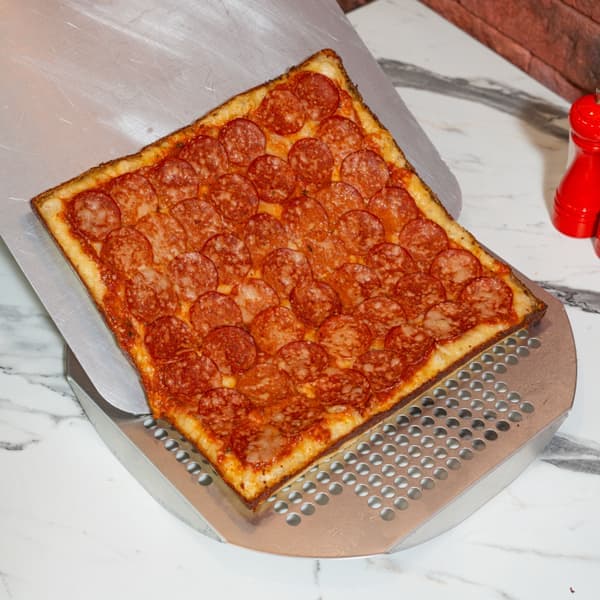
A perforated peel drops most of the excess before the pizza leaves, which is why it is the first thing we would buy alongside a stone.
The picks

What we would buy

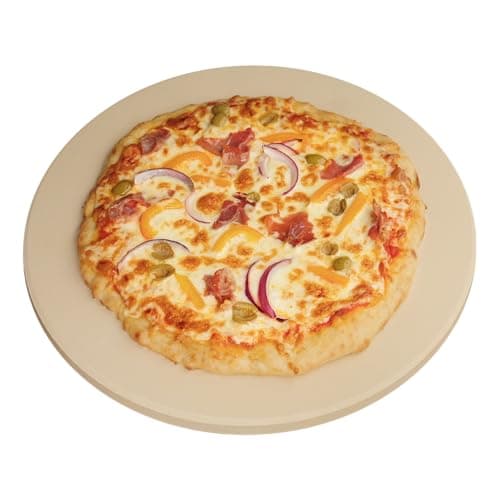
A ceramic baking stone - a stand-in for the Old Stone 16-Inch Round Cordierite Pizza Stone, not a photograph of this model

Old Stone

Old Stone 16-Inch Round Cordierite Pizza Stone

The most useful stone shape for a home oven, at a weight one hand can manage, and one of the very few whose retailer publishes both a thickness and a weight.

Check price on Amazon

#ad We hold no verified live price for this product, so we show none. How this site is funded.

An infrared thermometer gun - a stand-in for the ThermoWorks Industrial IR Gun (IR-GUN-S), not a photograph of this model

ThermoWorks

ThermoWorks Industrial IR Gun (IR-GUN-S)

The adjustable emissivity is the reason to buy this rather than a cheap gun. Fixed-emissivity instruments read a seasoned steel 40 to 80 F low, and that is the difference between a good bake and a pale one.

Check price on Amazon

#ad We hold no verified live price for this product, so we show none. How this site is funded.

A metal pizza peel - a stand-in for the Ooni 14-Inch Perforated Pizza Peel, not a photograph of this model

Ooni

Ooni 14-Inch Perforated Pizza Peel

Perforations let flour fall off before the pizza does, and 610 grams across 14 inches is light enough to keep the launch steady. The best single peel for a home oven if you are only buying one.

Check price on Amazon

#ad We hold no verified live price for this product, so we show none. How this site is funded.

Questions

Frequently asked

Do you preheat a pizza stone before putting the pizza on?
Always, and for longer than the oven takes. A stone in a preheated-but-not-waited oven is a cold stone, and the pizza will steam on it rather than sear.
Do I need to wash a new pizza stone?
No. A damp wipe is enough, and soap is actively bad because the stone absorbs it. If you do wet it, let it dry overnight before its first heat.
Can I put parchment paper on a pizza stone?
For the first minute or two of the bake, as a launching aid, yes - then pull it out. Leaving it in for the whole bake puts a layer between the base and the stone and gives away most of what the stone does. Check the paper's own temperature rating, which is often 425 to 450 F.
What rack should the stone go on?
Lower-middle for most home ovens: close enough to the bottom element for strong base heat, far enough from it that the stone is not taking direct radiant heat on one small area. If your base burns before the top is done, move it up one.

Sources

Every number on this page came from one of these, or from arithmetic on one of these that we showed in full.