Heads up: some links on this page are affiliate links. If you buy through one we may earn a commission at no extra cost to you. It never changes a ranking, and we accept no payment for placement. The full version.
The short answer
Measure your oven rack, subtract about an inch on each side, and buy the largest stone that fits inside what is left. For most domestic ovens that lands on a rectangle around 15 by 12 inches, which bakes a 12-inch pizza with margin. The 16-inch round that most guides recommend does not fit a lot of the ovens people own, and the reason is a number the stone makers never mention.
Start with what your oven publishes, not what the stone does
GE publishes rack dimensions for its wall ovens. They are smaller than people assume, and convection models are the smallest of all:
Oven
Rack width
Rack depth
30" wall oven, convection
23.78"
14.81"
30" wall oven, non-convection
23.78"
17.25"
27" wall oven, convection
21.20"
15.18"
27" wall oven, non-convection
21.20"
17.18"
24" wall oven
16.73"
17.05", of which about 15.78" is usable
14.81 in
Rack depth in a 30-inch convection wall oven - the shallowest rack of the lot
Depth, not width, is the binding constraint in a domestic oven, and convection racks are about 2.4 inches shallower than non-convection ones. A 16-inch round stone needs 16 inches of depth and simply does not fit inside this footprint.
Those are GE wall oven figures and we are citing them because they are published; a freestanding range or another brand will differ by an inch or two. The lesson transfers even if the numbers do not: measure your own rack, both ways, before you buy anything. The rack is the thing the stone has to sit inside, and a slab that overhangs is unsupported exactly where a heavy ceramic plate least wants to be.
What we did not do
We have not baked on any of these. Every guide in this category says it tested a dozen stones; we would rather say plainly that we did not. What we did instead is on this page in full: published specs with their sources, thermal arithmetic from material constants with the working shown, and the makers' own manuals read rather than paraphrased.
Then subtract the clearance
A stone that fills the rack blocks the air the oven uses to move heat around. That is our judgment rather than a published figure, but the direction is not controversial: leave roughly an inch on each side and at the back so hot air can still circulate past the slab rather than piling up under it. A stone edge-to-edge with the cavity gives you a pale top and a scorched base.
So the working sum for a 30-inch convection oven is not 23.78 by 14.81. It is about 21.8 by 12.8 - and that is the box your stone has to live inside.
Which shapes actually fit
Stone
Footprint
30" convection rack
30" non-convection
24" oven
15 x 12 rectangle
15" x 12"
Fits, with clearance
Fits easily
Fits, tight on width
16" round
16" x 16"
Does not fit the depth
Fits, no clearance front to back
Does not fit
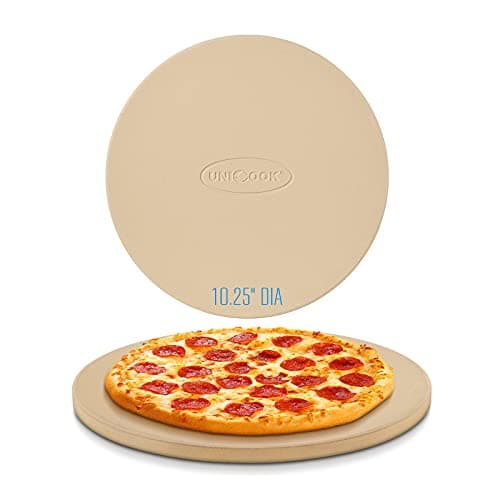
10.25" round
10.25" x 10.25"
Fits with room to spare
Fits
Fits
This is the whole argument for a rectangle in a home oven: an oven rack is a rectangle, so a rectangular stone converts more of it into baking surface. A circle inscribed in that box wastes the corners, and the bigger the circle the worse the waste gets.
Now size it to the pizza, not the oven
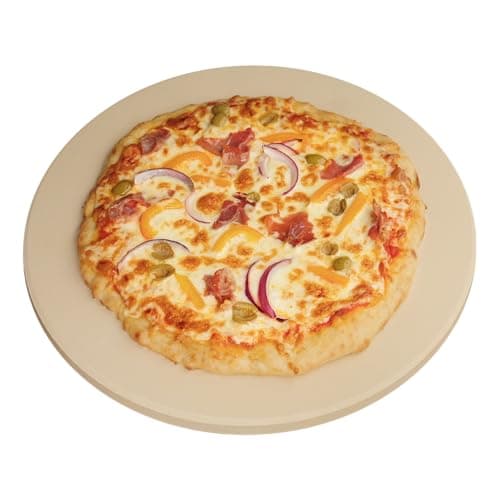
The second number is the pizza. A base that overhangs the stone bakes pale at the edge because there is no hot surface under it, so the stone has to be bigger than the pizza - and on a rectangle, the limit is the SHORT side.
Pizza you want
Minimum short side
Dough ball at standard thickness
10 in
11 in
197 g
12 in
13 in
284 g
14 in
15 in
386 g
16 in
17 in
504 g
Read that table against the rack table above and the squeeze is obvious. A 14-inch pizza wants 15 inches of clear stone in both directions, and a 30-inch convection rack gives you about 12.8 inches of usable depth. In a lot of ovens, a 14-inch pizza is not available at any stone price. The dough weights come from our dough ball weight chart, which scales by area rather than diameter.
The rack is the constraint, not the cavity. Measure the shelf the stone will sit on, both ways, and buy inside that.
Bigger is not automatically better, and here is the cost
A bigger stone is more mass to bring up to temperature. Going from the 15 by 12 to the 16-inch round adds 21 square inches of surface and 0.7 lb, which lifts stored energy from 0.165 to 0.182 kWh and preheat from 24 minutes to 25. That is a fair trade. Going much bigger stops being one: mass scales with area, so does preheat time, and the pizza you can actually launch is still limited by the rack.
Per square inch the two are the same stone - 25.8 against 25.5 kg/m2 - which is the point worth holding on to. Size changes how much pizza you can bake, not how well you can bake it. How well is set by thickness and material, and that is settled in the stone roundup and, for steel, in the thickness guide.
Do not forget the peel has to get in there too
A stone sized to the last half inch of the rack leaves nowhere for the peel to go. You need to slide a blade over the stone, tilt it, and pull it back out, all inside the same cavity. A peel blade roughly an inch narrower than the stone's short side is the workable combination, and the peel size guide covers matching blade to pizza and oven properly.
What to buy, by oven
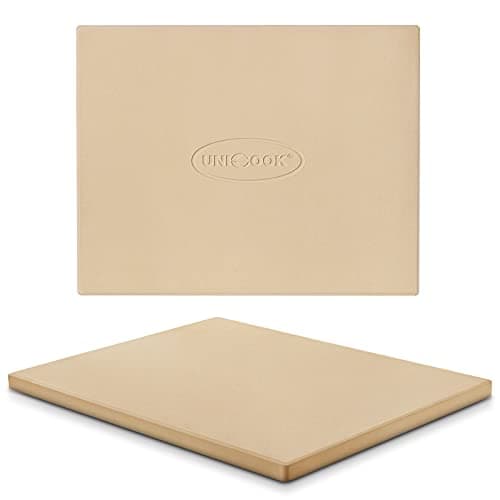
A standard 30-inch oven, convection or not: a 15 by 12 rectangle. It fits both rack depths with clearance, it bakes a 12-inch pizza with margin, and per square inch it matches stones costing several times more. Our full take is in the Unicook review.
A 30-inch non-convection oven, and you want 14-inch pizzas: a 16-inch round, after you have measured 17-plus inches of rack depth. Accept that it will sit nearly edge-to-edge front to back.
A 24-inch oven: the 15 by 12 still fits, tight on width. Do not try a 16-inch round.
A countertop, toaster or air fryer oven: none of the above. The small-oven roundup covers the three stones that fit and what the thinner body costs you.
The picks
What we would buy
Unicook
Unicook Heavy Duty Cordierite Pizza Stone, 15 x 12
A rectangle uses an oven rack better than a circle does, and at 6.6 published pounds this is the lightest surface here that still holds a useful amount of heat.
The most useful stone shape for a home oven, at a weight one hand can manage, and one of the very few whose retailer publishes both a thickness and a weight.
The best-documented small stone here: the maker publishes the thickness, the kiln temperature and a 1450 F limit, and throws in the scraper. A third thicker than the toaster-oven stones, which is the compromise worth making if your cavity allows it.
The largest that fits inside your oven rack with about an inch of clearance on each side. For most domestic ovens that is a rectangle near 15 by 12 inches, good for a 12-inch pizza. Measure the rack depth first - it is the binding constraint, not the width.
Will a 16-inch pizza stone fit in my oven?+
Often not. A 30-inch GE convection wall oven rack is 14.81 inches deep, and a 16-inch round needs 16 inches. The non-convection version of the same oven is 17.25 inches deep and does take it, with no clearance front to back. Measure yours.
Is a rectangular or round pizza stone better?+
Rectangular, for a home oven. An oven rack is a rectangle, so a rectangular stone converts more of it into usable baking surface. Round only wins if your pizzas are round and you want the stone to be no bigger than it has to be.
How much bigger than the pizza should the stone be?+
About an inch all round, so roughly 13 inches of clear surface for a 12-inch pizza. A base that overhangs the stone bakes pale at the edge because nothing hot is under it.
Does a bigger stone make better pizza?+
No. Mass per unit area sets how much heat the base can draw, and a 15 by 12 (25.8 kg/m2) and a 16-inch round (25.5 kg/m2) are the same stone by that measure. Bigger means more pizza at once and a slightly longer preheat, not better crust.
Sources
Every number on this page came from one of these, or from arithmetic on one of these that we showed in full.