Heads up: some links on this page are affiliate links. If you buy through one we may earn a commission at no extra cost to you. It never changes a ranking, and we accept no payment for placement. The full version.
The shortlist
Ranked, with the working
Ranked on published manufacturer specifications and, where the numbers exist, our own arithmetic on what each option does thermally. Tap any row for the full write-up, including who should skip it.
#
Product
Best for
Score
Price
01
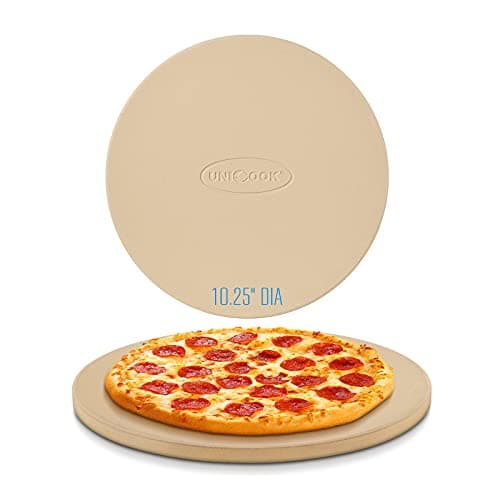
Unicook Round Pizza Stone, 10.25 InchA large toaster oven, a countertop oven, or a full oven used for personal pizzas
Scores are ours and editorial. They are never published as review or rating markup, because we have not baked on these products - here is how we pick.
Measure the cavity before you read the rest
Countertop ovens do not publish their interior dimensions the way wall ovens do, and the three stones here range from 64 to 104 square inches of surface. Open your oven, measure the widest thing that will slide onto the rack, and subtract an inch on every side so air can still move around the stone. Whatever number that leaves is the only spec that matters first.
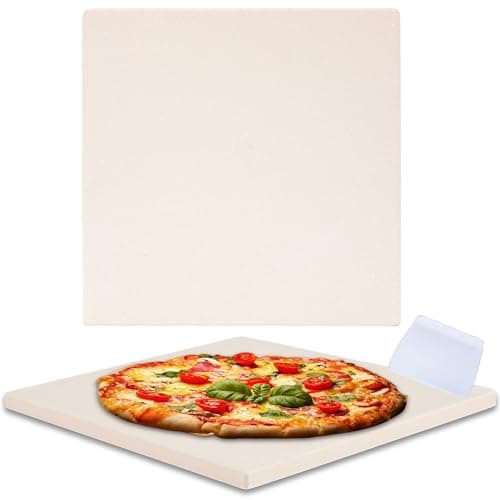
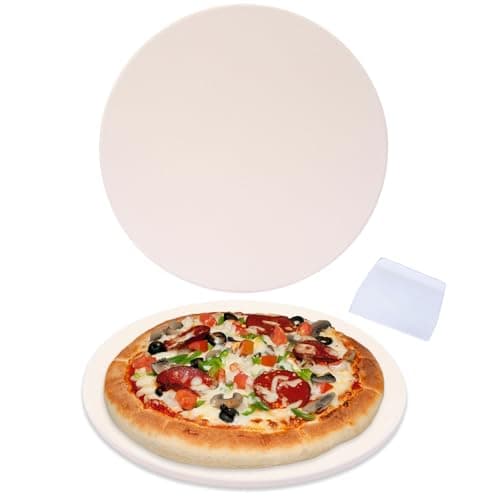
The footprints below are 9 inches round, 10.25 inches round, and 10 by 10.4 inches rectangular. If your answer above is under 9 inches, no stone here fits and the honest advice is a steel plate cut to size or nothing at all.
What we did not do
We have not baked on any of these. Every guide in this category says it tested a dozen stones; we would rather say plainly that we did not. What we did instead is on this page in full: published specs with their sources, thermal arithmetic from material constants with the working shown, and the makers' own manuals read rather than paraphrased.
How we ranked these
1. Published footprint and thickness. Fit is binary in a small cavity, so every candidate had to publish real dimensions rather than a hero photo.
2. Heat it actually stores. A stone works by carrying energy into the base of the pizza. We compute that from the published dimensions and the cordierite constants in our methodology, and we show the figure rather than saying "great heat retention".
3. Published spec quality. A maker that states a thickness, a kiln temperature and a care instruction has told you what it built. One that states "ceramic" has not.
4. Weight in a small cavity. You are lifting a hot slab out of a box at chest height, not off a floor-level oven rack, so light matters more here than it does in a range.
The honest problem with a small stone
Our main stone roundup tells you to skip anything under about 0.4 inches thick for a domestic oven, and that advice stands. Here is what it costs you, using the site's own arithmetic:
Stone
Surface
Mass per unit area
Energy stored, 68 to 500 F
95% of oven temperature
Waykea 9" round, 0.3"
64 sq in
13.3 kg/m2
0.030 kWh
13 min
Unicook 10.25" round, 0.4"
83 sq in
21.3 kg/m2 (derived)
0.062 kWh
20 min
Waykea 10 x 10.4", 0.5"
104 sq in
26.7 kg/m2 (derived)
0.098 kWh
25 min
Unicook 15 x 12", 0.6" (full size)
180 sq in
25.8 kg/m2
0.165 kWh
24 min
13.3 vs 25.8
Kilograms per square meter: the 9-inch toaster-oven stone against a full-size stone
The thin stone carries about half the mass per unit area, so it holds about half the energy per unit area and gives it up to the dough faster than it can be replaced. That is the whole compromise, and no listing will tell you.
Two of those mass figures are derived rather than published, because neither maker states a weight for the size in question. Our arithmetic uses the dense-body density for cordierite, which we know overstates real bakeware by around a fifth - the two stones here whose weight IS published come out near 1,700 kg/m3 rather than the textbook 2,100. Treat the derived rows as upper bounds. Where that matters, the product cards say so.
What the thin stone buys in exchange is preheat: 13 minutes to reach 95 percent of oven temperature against 24 for a full-size stone. In a countertop oven with a small element that is not a trivial advantage, and it is the honest case for the 9-inch.
Thermal shock does not care how small the stone is. Everything in why pizza stones crack applies here, and a thin stone has less body to absorb a sudden gradient.
What each one is for
The Unicook 10.25-inch round takes the top spot on documentation. It is the only stone here whose maker publishes the thickness, the kiln temperature it was sintered at, a 1450 F heat limit and the care instructions - and it ships with the plastic scraper that an unglazed stone genuinely needs. At 0.4 inches it is a third thicker than the toaster-oven stones, which is the compromise worth making whenever your cavity allows it.
The Waykea 10 by 10.4 stores the most heat. Half an inch is full-size thickness in a small-oven footprint, and 104 square inches is the largest surface here. Its maker also names air fryer ovens explicitly, which most stone listings ignore. The costs are real: no published weight, the longest preheat of the three at 25 minutes, and 10.4 inches of depth that a genuinely small oven will not take.
The Waykea 9-inch round is the one that fits when nothing else does. It publishes both a thickness and a weight - 0.3 inches and 1.2 lb - and those two figures cross-check each other: they imply a density of about 1,740 kg/m3, right on top of the ~1,700 we derive for every other bakeware cordierite stone on this site. That is a listing telling the truth. It is also the thinnest surface we have ever ranked, and the table above is what that costs.
What we would skip
Any small stone that does not publish a thickness. In this size class thickness is the entire difference between the picks, and a listing that hides it is hiding the only number that matters.
Stones sold as a set with parchment paper. Parchment between the dough and the stone defeats the point of a porous surface, which is to wick moisture out of the base. If you need parchment to launch, read how to launch a pizza instead.
A full-size stone you intend to cut down. Cordierite does not take kindly to being cut and a fresh edge is where a crack starts.
Using one in a countertop oven
The rules are the same as any stone, and they are covered properly in how to use a pizza stone. Two points bite harder in a small cavity. First, preheat with the stone already inside from cold and give it the full time in the table above, because a small element takes longer to recover than a range element does. Second, a stone that fills the rack blocks the airflow the oven uses to move heat around, so leave the inch of clearance on every side - the alternative is a pale top and a dark base.
The one rule that is stricter than in a full oven: never wash it. Unicook states it outright - no soap, no detergent, no seasoning with oil - and our cleaning guide explains why water is the wrong tool on anything porous.
Who should not buy any of these
If you own a full-size oven, buy a full-size stone. The picks in the main roundup cost about the same and carry twice the energy per unit area. These three exist for people whose oven is the constraint, not people whose budget is.
And if what you actually want is a bigger pizza rather than a better one, the limit is the cavity, not the stone. Our stone size guide works through how the numbers relate in any oven.
In full
Every pick, with the specs and the sources
01 / Best documented
Unicook
8.4/10
Unicook Round Pizza Stone, 10.25 Inch
The best-documented small stone here: the maker publishes the thickness, the kiln temperature and a 1450 F limit, and throws in the scraper. A third thicker than the toaster-oven stones, which is the compromise worth making if your cavity allows it.
What it does well
The maker publishes thickness, kiln temperature, heat limit and care instructions - more than any other small stone here
0.4 inches is a third thicker than the toaster-oven stones, so it holds meaningfully more heat
A scraper in the box, which is the tool you need on an unglazed stone and the one nobody has
Explicit care instructions that match what porous cordierite actually needs
What it does not
No published weight for this size, so its mass has to be derived rather than read
10.25 inches still bakes a personal pizza, not a family one
Round, so it uses a square cavity poorly
0.4 inches is thin by full-oven standards even if it is thick by small-oven ones
Skip it if
Your cavity is genuinely small. At 10.25 inches across it needs more clearance than a 9-inch stone, and clearance is the whole constraint in a countertop oven.
No published weight for this one, so the mass is derived from the published dimensions and the dense-body density for cordierite. Treat it as an upper bound - across the stones here whose weight IS published, the real bodies come in around 20 percent lighter than the textbook figure, because bakeware cordierite is porous.
Half an inch thick and very nearly square, which is the shape a toaster-oven cavity actually is. The most stored heat of the three small stones, and the one the maker also points at air fryer ovens.
What it does well
0.5 inches is full-size thickness in a small-oven footprint
Nearly square, so it uses a countertop cavity better than a round stone does
104 square inches of surface, the most of the three small stones here
The maker names air fryer ovens explicitly, which most stone listings ignore
What it does not
No published weight, and at half an inch thick it is the heaviest of the three
10.4 inches of depth needs a genuinely roomy countertop oven
Cordierite is named but no kiln temperature or care instruction is published, unlike the Unicook
Thicker means slower: the longest preheat of the three small stones
Skip it if
You need the lightest possible stone. It is the thickest of the small three, and no weight is published, so budget for more than the 1.2 lb the 9-inch publishes.
No published weight for this one, so the mass is derived from the published dimensions and the dense-body density for cordierite. Treat it as an upper bound - across the stones here whose weight IS published, the real bodies come in around 20 percent lighter than the textbook figure, because bakeware cordierite is porous.
Nine inches and 1.2 published pounds, which is the only stone here light enough and small enough for a genuine toaster oven. It publishes both figures, and they agree with the density we derive for bakeware cordierite.
What it does well
Small enough to actually fit a toaster oven, which almost no pizza stone is
Publishes a thickness AND a weight, which most stones at this price do not
1.2 lb means no wrestling a hot slab out of a small cavity
Cordierite rather than an unnamed clay, with a stated temperature limit
What it does not
0.3 inches is the thinnest surface on this site - about half the mass per unit area of a full-size stone
Nine inches is a personal pizza and nothing larger
Round wastes area in a square toaster-oven cavity
No published temperature limit for thermal shock specifically, only the 1400 F figure
Skip it if
You have a full-size oven. Three tenths of an inch carries about half the mass per square inch of a proper stone, and in a 500 F oven you want the mass.
Yes, if it fits with about an inch of clearance on every side so air can still circulate. Two of the stones here are sold explicitly for toaster ovens, at 9 inches round and 10 by 10.4 inches. Measure the rack before buying - countertop ovens rarely publish their interior dimensions.
Can you use a pizza stone in an air fryer oven?+
The Waykea 10 by 10.4 names air fryer ovens in its own listing. The same clearance rule applies, and it matters more in a convection-style cavity, because the moving air is how the oven transfers heat and a stone that fills the rack blocks it.
How thick should a small pizza stone be?+
As thick as your cavity allows. Across these three, going from 0.3 to 0.5 inches roughly triples the stored energy, from 0.030 to 0.098 kWh between room temperature and 500 F. The cost is preheat time, which roughly doubles.
Is a thin pizza stone worth buying at all?+
In a small oven, yes - it is the only thing that fits, and it still wicks moisture out of the base, which is half of what a stone does. In a full-size oven, no: you would be choosing half the stored heat for no reason.
Do small stones crack more easily?+
A thinner body has less material to absorb a temperature gradient, so treat thermal shock seriously: in from cold, out to a dry trivet, and never onto a wet counter. The full failure modes are in why pizza stones crack.
Sources
Every number on this page came from one of these, or from arithmetic on one of these that we showed in full.