Heads up: some links on this page are affiliate links. If you buy through one we may earn a commission at no extra cost to you. It never changes a ranking, and we accept no payment for placement. The full version.
What this review is
We have not baked on a NerdChef. What makes this one worth writing anyway is that NerdChef publishes two physical claims as separate numbers rather than mashing them into a slogan, which means they can be checked against published material constants. We checked both. The method is on the methodology page.
What we did not do
We have not baked on any of these. Every guide in this category says it tested a dozen stones; we would rather say plainly that we did not. What we did instead is on this page in full: published specs with their sources, thermal arithmetic from material constants with the working shown, and the makers' own manuals read rather than paraphrased.
The published specification
Specification
Standard (1/4")
Ultimate (1/2")
Dimensions
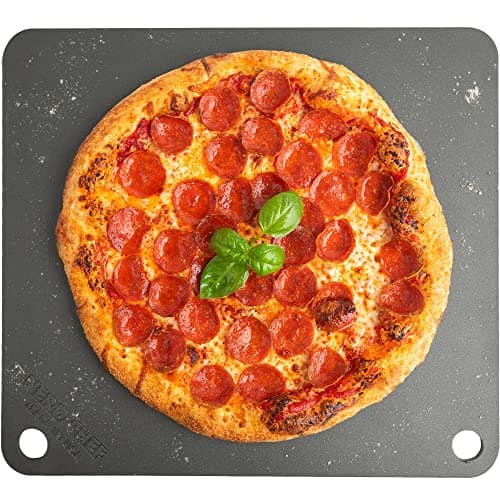
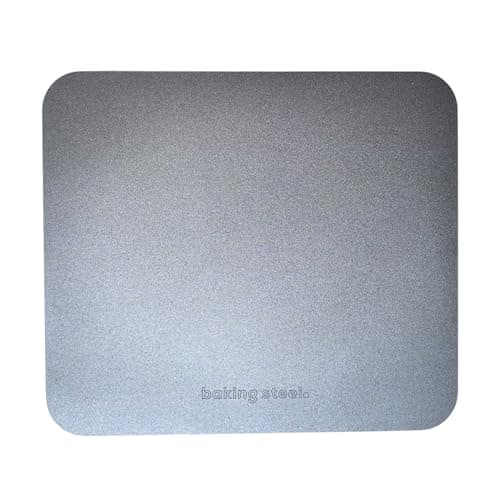
16" x 14.25" x 0.25"
16" x 14.25" x 0.5"
Weight
16 lb
32 lb
Surface
Textured, sanded smooth, seasoned with flaxseed oil
Guarantee
Guaranteed for life, per the listing
Made in
USA
Both plates were listed in stock when we checked. Note the depth: 14.25 inches, not 16. The long side is the one quoted first, and the short side is the one your pizza has to fit inside.
Claim one: "twice the heat capacity" of a ceramic stone
Volumetric heat capacity is density times specific heat capacity - how much energy a given volume of material holds per degree. Using the published constants this site uses everywhere: carbon steel is 7,900 kg/m3 at 470 J/kg.K, which is 3.71 MJ/m3.K. Cordierite is 2,100 kg/m3 at 825 J/kg.K, which is 1.73.
Divide one by the other and you get 2.14 times. NerdChef says twice. That is accurate to within about 7 percent, and it is the correct property to name - it is the reason a steel does not lose its surface temperature the moment a cold base lands.
Claim two: "20x higher conductivity" - and here they undersell it
Thermal conductivity is how fast heat travels through a material. Published figures: carbon steel 50 W/m.K, cordierite 1.3 to 1.7 W/m.K. That is a ratio of 29 to 38 times depending on where in the published cordierite band you sit, with about 33 at the midpoint.
33x
Carbon steel's published conductivity against cordierite's, at the midpoint of the ceramic's range
NerdChef claims 20x. In a category where numbers are routinely inflated, this maker published one that is lower than the published constants support. We have not found another surface listing on this site that errs in that direction.
It is worth being precise about what this does and does not mean for your pizza. Conductivity alone does not decide bottom crust - the property that governs the contact patch is thermal effusivity, the square root of conductivity times volumetric heat capacity, where steel leads a stone by 8.5 times rather than 20 or 33. That derivation is in stone versus steel. NerdChef naming two real properties separately is still more honest than the "18x" figure that floats around this category attached to nothing in particular.
The published weights check out too
A cheap way to catch a listing that is quoting someone else's numbers: multiply the dimensions by the density of the material and see whether the weight falls out.
Plate
Derived from dimensions
Published
Gap
Standard, 1/4"
16.3 lb
16 lb
2%
Ultimate, 1/2"
32.5 lb
32 lb
2%
Two percent is rolling tolerance and rounding. Three published figures, three that survive arithmetic - which, after reviewing a stone whose durability claim its own strength figure contradicts, is worth saying plainly.
Nothing here is exotic. It is hot-rolled carbon steel, cut, sanded and seasoned - and the value is entirely in whether the numbers on the listing are the numbers you receive.
What the two thicknesses actually ask of you
This is where the review turns from arithmetic to your kitchen. Our lumped-capacitance model, using a surface heat transfer coefficient of 20 W/m2.K:
Standard, 16 lb
Ultimate, 32 lb
95% of oven temperature
about 28 minutes
about 54 minutes
99% of oven temperature
about 43 minutes
about 83 minutes
Energy stored at 500 F
about 0.23 kWh
about 0.46 kWh
Read the second column as a commitment rather than a spec. Thirty-two pounds is a both-hands, feet-planted lift, and nearly an hour of preheat before the first pizza is not a weeknight decision. What it buys is recovery between back-to-back pizzas, which matters if you are feeding six people and is invisible if you are making one. The full thickness-versus-mass argument is in the thickness guide.
The 14.25 inch problem
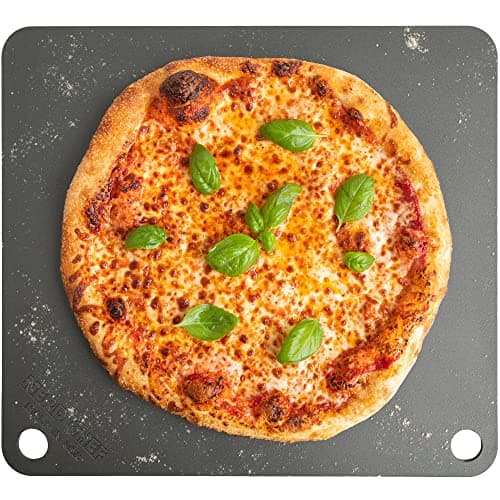
The plate is rectangular, 16 by 14.25 inches. A 14-inch pizza laid on it has about an eighth of an inch of margin front to back, which in practice means you are landing a 12 to 13 inch pizza on it with room to correct a slightly crooked launch.
That is not a defect - it is the same footprint most steels use, and a square plate of the same area would weigh more. It is simply the number to check against your own pizzas and your own rack before buying, in the same way the clearance rule matters for stones.
What it does not tell you
No published preheat guidance. Baking Steel publishes 45 to 60 minutes for its plate; NerdChef publishes nothing, so the numbers above are ours rather than a cross-check between two independent sources. Our model and Baking Steel's own figure agree closely for a comparable plate, which is the closest thing to validation available - see the preheat guide.
Nothing about seasoning maintenance. The listing says the plate arrives seasoned with flaxseed oil and stops there. It is bare carbon steel: keep it dry, wipe on a very thin film of oil, never leave it wet.
The "1000 F oven" line. The listing frames the plate as giving you the performance of a much hotter oven. No surface does that. What a steel changes is how hard heat crosses into the base at the moment it lands, and a 550 F oven with a steel in it is still a 550 F oven - the honest framing is in is a baking steel worth it.
Who should buy it
Buy the Standard if you want a quarter-inch steel and you value a maker that publishes checkable figures and a lifetime guarantee. It is the plate we would pick between the two.
Buy the Ultimate only if you bake several pizzas back to back and the plate will live in the oven permanently. Otherwise you are buying 16 extra pounds and 26 extra minutes of preheat for a difference you will not see on a single bake.
Buy the Baking Steel Original instead if published preheat guidance matters to you, or if you want the slightly larger 16 by 14 footprint from a maker that tells you how long to wait. Both are ranked in the steel roundup.
Buy neither if you have not yet ruled out a short preheat or an oven running cold, which are free to check and are the cause more often than the surface is.
The verdict
A plain, well-made plate from the one maker in this category whose published physics survives being checked - and which, unusually, claims less than the constants support. There is no published preheat guidance and the 14.25 inch depth is tighter than the headline size suggests. If you want a quarter-inch steel and you care whether a listing tells the truth, this is a straightforwardly good buy.
The picks
What we would buy
NerdChef
NerdChef Steel Stone Standard, 16 x 14.25 x 1/4
The same quarter-inch plate, from the one maker in this category that states conductivity and heat capacity as two separate numbers instead of mashing them into one slogan.
Thirty-two pounds of carbon steel. Genuinely the most thermally capable surface here, and genuinely the one most likely to sit in a cupboard because you cannot face lifting it.
A quarter inch is the thickness where a steel stops being a novelty and stays a thing you can still lift. Its advantage over a stone is not preheat speed - it is what happens one second after the base lands.
For a quarter-inch steel, yes. Its published weight checks out against its dimensions to within 2 percent, its heat-capacity claim is accurate to within 7 percent, and it carries a lifetime guarantee. The half-inch version is 32 lb and about 54 minutes of preheat, which most home cooks do not need.
Is NerdChef's 20x conductivity claim true?+
It is conservative. Published constants put carbon steel at 50 W/m.K against cordierite's 1.3 to 1.7, which is 29 to 38 times. Note that conductivity is not what decides bottom crust - thermal effusivity is, and there steel leads a stone by about 8.5 times.
NerdChef or Baking Steel?+
Close. NerdChef publishes conductivity and heat capacity as separate, checkable figures and a lifetime guarantee; Baking Steel publishes real preheat guidance and a slightly deeper 14-inch-plus footprint. Both are quarter-inch carbon steel and will bake the same.
How long does it take to preheat?+
Our model gives about 28 minutes to 95 percent of oven temperature for the 16 lb plate and about 54 for the 32 lb one. NerdChef publishes no guidance of its own, so those are our figures rather than a cross-check.
Will a 14-inch pizza fit?+
Barely. The plate is 16 by 14.25 inches, so a 14-inch base leaves about an eighth of an inch front to back. Treat it as a comfortable 12 to 13 inch surface.
Sources
Every number on this page came from one of these, or from arithmetic on one of these that we showed in full.