Heads up: some links on this page are affiliate links. If you buy through one we may earn a commission at no extra cost to you. It never changes a ranking, and we accept no payment for placement. The full version.
If a pale, floppy base is your specific complaint and your oven reaches 500 F, yes - a quarter-inch steel pushes heat into the base about 8.5 times harder than a cordierite stone, and nothing else you can buy for a domestic oven changes the crust that much. If your complaint is something else, or you cannot comfortably lift 15 pounds into a hot oven, it is the wrong purchase.
How we are judging "worth it"
Three questions, in this order, because they are the ones that decide whether a steel is a transformation or an expensive slab living in a cupboard.
1. Does it fix the thing you are actually unhappy about? A steel changes exactly one variable: how fast heat crosses from the surface into the base. It cannot fix anything else, and most disappointment in home pizza has a different cause.
2. Can you live with what it asks of you? Fifteen pounds, a long preheat, seasoning, and a permanent resident on one of your oven racks.
3. Is there a cheaper way to the same physics? There is, and this page names it rather than pretending otherwise.
What we did not do
We have not baked on any of these. Every guide in this category says it tested a dozen stones; we would rather say plainly that we did not. What we did instead is on this page in full: published specs with their sources, thermal arithmetic from material constants with the working shown, and the makers' own manuals read rather than paraphrased.
What you are buying, in one number
Thermal effusivity governs how far the contact patch drops when a cool, wet base lands on a hot surface. It is the property that decides bottom crust, and the gap is not subtle.
Surface
Effusivity, W.s^0.5/m2.K
Against a stone
Cordierite stone
1,612
1.0x
Gray cast iron
13,002
8.1x
Carbon steel
13,625
8.5x
8.5x
Carbon steel's thermal effusivity against a cordierite stone's
Note what is NOT on this table: stored energy. A quarter-inch steel holds about 12 percent more heat per square inch than a 15 mm stone, not eight times more. The transformation is in the transfer rate, not the reservoir.
That distinction matters when you read the marketing. The claim that a steel holds "18 times" anything is two different properties multiplied together by mistake - the full derivation is in stone versus steel. What you are buying is a surface that barely notices the dough arriving.
What it costs you, beyond the money
Fifteen pounds, at chest height, into a 500 F oven. This is the consideration people discover after buying. A quarter-inch 16 by 14 plate is 15 published pounds; the half-inch version is 32. If that is a problem now, it will be a bigger problem in five years.
About 27 minutes of preheat past the oven's beep. Our model puts the quarter-inch plate at 95 percent of oven temperature in roughly 27 minutes, and Baking Steel's own published guidance says 45 to 60 - the two agree once you account for the cabinet and the walls saturating after the plate does. Either way it is not a fifteen-minute weeknight decision. Timings by surface are in the preheat guide.
Roughly four cents of electricity to heat the plate itself. About 0.21 kWh from a 68 F kitchen to 500 F. The oven around it costs far more - worked through in what preheating costs.
Seasoning. It is bare carbon steel. Keep it dry, wipe on a very thin film of oil, never leave it wet. Less work than the internet suggests, but not zero.
A permanent rack. Most people leave it in, which is the right call thermally and means every other thing you bake shares the oven with a large thermal mass.
The four buyers who should not buy one
Anyone who has not ruled out the free fixes. A preheat that ended too early and an oven running 50 F cold are both more common than a surface problem, and both cost nothing to check. Do that first - the diagnostic is here. Buying a steel to fix a short preheat produces a heavy, cold slab and a pale pizza.
Anyone whose oven cannot pass about 450 F. The steel amplifies the heat the oven gives it. If the cabinet is not hot, there is nothing to amplify.
Bread-first bakers. The same aggression that sets a pizza base in six minutes scorches the bottom of a forty-five minute loaf, and the workarounds are real work - baking steel for sourdough and bread covers them. A stone is the better bread surface.
Anyone who bakes pizza a few times a year. A stone gets you most of the way for a fraction of the outlay, and the difference between a stone and a steel is much smaller than the difference between a sheet pan and a stone - which is the subject of are pizza stones worth it.
A steel is the biggest single upgrade a domestic oven can take. It is also the upgrade most often bought to fix a problem it has nothing to do with.
The cheaper route to 95 percent of it
This is the part most buying guides leave out, because it points away from the expensive purchase. Gray cast iron computes to an effusivity of 13,002 against carbon steel's 13,625 - about 95 percent - at a fraction of the price, and most households already own a large skillet.
So the honest test before you spend anything: preheat the biggest cast iron pan you own, empty, for 25 minutes at your oven's maximum, and bake a small pizza on it. If the base transforms, the surface was your problem and a steel will do it properly across a full 16 inches. If it does not, your problem is elsewhere and a steel will not find it. What cast iron gives up is the rim and the geometry, not the physics - cast iron versus pizza steel has the full comparison.
If you buy one, buy the quarter inch
The thickness question is where money gets wasted. A quarter-inch plate is 15 lb and reaches temperature in about 27 minutes. A half-inch plate is 32 lb, takes about 54 minutes, and draws roughly 0.45 kWh just to heat itself. What the extra mass buys is recovery between back-to-back pizzas - genuinely useful if you feed six people, invisible on a single pizza.
Most people should buy the quarter inch and spend the difference on a peel they can actually launch from. The full thickness-versus-mass table is in the thickness guide.
The verdict, by buyer
Weekly pizza, thin New York-style base, oven reaches 500 F: worth it, clearly. This is the buyer the product exists for.
Pizza and bread in equal measure: buy a thick stone instead, and spend the difference on a thermometer.
Already own a cast iron skillet and unsure: run the free test above before spending anything. It answers the question in one bake.
Cannot lift 15 pounds comfortably: not worth it at any price. The surface you actually use beats the surface that wins on paper, every time.
The picks
What we would buy
Baking Steel
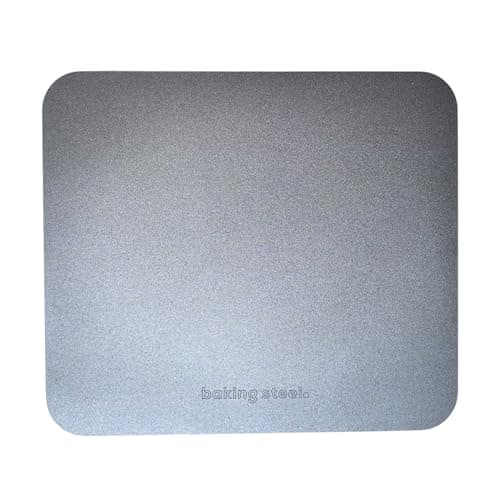
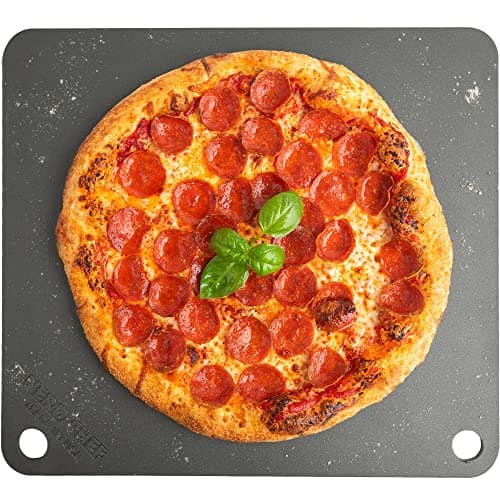
Baking Steel Original, 16 x 14 x 1/4
A quarter inch is the thickness where a steel stops being a novelty and stays a thing you can still lift. Its advantage over a stone is not preheat speed - it is what happens one second after the base lands.
The same quarter-inch plate, from the one maker in this category that states conductivity and heat capacity as two separate numbers instead of mashing them into one slogan.
Cast iron sits within about 5 percent of carbon steel on every thermal number that matters, costs a fraction of a steel, and has handles. The catch is that this is a pan with a rim, not a flat plate you can slide a pizza onto.
#ad We hold no verified live price for this product, so we show none. How this site is funded.
Questions
Frequently asked
Is a baking steel worth the money over a pizza stone?+
For thin, crisp bases, yes - carbon steel transfers heat into the base about 8.5 times harder than cordierite. For bread, for gentler bakes and for anyone who struggles with 15 pounds, the stone is the better buy.
Will a baking steel work in a normal home oven?+
Yes, provided the oven genuinely reaches about 500 F. The steel amplifies whatever heat the cabinet supplies; it cannot manufacture any. Check your oven with a thermometer before you spend, because domestic thermostats drift by 50 F or more.
How long does a baking steel take to preheat?+
About 27 minutes to reach 95 percent of oven temperature for a quarter-inch plate on our model, against Baking Steel's own published guidance of 45 to 60 minutes for the whole oven to settle. Either way, longer than the oven's beep.
Is cast iron as good as a baking steel?+
Thermally it is within about 5 percent - effusivity 13,002 against 13,625. What you give up is geometry: a pan has a rim, so launching from a peel is awkward. As a way to test whether a surface upgrade would help you, it is free and conclusive.
Quarter inch or half inch?+
Quarter inch for almost everyone: 15 lb and about 27 minutes, against 32 lb and about 54 minutes for the half inch. The extra mass only pays off when you are baking several pizzas back to back.
Sources
Every number on this page came from one of these, or from arithmetic on one of these that we showed in full.