Heads up: some links on this page are affiliate links. If you buy through one we may earn a commission at no extra cost to you. It never changes a ranking, and we accept no payment for placement. The full version.
What this review is
We have not baked on this plate. What makes it worth reviewing anyway is that Baking Steel publishes a preheat procedure - a figure almost nobody in this category states - which means it is the one product on this site where a maker's own guidance can be checked against an independent model. The method is on the methodology page.
What we did not do
We have not baked on any of these. Every guide in this category says it tested a dozen stones; we would rather say plainly that we did not. What we did instead is on this page in full: published specs with their sources, thermal arithmetic from material constants with the working shown, and the makers' own manuals read rather than paraphrased.
The published specification
Specification
Published figure
Dimensions
16" x 14" x 1/4" (6.35 mm)
Weight
15 lb
Material
Solid carbon steel, seasoned by hand with flax oil
Preheat guidance
45 to 60 minutes at 500 to 550 F
The preheat figure is the reason to trust the rest
Run our lumped-capacitance model on the published 15 lb - mass times specific heat capacity over surface heat transfer, with h taken as 20 W/m2.K - and a quarter-inch plate reaches 95 percent of oven temperature in about 27 minutes and 99 percent in about 41.
Baking Steel says 45 to 60 minutes. Those two numbers are not in conflict; they bracket each other. Our figure is when the plate itself has effectively arrived. Theirs is when the plate, the oven walls and the cabinet air have all settled, which is the state you actually bake into.
41 vs 45-60 min
Our computed time to 99 percent of oven temperature, against the maker's published guidance
Two completely independent routes - a textbook heat-transfer model and a manufacturer's own instruction - landing in the same place. It is the closest thing to validation available to a site that owns none of this equipment.
That agreement is why we use this plate as the anchor for every preheat figure on the site, including the ones for products whose makers publish nothing - the full working is in the preheat guide.
The published weight, which does not quite check out
The same arithmetic that validates the preheat figure raises a small question about the weight. A 16 by 14 by quarter-inch plate of carbon steel at a published density of 7,900 kg/m3 works out to 15.98 lb. Baking Steel publishes 15.
That is a 6 percent gap. For comparison, NerdChef's published 16 lb for a near-identical plate lands within 2 percent of its own dimensions - the detail is in the NerdChef review.
The likely explanations are dull: a rounded-down nominal figure, or stock that runs slightly under nominal thickness, both of which are normal in hot-rolled steel. It is not evidence of anything wrong. It is worth stating because this site checks published numbers, and checking means reporting the ones that come out imperfect as well as the ones that do not.
What 15 pounds and a quarter inch actually give you
Carbon steel computes to a thermal effusivity of 13,625 against a cordierite stone's 1,612 - a factor of 8.5 on the property that decides how far the contact patch falls when a cold base lands. That, and not conductivity or stored energy, is what a steel is for; the derivation is in stone versus steel.
At 500 F the plate holds roughly 0.21 kWh, and the quarter-inch thickness is the point on the curve where a steel stops being a novelty and remains something one person can lift. The half-inch tier is 32 lb and nearly an hour of preheat, which the thickness guide argues almost nobody needs.
Fifteen published pounds of hot-rolled carbon steel. The specification that matters most is not on the plate at all - it is the instruction to wait 45 minutes.
The honest downsides
Fifteen pounds at chest height. Into a 500 F oven, repeatedly. If that is marginal for you now it will not improve, and the surface you actually use beats the one that wins on paper.
Seasoning is your problem. It ships pre-seasoned with flax oil and it is still bare carbon steel: keep it dry, wipe on a very thin film of oil, never leave it wet. Less work than the internet suggests, not zero.
No published temperature ceiling. NerdChef publishes 1000 F for its plates. Baking Steel publishes preheat guidance and no maximum, which is irrelevant in a domestic oven and a real gap if you intend to put it over live fire - see the grill steel roundup.
It costs more than the alternatives. Cast iron reaches 95 percent of carbon steel's effusivity for a fraction of the money, and gives up the flat geometry to do it.
Who should buy it
Buy it if you want the plate whose maker tells you how to use it, you bake thin pizza weekly, and 15 pounds is comfortable.
Buy the NerdChef instead if you want a published temperature ceiling, a lifetime guarantee and a slightly deeper plate for a little less money.
Buy the Lodge cast iron pan instead if you want most of the physics for a fraction of the outlay and you can live with a rim.
Buy nothing yet if you have not ruled out a short preheat or an oven running cold - both free to check, and both more often the cause than the surface is. The diagnostic is in what to upgrade next.
The verdict
The plate that deserves its reputation, for a reason that has little to do with the steel: its maker publishes an instruction most of this category refuses to, and that instruction survives being checked. The weight is rounded optimistically and there is no published ceiling. Everything else about it is exactly what it claims.
The picks
What we would buy
Baking Steel
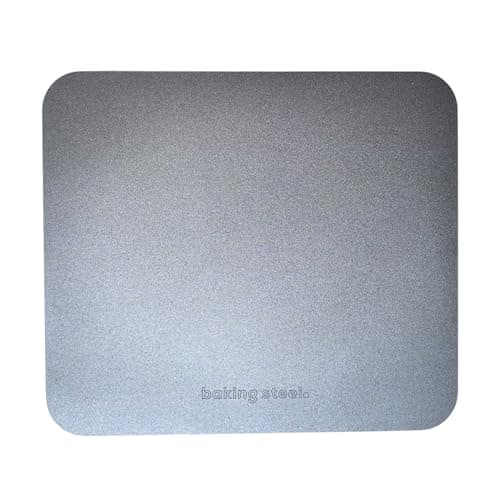
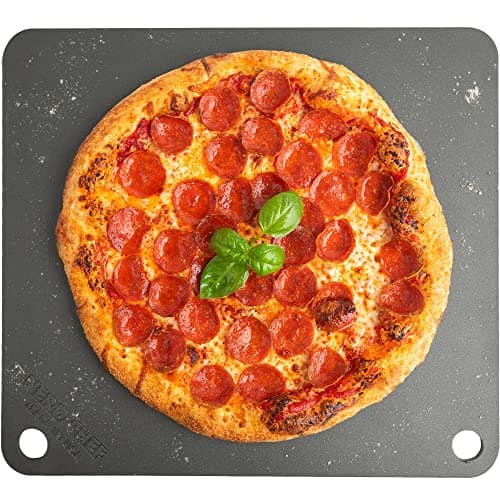
Baking Steel Original, 16 x 14 x 1/4
A quarter inch is the thickness where a steel stops being a novelty and stays a thing you can still lift. Its advantage over a stone is not preheat speed - it is what happens one second after the base lands.
The same quarter-inch plate, from the one maker in this category that states conductivity and heat capacity as two separate numbers instead of mashing them into one slogan.
Cast iron sits within about 5 percent of carbon steel on every thermal number that matters, costs a fraction of a steel, and has handles. The catch is that this is a pan with a rim, not a flat plate you can slide a pizza onto.
#ad We hold no verified live price for this product, so we show none. How this site is funded.
Questions
Frequently asked
How long should you preheat a Baking Steel?+
Baking Steel publishes 45 to 60 minutes at 500 to 550 F. Our own model puts the plate itself at 99 percent of oven temperature in about 41 minutes, so the two agree - the extra time lets the oven walls and air settle as well.
Is the Baking Steel Original worth it over a cheaper steel?+
All quarter-inch carbon steel plates bake alike. What you are paying for here is a maker that publishes a preheat procedure and hand-seasons the plate. NerdChef publishes a temperature ceiling and a lifetime guarantee instead, for slightly less.
Does it really weigh 15 pounds?+
Its own published dimensions imply 15.98 lb in carbon steel, so the 15 lb figure is about 6 percent optimistic - most likely rounding or stock running under nominal thickness. Either way, plan for something close to 16 pounds in your hands.
Can you use it on a grill?+
Steel cannot be thermally shocked, so a grill is not a risk to the plate. Baking Steel publishes no maximum temperature, which is the gap worth knowing before you put it over charcoal.
How do you season and store it?+
It arrives seasoned with flax oil. Keep it dry, wipe a very thin film of oil after any wet clean, and leave it in the oven if you can - a plate that lives on the rack sees fewer handling risks and is always ready.
Sources
Every number on this page came from one of these, or from arithmetic on one of these that we showed in full.