Heads up: some links on this page are affiliate links. If you buy through one we may earn a commission at no extra cost to you. It never changes a ranking, and we accept no payment for placement. The full version.
The shortlist
Ranked, with the working
Ranked on published manufacturer specifications and, where the numbers exist, our own arithmetic on what each option does thermally. Tap any row for the full write-up, including who should skip it.
#
Product
Best for
Score
Price
01
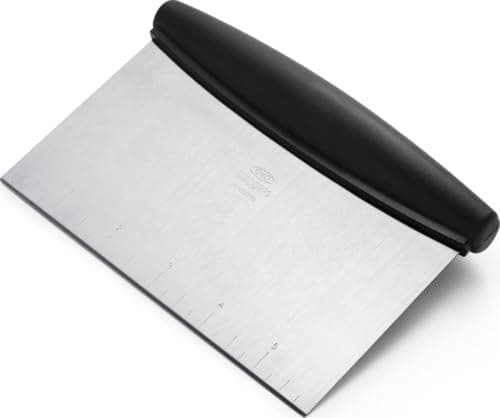
OXO Good Grips Bench Scraper and ChopperDividing a bulk batch into balls without deflating them
Scores are ours and editorial. They are never published as review or rating markup, because we have not baked on these products - here is how we pick.
Two tools, not one
A bench scraper is a rigid steel blade with a handle along the top. It divides dough, lifts a sticky ball off the counter in one piece, and clears the counter afterwards. Rigidity is the point: it cuts through a proofed ball rather than squashing it. If you are deciding between the two materials rather than between models, plastic versus metal sets out which jobs each one physically can and cannot do.
A bowl scraper is a flexible plastic curve with no handle. Its job is getting a wet dough out of a round bowl, which a straight rigid blade cannot do because it cannot follow the curve. Flexibility is the point.
They are not substitutes. Most people own the first and improvise the second with a spatula, which is why a third of a high-hydration dough ends up in the sink.
6 x 4 in
Blade dimensions of the bench scraper we would buy first
Six inches wide is enough to divide a domestic batch in one pass; four inches deep is enough to get right under a proofed ball and lift it whole.
What actually differs between bench scrapers
Blade depth. Six by four inches lifts more at once than six by three, and gets further under a ball before the handle gets in the way. This is the specification worth comparing and the one least often published.
Stiffness. A blade that flexes when you lean on it will not cut cleanly through a proofed ball. Commercial blades are noticeably stiffer than domestic ones.
Markings. Inch markings etched along the blade let you divide a slab of dough evenly without a ruler. It sounds like a gimmick and it is the feature we use most.
Handle. Anything you can lean on with a wet hand. A slim rolled-steel handle is uncomfortable at the pressure a proper counter-clear takes.
What we did not do
We have not baked on any of these. Every guide in this category says it tested a dozen stones; we would rather say plainly that we did not. What we did instead is on this page in full: published specs with their sources, thermal arithmetic from material constants with the working shown, and the makers' own manuals read rather than paraphrased.
The four things a bench scraper is for
1. Dividing. Press straight down through the dough in one movement. Never saw - dragging tears gluten and the ball never quite recovers its shape.
2. Lifting. Slide it flat under a ball that has stuck, keeping the blade almost parallel to the counter. Nothing else lifts a proofed ball without deforming it.
3. Shaping. Use the edge to push a ball against the counter and tighten its surface. Two or three pushes turns a slack lump into a taut ball.
4. Cleaning. A dried dough film scrapes off a counter in seconds and fights a cloth for minutes.
Divide by weight, not by eye - and cut straight down. A sawing cut tears gluten and the ball never fully rounds up again.
Steel on your counter
A steel blade will mark a soft surface. Laminate, painted wood and some solid-surface composites all scratch; granite, quartz, stainless and a wooden board do not care. If your counter is soft, work on a board - which also lets you scrape hard without thinking about it.
What we would skip
Scrapers with a wooden handle glued on. They come apart, and the joint traps dough.
Very large scrapers. Anything much over 6 inches is a commercial tool for a commercial bench and is unwieldy on a domestic counter.
Sets that bundle a bench scraper with novelty cutters. You need two shapes and the rest is drawer clutter.
In full
Every pick, with the specs and the sources
01 / Best overall
OXO
8.8/10
OXO Good Grips Bench Scraper and Chopper
Six inches of stainless with inch markings etched into it. It divides dough, it lifts dough, and it measures the divisions - which is more than most single-purpose dough tools manage.
What it does well
Inch markings on the blade, so you can cut evenly without a ruler
Rigid enough to lift a whole ball off the counter cleanly
Non-slip handle stays usable with wet hands
Dishwasher safe
What it does not
Too rigid to scrape a bowl
Steel will scratch a soft counter finish
A six-inch blade is short for dividing a large bulk batch in one pass
Skip it if
You want a flexible bowl scraper. A rigid steel blade cannot follow the curve of a bowl, and that is a different tool.
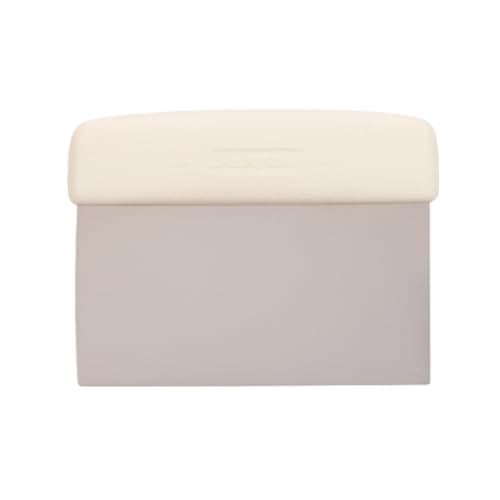
Dexter-Russell Sani-Safe 6 x 3 Dough Cutter and Scraper
A commercial bench scraper with a 6 by 3 inch high-carbon stainless blade and a molded handle you can lean on. No measurement markings, and a stiffer blade than the domestic ones.
What it does well
Stiffer than most domestic bench scrapers, so it clears a counter in one pass
Molded commercial handle takes real downward pressure without flexing
High-carbon stainless holds an edge that cuts through a proofed ball rather than squashing it
What it does not
No inch markings, so even division is by eye
3 inches of blade depth is shallower than the OXO, so it lifts less at once
Sold mostly through restaurant-supply channels, so sizing information varies by listing
Skip it if
You want inch markings to divide by eye. This one is a working blade with nothing printed on it.
Stock photo of the product type, not this model. We publish no product photography we cannot source.
OXO
8.2/10
OXO Good Grips 2-Piece Bowl Scraper Set
Flexible plastic, which is the half of the job a rigid steel bench scraper cannot do. The bean shape follows the curve of a bowl; the paddle gets into the corner of a mixer.
What it does well
Follows the curve of a bowl, so a high-hydration dough actually comes out
Will not scratch a bowl, a counter or a non-stick surface
Two shapes covers round bowls and mixer bowls
Costs almost nothing and lasts indefinitely
What it does not
Cannot divide dough cleanly
Too flexible to lift a proofed ball without deforming it
Small enough to disappear into a drawer
Skip it if
You want to divide dough or lift a ball off the counter. Flexible plastic cannot cut and cannot lift cleanly - that is what the steel one is for.
#ad We hold no verified live price for this product, so we show none. How this site is funded.
Questions
Frequently asked
Do I need a bench scraper for pizza dough?+
It is the cheapest tool that measurably changes how dough behaves. Dividing without tearing and lifting a proofed ball without deforming it are both hard by hand and trivial with a blade.
What is the difference between a bench scraper and a bowl scraper?+
Rigidity. A bench scraper is stiff steel that divides and lifts; a bowl scraper is flexible plastic that follows the curve of a bowl. They do opposite jobs and you want both.
Metal or plastic dough scraper?+
Metal to divide and lift, plastic to clear a bowl. If your counter is a soft laminate, work on a board rather than switching to a plastic bench scraper, which will not cut cleanly.
Can I use a dough scraper to cut pizza?+
On a pan pizza in the tin, yes, and it is gentler on the pan than a wheel. On a round pizza on a board a proper cutter is better, because a straight blade pressed down through a crisp base tends to compress it.
Sources
Every number on this page came from one of these, or from arithmetic on one of these that we showed in full.