Heads up: some links on this page are affiliate links. If you buy through one we may earn a commission at no extra cost to you. It never changes a ranking, and we accept no payment for placement. The full version.
Buy metal if you divide dough, lift proofed balls or clear a floured counter - a rigid steel blade is the only thing that cuts cleanly and scrapes a bench flat. Buy plastic if your problem is wet dough clinging to the inside of a bowl, because a flexible blade follows a curve and a rigid one cannot. They cost so little that the real answer for most kitchens is one of each.
The distinction, in one line each
Metal is a blade. Rigid, straight-edged, and stiff enough to lean on. It divides a bulk dough into portions in one press, lifts a slack ball off the counter without stretching it, and clears stuck flour and dough off a work surface in a single pass.
Plastic is a squeegee. Flexible, usually curved on one edge, and unable to cut anything. Its whole job is contact with a shape that is not flat: the inside of a mixing bowl, the corner of a stand mixer bowl, the side of a proofing tub.
Once you put it that way, most buying mistakes in this category explain themselves. A steel bench scraper leaves a third of a 70 percent hydration dough welded to the bowl, because a straight rigid edge only ever touches a curved bowl at one point. A plastic scraper folds when you try to divide with it.
What we did not do
We have not baked on any of these. Every guide in this category says it tested a dozen stones; we would rather say plainly that we did not. What we did instead is on this page in full: published specs with their sources, thermal arithmetic from material constants with the working shown, and the makers' own manuals read rather than paraphrased.
What we compared them on
Rigidity. The property that decides whether a tool can divide and lift, and the same property that decides whether it can follow a curve. You cannot have both in one blade.
Edge. A steel scraper has a straight cutting edge; a plastic one has a rounded working edge that will not cut dough and will not mark a surface.
What it touches. This is the part that costs people money. Metal on a non-stick bowl, a glazed ceramic dish or a seasoned steel is a scratch waiting to happen. Plastic is safe on everything and useless on a bench.
Cleaning and hygiene. Both go in a dishwasher. A metal blade with a riveted handle has a seam that traps dough; a one-piece plastic scraper has nowhere for anything to hide, which is why commercial kitchens keep both.
Markings. Some steel scrapers print inch or centimeter rules along the blade. Useful for dividing by eye, absent on most commercial blades - the Dexter-Russell we rank publishes explicitly that its blade is unmarked.
Jobs, and which tool actually does them
Job
Metal
Plastic
Dividing bulk dough into balls
Yes - one press, clean cut
No - it folds
Lifting a proofed ball off the counter
Yes
Deforms the ball
Clearing a floured bench
Yes - the job it was made for
Poorly
Getting wet dough out of a mixing bowl
Leaves a third behind
Yes - the job it was made for
Scraping a stand mixer bowl corner
Risks the finish
Yes, with the straight paddle
Working on non-stick or glazed surfaces
No
Yes
Two tools
What a 70 percent hydration dough asks for, and what most people buy half of
The wetter the dough, the more the split matters. At 60 percent you can get away with one steel blade; at 70 the bowl work is a different tool's job entirely.
Hydration is what decides how much you need the plastic one
A stiff 58 to 62 percent dough comes out of a bowl in one piece and barely sticks to anything. Move up to 65 or 70 percent - the range that gives the open, blistered rim most people are chasing - and the dough becomes something that clings to every curved surface it touches. The full picture is in the hydration guide.
That is the honest trigger for buying the plastic one: not preference, but the hydration you have settled on. Below about 63 percent it is a convenience. Above it, it is the difference between using your whole dough and throwing away a portion of it every bake.
A rigid edge and a flat bench. Change either one - a curved bowl, a non-stick surface - and this is the wrong tool.
Within metal: stamped, commercial and marked
Not all steel scrapers are the same, and two differences matter.
Stiffness. A thin stamped blade flexes when you lean on it, which turns a single clean pass into three passes. The commercial blades - the Dexter-Russell here is 6 by 3 inches of high-carbon stainless with a molded handle - do not flex, and you feel it immediately on a floured bench.
Markings. An inch or centimeter rule printed along the blade lets you cut a bulk dough into even portions by eye rather than by scale. It is genuinely useful if you divide often, and entirely absent from most commercial blades. Neither approach is better - it is a question of whether you weigh every ball, which the dough ball weight chart argues you should.
Within plastic: shape is the only real variable
A curved "bean" follows a round mixing bowl. A straight paddle reaches into the corner where a stand mixer bowl meets its base, and into square proofing tubs. Sets that include both exist for the price of a coffee, which is why we rank a two-piece set rather than a single shape.
The one thing to check is thickness. Very thin plastic scrapers flex so much that they stop transmitting any force at all; a scraper needs to be flexible in one direction and stiff enough to push with.
What each one damages
Metal damages surfaces. A steel edge on a non-stick bowl, a glazed ceramic dish or the seasoning of a carbon steel plate removes exactly what you paid for. The one exception worth naming: a bare wooden or composite bench, where a steel scraper is the correct cleaning tool.
Plastic damages nothing and wears out. The working edge rounds off over a few years of use, at which point it stops clearing a bowl cleanly. That is a consumable rather than a fault.
Neither belongs on a hot baking surface. Scraping a stone or a steel is covered in how to clean a pizza stone - the short version is a brush, not a blade.
The verdict
Buying one, and you make dough: metal. Dividing and bench work are the jobs that have no substitute, and a bowl can be scraped with a spatula at a pinch.
Buying one, and you mostly mix in a bowl or a stand mixer: plastic, and accept that you will divide with a knife.
Buying both: the right answer, and it costs less than a bag of good flour. The ranked picks across both types are in the dough scraper roundup.
The picks
What we would buy
OXO
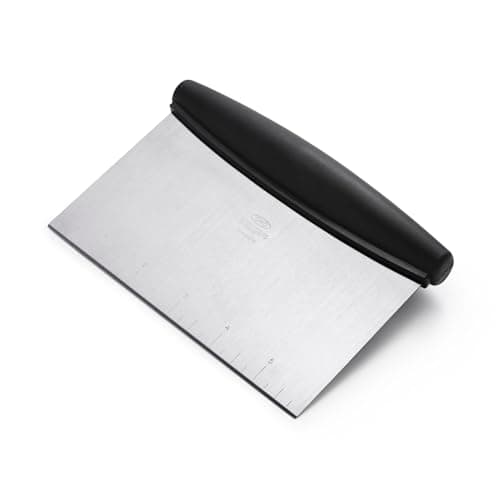
OXO Good Grips Bench Scraper and Chopper
Six inches of stainless with inch markings etched into it. It divides dough, it lifts dough, and it measures the divisions - which is more than most single-purpose dough tools manage.
Flexible plastic, which is the half of the job a rigid steel bench scraper cannot do. The bean shape follows the curve of a bowl; the paddle gets into the corner of a mixer.
#ad We hold no verified live price for this product, so we show none. How this site is funded.
Dexter-Russell
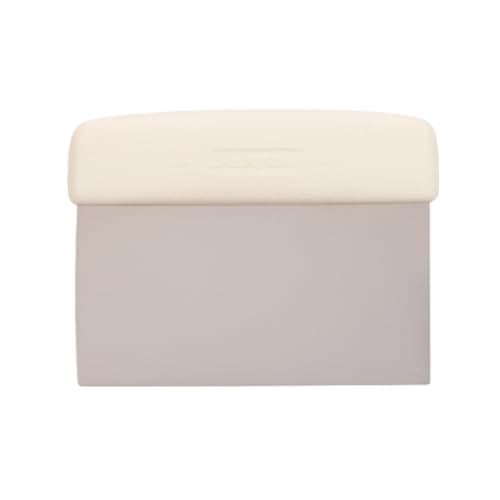
Dexter-Russell Sani-Safe 6 x 3 Dough Cutter and Scraper
A commercial bench scraper with a 6 by 3 inch high-carbon stainless blade and a molded handle you can lean on. No measurement markings, and a stiffer blade than the domestic ones.
Metal if you divide dough, lift balls or clear a bench - those jobs need a rigid blade. Plastic if wet dough sticking inside a bowl is your problem, because only a flexible edge follows a curve. Most kitchens want one of each.
Can a metal bench scraper scratch things?+
Yes - non-stick bowls, glazed ceramic and the seasoning on a carbon steel plate all suffer from a steel edge. On a bare wooden or composite bench it is the right tool.
Is a bench scraper the same as a dough cutter?+
Same tool, two names. A rigid rectangular blade with a handle along the top edge - some listings call it a bench knife or a dough cutter, and some print a ruler along the blade.
Do I need a scraper at all if I have a knife?+
A knife divides but cannot clear a bench or lift a slack ball without stretching it. If you only ever make one or two balls at a time you can manage; past that the scraper stops being optional.
Which one for high-hydration dough?+
Both, and the plastic one becomes genuinely necessary somewhere around 65 percent hydration - that is where dough stops leaving a bowl by itself and starts leaving a portion of itself behind.
Sources
Every number on this page came from one of these, or from arithmetic on one of these that we showed in full.