Heads up: some links on this page are affiliate links. If you buy through one we may earn a commission at no extra cost to you. It never changes a ranking, and we accept no payment for placement. The full version.
The shortlist
Ranked, with the working
Ranked on published manufacturer specifications and, where the numbers exist, our own arithmetic on what each option does thermally. Tap any row for the full write-up, including who should skip it.
#
Product
Best for
Score
Price
01
Ooni Pizza Dough Proofing Boxes, Set of 2A household making four to twelve dough balls at a time
Scores are ours and editorial. They are never published as review or rating markup, because we have not baked on these products - here is how we pick.
Measure your fridge before you read any further
The vertical gap between two shelves in a domestic fridge is typically 8 to 10 inches. The usable depth is around 18. Those two numbers decide this entire category, and almost no roundup in it mentions either.
The 6-quart Cambro round that every pizza forum recommends is 10 7/8 inches tall. The Winco dough box that appears in most published lists is 25 5/8 inches wide. Both are excellent products for the kitchens they were designed for, and both are the wrong shape for a domestic fridge.
10 7/8 in
Published height of the 6-quart container most guides recommend
Against a typical domestic fridge shelf gap of 8 to 10 inches. It is not a bad container. It was designed for a walk-in cooler.
How we ranked
1. Fridge fit. Height first, then footprint. A container that has to displace a whole shelf gets used twice and then abandoned.
2. Balls per week. One or two balls: individual tubs, one per ball. Four to twelve: a shallow stackable tray. More than that and you genuinely are in dough-box territory, in which case measure your shelf and consider a garage fridge.
3. Shape, for the dough's sake. A ball roughly doubles in volume as it proofs and relaxes sideways as the gluten slackens. A tall narrow vessel forces it upward into a dome that never relaxes into a disc; a wide shallow one lets it spread the way you want it to. Working rule: at least twice the height of the seated ball, and at least 1.5 times its diameter across. For a 280 g ball that seats at about 4 inches across and 1.5 inches tall, that means roughly 6 inches across and 3 inches deep.
4. Visibility. Being able to see the side of the ball tells you far more about the ferment than the top does - you can read the bubble structure through a clear wall. Opaque polypropylene is tougher and cheaper; clear polycarbonate tells you more.
What we did not do
We have not baked on any of these. Every guide in this category says it tested a dozen stones; we would rather say plainly that we did not. What we did instead is on this page in full: published specs with their sources, thermal arithmetic from material constants with the working shown, and the makers' own manuals read rather than paraphrased.
Individual tubs or one shared tray?
Individual tubs keep balls perfectly round, let you take one out without disturbing the others, and stack. They also take up more total shelf area, and each one is a lid to lose.
A shared shallow tray is far more space-efficient and is what pizzerias use, but balls proofing side by side will grow into each other, and separating two joined balls degasses both. Leave a ball's width between them, and accept that a full tray means fewer balls than the maker's count suggests - the Ooni dough boxes review takes that count apart and converts it into grams.
Balls relax sideways as the gluten slackens. Anything that stops that happening gives you a dome that fights back when you stretch it.
What we would skip
Anything over about 5 inches tall for individual balls. You are buying headroom you do not need and shelf height you do not have.
Glass. Heavy, breakable, and no thermal advantage - a fridge equalizes everything overnight regardless of what the vessel is made of.
Dedicated electric proofing boxes, unless your kitchen genuinely sits below about 65 F in winter. For everyone else the oven with the light on, or the top of the fridge, does the same job for nothing.
Cling film over a bowl, as a permanent solution. It works, it wastes a sheet of plastic per ball per proof, and it seals badly enough that the surface skins.
In full
Every pick, with the specs and the sources
01 / Best for four or more balls
Ooni
8.9/10
Ooni Pizza Dough Proofing Boxes, Set of 2
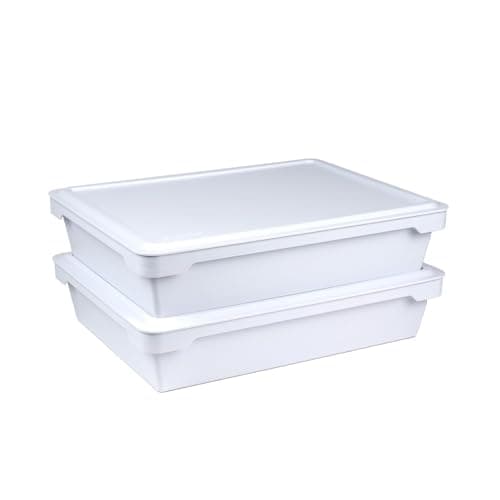
Shallow, stackable and 3.7 inches tall, which makes this the only dough box here that clears a domestic fridge shelf. The maker publishes both the dimensions and the dough-ball count, which is more than the restaurant-supply options manage.
What it does well
3.7 inches tall, so it slides under a normal fridge shelf
Stacks, which is the only reason dough boxes exist
The maker publishes a dough-ball count, so you can size a batch before you buy
Shallow enough that balls relax sideways into discs instead of doming
What it does not
16.7 inches wide still demands a mostly clear shelf
Two boxes is more than a two-ball household needs
No published temperature range, so freezer use is a guess we will not make
Skip it if
You bulk-ferment in one mass rather than portioning into balls. A 3.7-inch tray is the wrong shape for a rising bulk dough - that wants a tall lidded container.
The container every pizza forum recommends, with the dimension none of them quote: it is nearly 11 inches tall. Measure your fridge shelf before you buy it.
What it does well
Graduations molded into the wall, so you can read the rise without guessing
Clear polycarbonate: you can see the bubble structure from the side
Genuinely unbreakable in domestic use
-40 F to 210 F covers freezing dough as well as proofing it
What it does not
10 7/8 inches tall will not clear most domestic fridge shelves
One vessel means bulk fermenting, not individual balls
Foodservice sizing throughout - the 6 qt is the smallest that is still useful
Skip it if
Your fridge shelves are spaced under 11 inches, which most domestic fridges are. This is a foodservice vessel and it was designed for a walk-in.
#ad We hold no verified live price for this product, so we show none. How this site is funded.
04 / Only if you have a spare fridge
Stock photo of the product type, not this model. We publish no product photography we cannot source.
Winco
6.4/10
Winco PL-3N Pizza Dough Box, 25 5/8 x 18 x 3 1/4
This is the box every proofing-box guide recommends, and it is 25 5/8 inches wide. That is wider than most domestic fridge shelves are deep. We list it so you can see the trap before you fall into it.
What it does well
Stacks, which is the entire reason dough boxes exist
Three and a quarter inches is genuinely the right depth for proofed balls
NSF listed and effectively indestructible
What it does not
25 5/8 inches wide. Measure your shelf. Then measure it again
Holds far more dough than a household makes
The lid is a separate purchase in most listings
Skip it if
It is going in a kitchen fridge. Measure the shelf first - the internal depth of a standard 36-inch American fridge is around 18 inches, so this only ever goes in sideways, on a completely clear shelf.
#ad We hold no verified live price for this product, so we show none. How this site is funded.
Questions
Frequently asked
Do I need a proofing box or will containers do?+
Containers, for almost every household. A dough box earns its space at roughly a dozen balls at a time; below that it is mostly empty tray taking up a whole shelf. Full comparison.
What size container for one pizza dough ball?+
About 6 inches across and 3 inches deep for a 250 to 300 g ball - roughly twice the seated height and 1.5 times the seated diameter. A 2-quart round at 8 3/16 inches across and 4 3/16 tall is comfortably inside that.
Should proofing containers be airtight?+
Sealed enough that the surface does not dry and skin, not so sealed that pressure builds. A snap lid that is not fully pressed down on one corner is the usual answer, and it is what most people do without thinking about it.
Can I proof dough in the container I ferment it in?+
You can bulk-ferment and then ball into separate containers, which is the usual sequence, or do both in one shallow tray. What you cannot do well is bulk-ferment in a shallow tray - a rising bulk mass wants height.
Is polycarbonate safe for dough?+
Commercial food-storage polycarbonate is made for exactly this and the containers here publish temperature ranges down to -40 F. If you would rather avoid polycarbonate, polypropylene versions of the same containers exist and cost less; you lose the clarity.
Sources
Every number on this page came from one of these, or from arithmetic on one of these that we showed in full.