Heads up: some links on this page are affiliate links. If you buy through one we may earn a commission at no extra cost to you. It never changes a ranking, and we accept no payment for placement. The full version.
Before you touch it
Three things decide whether this goes well, and all three happen before your hands are involved.
Temperature. The ball needs one to two hours out of the fridge, until it is around 65 F. Cold gluten does not extend. This is the single most common reason dough will not open, and it is not a technique problem.
Proof. A properly proofed ball has relaxed. Poke it half an inch with a floured finger: springs straight back, needs longer; fills in slowly leaving a shallow mark, ready; does not come back at all, overproofed.
Shape. A ball that has been sitting flat as a disc opens far more easily than one that has domed up in a narrow container. This is why container shape matters - the container roundup covers it.
The six steps
Flour the counter lightly and lift the ball out with a bench scraper. Under, not around - grabbing a proofed ball with your fingers degasses it before you have begun.
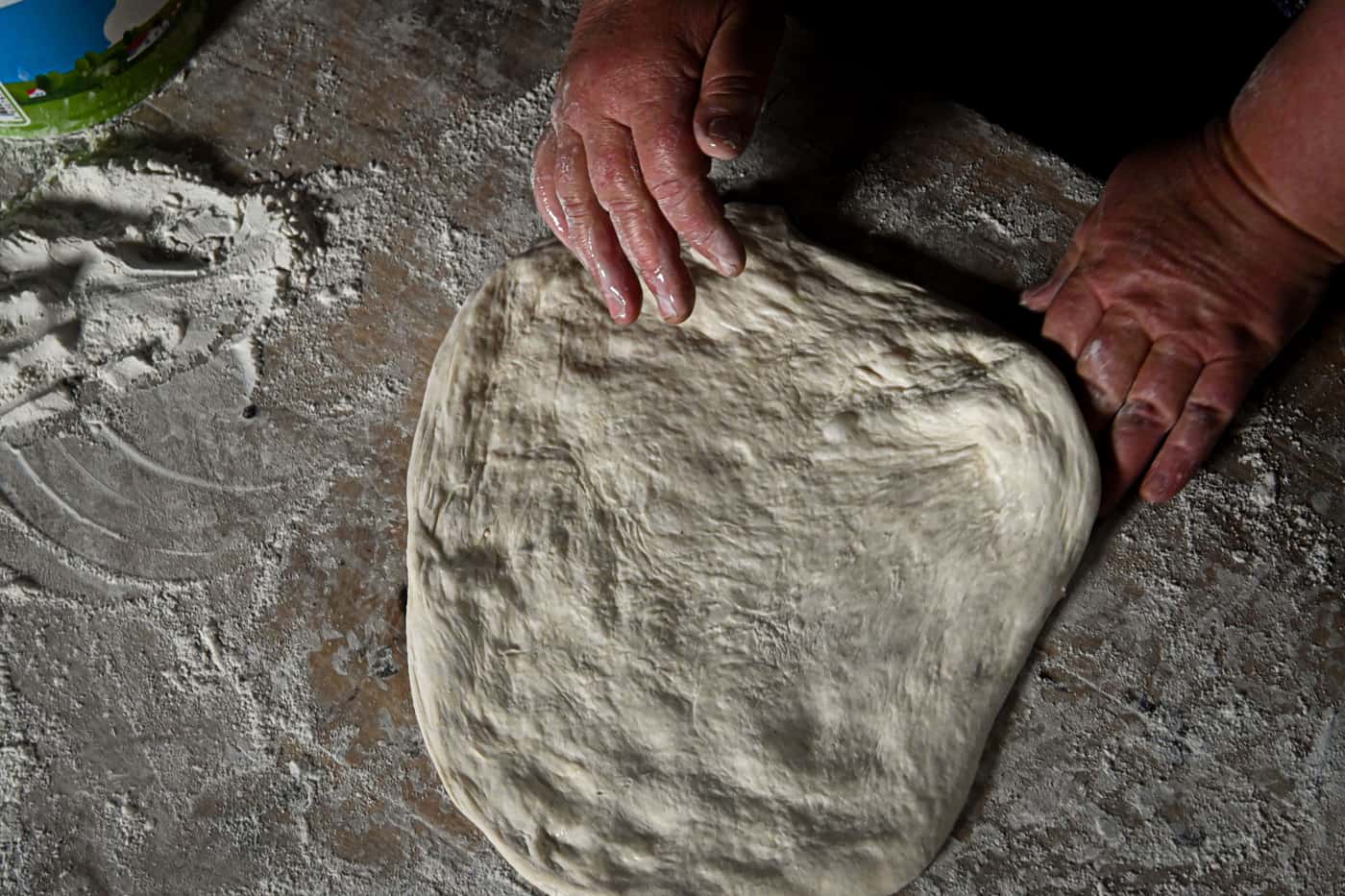
Press from the center outward with your fingertips, leaving a clear half-inch to inch untouched at the edge. That untouched ring keeps its gas and becomes the cornicione. Work to about 6 inches.
Flip it over and repeat. Both faces get the same treatment, which keeps the thickness even.
Move to the backs of your hands. Drape the disc over both fists, knuckles up, and rotate it slowly, letting gravity pull it outward as you move your hands apart. Gravity does the work; your hands only steer.
Finish on the counter. Lay it down, and use a gentle outward pull from underneath at any spot that is still thick. Hold it up to a light - you should see an even translucence with no windows.
Move it straight to the peel. A stretched base left on a counter starts sticking immediately. Launching guide.
65 F
The dough temperature at which stretching stops being a fight
One to two hours out of the fridge. Nearly every 'my dough will not stretch' problem is a cold dough problem wearing a technique costume.
Why not a rolling pin
A rolling pin compresses the dough and drives out the gas the ferment produced. That gas is what becomes the open crumb and the puffed cornicione - crushing it gives a flat, dense, uniform base.
It also stretches the gluten in one direction rather than radially, which makes the base shrink back unevenly in the oven.
The exception is genuinely cracker-thin styles, where a dense base is the point. For anything with a cornicione, hands only.
When it springs back
Cold. Give it another 30 to 60 minutes on the counter.
Underproofed. Same fix, more time.
You have been working it too long. Handling tightens gluten. Set it down, cover it, and walk away for 15 minutes - it will relax and open in half the time.
Nothing here is fixed by pulling harder. Pulling harder is how you get a hole. The four causes in full, ranked by how often each is the real one, are in why pizza dough shrinks back.
A ball that has relaxed into a low dome opens easily. One that is still a tight sphere has not had enough time, and no technique substitutes for that.
When it tears
A hole in the middle means it went too thin there - usually from pressing from the middle rather than working outward evenly. Pinch it closed, let it rest two minutes, and carry on more gently.
Tearing at the edge of your knuckles means the dough is over-fermented and the gluten has broken down. That ball will not stretch properly however careful you are - use it as a flatbread and check your timing.
Tearing everywhere usually means the dough was too wet for its flour, or it was under-mixed. Neither is fixable at this stage.
Getting a round pizza
Rotate constantly rather than pulling in one direction. Rotate the dough on your knuckles, on the counter, and again when it lands on the peel. Almost nobody makes perfectly round pizzas at home and it does not affect the eating at all.
What we did not do
We have not baked on any of these. Every guide in this category says it tested a dozen stones; we would rather say plainly that we did not. What we did instead is on this page in full: published specs with their sources, thermal arithmetic from material constants with the working shown, and the makers' own manuals read rather than paraphrased.
The picks
What we would buy
OXO
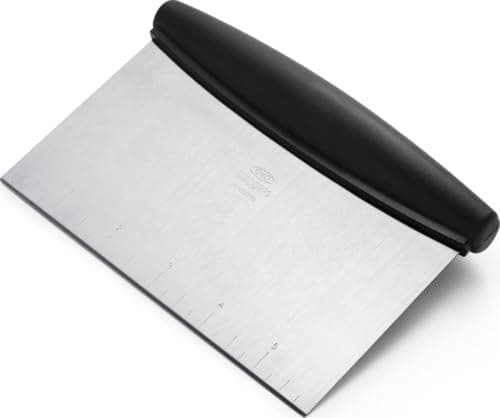
OXO Good Grips Bench Scraper and Chopper
Six inches of stainless with inch markings etched into it. It divides dough, it lifts dough, and it measures the divisions - which is more than most single-purpose dough tools manage.
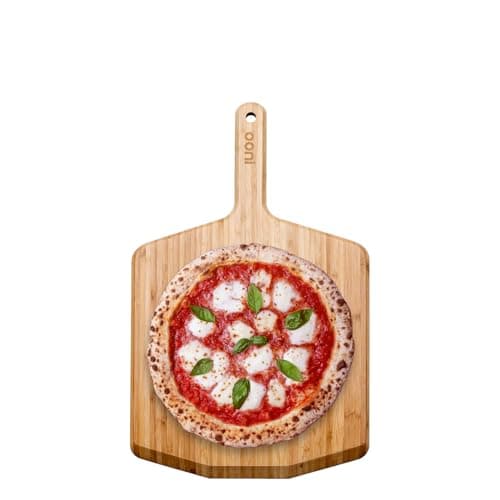
Wood is the surface a raw base does not stick to, which makes this the thing you build on. It is also a serving board, which is the only honest reason a peel should be pretty.
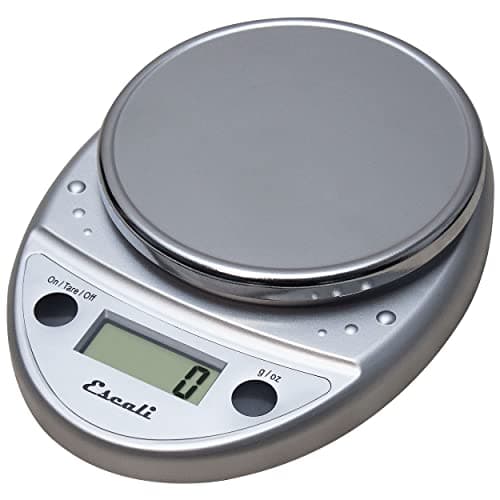
Eleven pounds of capacity at one-gram resolution, which is exactly right for flour and dough balls and exactly wrong for yeast. Know which half of your recipe it is for.
How do you stretch pizza dough without a rolling pin?+
Press from the center outward with your fingertips leaving the edge untouched, then drape the disc over the backs of your fists and rotate, letting gravity pull it outward. Finish flat on the counter.
Why does my pizza dough keep springing back?+
Almost always cold or underproofed dough. Take balls out one to two hours before you bake and let them reach about 65 F. If it still fights, cover it and rest 15 minutes - handling tightens gluten.
Can I use a rolling pin for pizza dough?+
You can, and you will crush the gas out of it. That gives a flat, dense base with no puffed edge. It is the right tool only for genuinely cracker-thin styles.
How thin should pizza dough be stretched?+
Thin enough to be evenly translucent when held up to a light, with no windows, and with the outer half-inch to inch left thick as the cornicione. How thin that ends up depends on your ball weight for the diameter.
How do you fix a hole in stretched dough?+
Pinch it closed, let it rest two minutes, and carry on more gently. A repaired hole bakes fine. A hole you keep stretching becomes a tear you cannot close.
Sources
Every number on this page came from one of these, or from arithmetic on one of these that we showed in full.