Heads up: some links on this page are affiliate links. If you buy through one we may earn a commission at no extra cost to you. It never changes a ranking, and we accept no payment for placement. The full version.
The fridge is not a pause button
Yeast slows dramatically at fridge temperature; it does not stop. Enzymes carry on breaking starch into sugars, and the gluten network keeps relaxing. That is why a cold-retarded dough browns better, tastes more complex and stretches more easily than one used the same day - the retard is doing work, not just waiting.
It is also why timing matters. A dough that is perfect on day two is slack and tearing on day five.
Timings
Where
How long
What happens
Room temperature, ~70 F
4-8 hours
Fast, one-note flavor, easy to overproof
Fridge, day 1
24 h
Noticeably better than same-day; still a little tight to stretch
Fridge, days 2-3
48-72 h
The sweet spot for most doughs - relaxed, flavorful, browns well
Fridge, days 4-5
96-120 h
Slack and fragile; usable if your dough was strong to begin with
Freezer
Up to about 3 months
Ferment effectively stops; some yeast dies, so the first rise after thawing is slow
48-72 hours
Where a cold-retarded pizza dough is usually at its best
Long enough for the enzymes to produce the sugars that brown, short enough that the gluten has not given up. Beyond about 96 hours you are managing decline.
How to tell a dough has gone too far
It will not hold a ball. Tipped out, it spreads into a puddle instead of sitting as a dome.
It tears rather than stretches. The gluten has been broken down past the point where it can hold a thin sheet.
It smells sharply alcoholic or of acetone. Some winey smell is normal and good. Solvent is not.
Gray liquid on the surface. Hooch, the same as an over-hungry sourdough starter. Not dangerous, and a clear signal you are past the useful window.
A dough with one of these is still edible and will make an acceptable flatbread. It will not make a good pizza.
The two mistakes
Not sealing it. A ball left uncovered in a fridge for 48 hours forms a leathery skin that never rehydrates and shows up as pale patches on the baked base. Lid, or a bag, every time.
Using it straight from the fridge. Cold dough is tight, tears, and will not open. Take balls out 1 to 2 hours before you bake and let them come up to around 65 F. They will visibly relax, and stretching goes from a fight to a formality.
An hour or two on the counter before baking is the step people skip, and it is the difference between dough that opens and dough that fights.
Freezing, properly
Freeze after balling and after a short room-temperature rest, not straight from the mixer - a ball that has had an hour or two has developed enough structure to survive the process. Oil each ball lightly, bag it individually, and get it cold fast.
Thaw in the fridge overnight, then two to three hours at room temperature. The extra time is because freezing kills some of the yeast and the survivors need longer to get going. Expect a slightly less airy cornicione; everything else is close to unaffected.
Bulk or balled?
Ball first, then retard, for pizza. Balled dough in individual containers keeps its shape, proofs evenly, and is ready to use one at a time. Retarding in bulk and balling later works for bread, and for pizza it means degassing and re-tightening the dough right before you need it relaxed.
#ad We hold no verified live price for this product, so we show none. How this site is funded.
Ooni
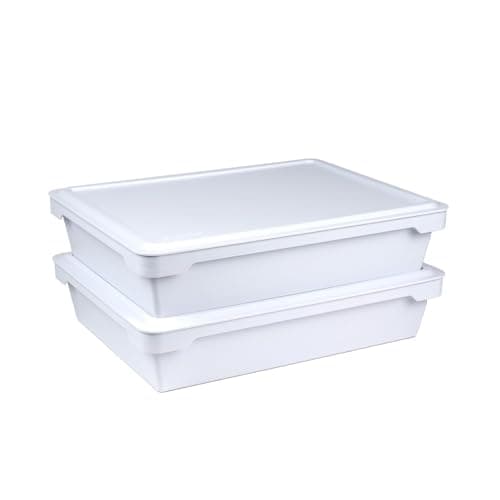
Ooni Pizza Dough Proofing Boxes, Set of 2
Shallow, stackable and 3.7 inches tall, which makes this the only dough box here that clears a domestic fridge shelf. The maker publishes both the dimensions and the dough-ball count, which is more than the restaurant-supply options manage.
Flexible plastic, which is the half of the job a rigid steel bench scraper cannot do. The bean shape follows the curve of a bowl; the paddle gets into the corner of a mixer.
#ad We hold no verified live price for this product, so we show none. How this site is funded.
Questions
Frequently asked
How long does pizza dough last in the fridge?+
Three to five days, with days two and three usually the best. Past about 96 hours the gluten has relaxed to the point where the dough tears rather than stretches.
How do you store pizza dough after proofing?+
Balled, in individual sealed containers, in the fridge. Seal it properly - an unsealed surface skins within a day and the skin never rehydrates.
Can you freeze pizza dough?+
Yes, for up to about three months. Ball it, let it rest an hour, oil it lightly, bag each ball separately and freeze fast. Thaw in the fridge overnight then two to three hours at room temperature.
How long should dough sit out before making pizza?+
One to two hours, until it is around 65 F and visibly relaxed. Cold dough will not open - it tears and springs back, and no amount of technique fixes that.
Why is my refrigerated dough sticky?+
Either condensation inside a fully airtight container, or the dough is past its window and the gluten has broken down. If it is also spreading rather than holding a ball, it is the second one.
Sources
Every number on this page came from one of these, or from arithmetic on one of these that we showed in full.