Heads up: some links on this page are affiliate links. If you buy through one we may earn a commission at no extra cost to you. It never changes a ranking, and we accept no payment for placement. The full version.
What this review is
We have not weighed a year of flour on this scale. What follows is its published specification, taken from the Escali user manual, and the arithmetic that specification implies for pizza dough. That arithmetic is the entire reason to buy this scale or to buy a different one. The method is on the methodology page.
What we did not do
We have not baked on any of these. Every guide in this category says it tested a dozen stones; we would rather say plainly that we did not. What we did instead is on this page in full: published specs with their sources, thermal arithmetic from material constants with the working shown, and the makers' own manuals read rather than paraphrased.
The published specification
Specification
Published figure
Capacity
5000 g / 11 lb / 175 oz
Resolution
1 g, or 0.1 oz
Dimensions
8" x 6" x 1.25"
Auto shut-off
After 4 minutes of non-use
One gram, read two ways
Resolution only means something relative to what you are weighing, so here is the same 1-gram step against the four things a pizza recipe asks you to measure.
Ingredient, typical home batch
Amount
What 1 g of uncertainty is
Flour
500 g
0.2%
Water
325 g
0.3%, or 0.2 points of hydration
Dough ball
280 g
0.36%
Salt
10 g
10%
Instant yeast
2 g
50%
50%
What a 1-gram step means when you are weighing 2 grams of instant yeast
No technique fixes that. It is the single reason this scale cannot be the only scale in a kitchen that makes small batches, and the reason we rank a 0.01 g pocket scale alongside it.
So the Primo is excellent at four of the five rows and hopeless at the fifth. If you make large batches - 1 kg of flour or more - the yeast quantity rises into a range where 1 gram is tolerable. If you make one or two balls at a time, you need a second, finer scale, and the scale roundup explains why that pairing is the standard answer rather than a compromise.
Five kilos is the right capacity, and it is not obvious
Capacity looks like a specification you can ignore until you try to weigh flour directly into a mixing bowl. A domestic stainless bowl is commonly 500 to 900 grams empty. Add a kilo of flour and 650 grams of water and you are at roughly 2.5 kg before anything else - comfortably inside 5 kg, and outside the 3 kg ceiling some cheaper scales carry.
That is what lets you tare the bowl, add flour, tare again, add water, and never wash a measuring jug. For baker's percentage work - the method behind the hydration guide - that workflow is the whole point.
The auto shut-off is the specification people trip over
Four minutes of non-use and the scale turns itself off. That is sensible for battery life and it is exactly wrong for one common workflow: weighing flour, pausing to do something else, and coming back to add water on the same tare.
It is not a defect, and every battery scale does some version of it. It is simply worth knowing before it costs you a tare mid-recipe. Weigh in one continuous session, or write the number down.
A 1-gram step is 0.36 percent of a 280 g ball. For everything except yeast, this scale is more precise than the dough is consistent.
What it does not publish
Escali publishes capacity, resolution, dimensions and the shut-off timer. It does not publish a linearity or accuracy figure - the amount by which a reading may differ from the true mass, which is a different thing from the size of the step it displays.
In practice, for dough, this matters less than it sounds: baker's percentage is a system of ratios, and a scale that reads consistently high or low by a fraction of a percent produces the same dough every time. It would matter if you were calibrating instruments. You are making pizza.
Who should buy it
Buy it if you want one scale for flour, water and dough balls, and you either make large batches or already own something finer for yeast.
Buy the pocket scale as well if you make one or two balls at a time. A 0.01 g scale costs very little and removes the only real weakness here.
Buy a larger-platform scale instead if you regularly weigh wide trays or big bowls that overhang an 8 by 6 inch footprint and hide the display.
Do not buy any scale expecting it to fix inconsistent dough on its own. It removes one variable - an important one - and leaves temperature and time, which are covered in the proofing temperature guide.
The verdict
A plain, well-specified scale that is right for four of the five things a pizza recipe asks you to weigh, and unusable for the fifth. That is not a criticism so much as the defining fact about every 1-gram kitchen scale, and Escali publishes enough for you to work it out before buying rather than after.
The picks
What we would buy
Escali
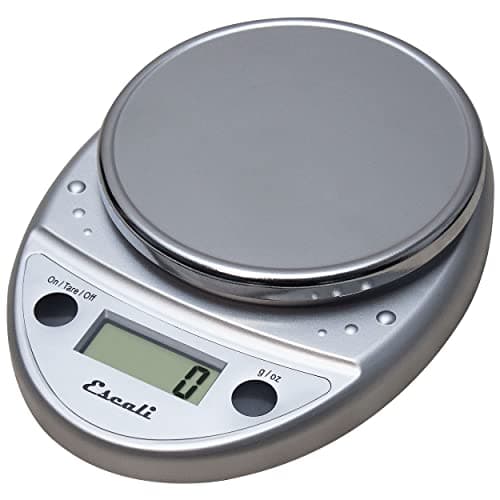
Escali Primo P115 Digital Kitchen Scale
Eleven pounds of capacity at one-gram resolution, which is exactly right for flour and dough balls and exactly wrong for yeast. Know which half of your recipe it is for.
American Weigh AWS-100 Pocket Scale, 100 g x 0.01 g
The cheapest genuine upgrade in the whole dough-tools category. A 1 g kitchen scale cannot weigh 2 g of yeast to better than 50 percent; this resolves it to half a percent.
#ad We hold no verified live price for this product, so we show none. How this site is funded.
OXO
OXO Good Grips 11 lb Stainless Steel Food Scale
The same 11 lb capacity and 1 g resolution as any other domestic scale, with one design decision that matters: the display pulls out, so a wide mixing bowl does not hide it.
#ad We hold no verified live price for this product, so we show none. How this site is funded.
Questions
Frequently asked
Is the Escali Primo accurate enough for pizza dough?+
For flour, water and dough balls, comfortably - a 1-gram step is 0.2 to 0.36 percent of those quantities. For 2 grams of instant yeast it is a 50 percent uncertainty, which is why a 0.01 g pocket scale belongs beside it.
What is the Escali Primo's capacity?+
5000 g, which is 11 lb. That is enough to weigh flour directly into a mixing bowl and tare as you go, which is the workflow baker's percentage assumes.
Does it turn itself off?+
After 4 minutes of non-use, per the manual. Weigh in one continuous session, because losing a tare halfway through a recipe is the usual way this bites.
Do I need two scales for pizza?+
If you make small batches, yes - one with 5 kg capacity at 1 g steps for flour and water, and one with 0.01 g steps for yeast and salt. Together they cost less than a stone.
Can I weigh in ounces?+
Yes, at 0.1 oz resolution. For dough work grams are the better unit, because baker's percentage arithmetic in ounces is needlessly hard.
Sources
Every number on this page came from one of these, or from arithmetic on one of these that we showed in full.