Heads up: some links on this page are affiliate links. If you buy through one we may earn a commission at no extra cost to you. It never changes a ranking, and we accept no payment for placement. The full version.
What actually changes
Flavor. Wild yeast and lactic acid bacteria together produce acids that commercial yeast does not. That is the whole reason to do this, and it is a real difference rather than a subtle one.
Timeline. A starter is slower and less predictable than instant yeast. Budget 24 to 48 hours rather than 4 to 24.
Extensibility. The extra acidity and longer ferment relax gluten further, so a well-managed sourdough pizza dough often stretches beautifully. Pushed too far, the same mechanism goes past relaxed into slack and tearing.
Browning. More available sugars from the longer enzymatic breakdown, so it colors a little faster.
What does not change
The bake. Surface temperature, effusivity, preheat length, topping moisture - all identical. A sourdough base on an underheated stone is exactly as pale and floppy as a commercial-yeast one.
24-48 hours
A realistic sourdough pizza timeline
Against 4 to 24 for commercial yeast. The extra time is the flavor, and it is also the thing most likely to catch you out on a weeknight.
A workable timeline
Day 1 morning. Feed the starter. It should be at peak - doubled, domed, bubbly - about four to eight hours later, and that peak is when you use it.
Day 1 evening. Mix. Around 15 to 20 percent starter as a proportion of the flour weight. Bulk ferment at room temperature for two to four hours, with a couple of folds in the first hour.
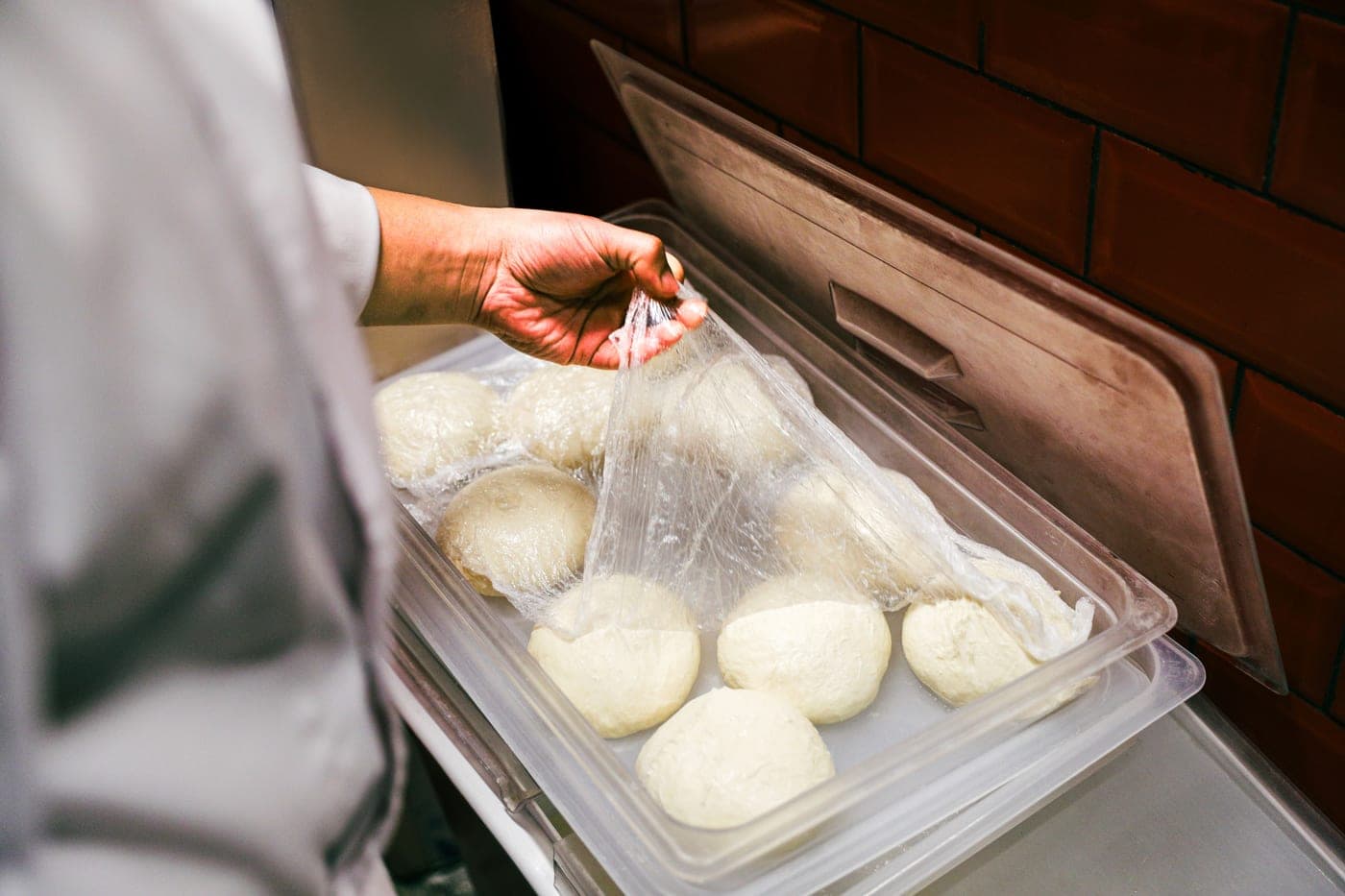
Day 1 night. Ball, into individual containers, into the fridge.
Day 2 or 3. Out one to two hours before baking, then bake. Twenty-four to forty-eight hours of cold retard is the usual window.
The two adjustments people miss
Use less starter than a bread recipe suggests. Bread recipes often run 20 to 30 percent. For pizza, 10 to 20 percent gives you a slower, more controllable ferment and a dough that is still extensible when you want to stretch it thin.
Watch the dough, not the clock. A starter's activity varies with its feeding schedule, its hydration, the flour and the room temperature. Every timing above is a starting estimate. The poke test is the actual instrument.
A clear container earns its place here: a sourdough ferment is far more variable than a commercial one, and the bubble structure at the wall is the most honest signal you get.
The equipment that matters, and the equipment that does not
A fine scale matters. Starter percentages are small enough that a 1 g kitchen scale is marginal, and salt at 2 percent of flour weight is a number you genuinely want right. A 0.01 g pocket scale is the cheapest useful addition.
Clear containers matter, for the reason above: you read a sourdough ferment by what the wall shows you.
A banneton does not matter here. It is a bread tool that holds a loaf's shape upright, and pizza dough wants to relax outward - banneton versus dough tray.
A proofing box mostly does not matter, unless your kitchen sits below about 65 F. See the temperature guide.
Where it goes wrong
Using a starter that is not at peak. Under-active starter gives a dough that never really rises; over-hungry starter gives sharp, acetone-ish acidity.
Treating the timeline as fixed. A recipe's hours assume a room temperature and a starter that are not yours.
Over-fermenting in the fridge. Sourdough carries on working at fridge temperature more than commercial yeast does. Days three and four are less reliable than they are with a yeasted dough.
Expecting it to fix a bake problem. It will not. If your base is pale, that is surface and temperature, and it is the same conversation whatever raised the dough.
What we did not do
We have not baked on any of these. Every guide in this category says it tested a dozen stones; we would rather say plainly that we did not. What we did instead is on this page in full: published specs with their sources, thermal arithmetic from material constants with the working shown, and the makers' own manuals read rather than paraphrased.
#ad We hold no verified live price for this product, so we show none. How this site is funded.
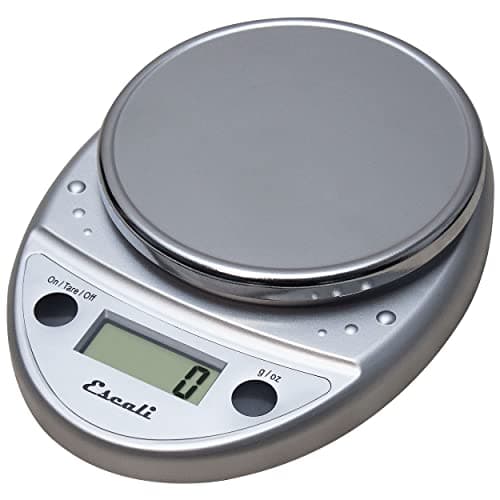
Escali
Escali Primo P115 Digital Kitchen Scale
Eleven pounds of capacity at one-gram resolution, which is exactly right for flour and dough balls and exactly wrong for yeast. Know which half of your recipe it is for.
American Weigh AWS-100 Pocket Scale, 100 g x 0.01 g
The cheapest genuine upgrade in the whole dough-tools category. A 1 g kitchen scale cannot weigh 2 g of yeast to better than 50 percent; this resolves it to half a percent.
#ad We hold no verified live price for this product, so we show none. How this site is funded.
Questions
Frequently asked
Is sourdough pizza better?+
Different, and better on flavor if you like the acidity. It changes nothing about the bake, so a sourdough base on an underheated surface is exactly as disappointing as any other.
How much starter for pizza dough?+
Around 10 to 20 percent of the flour weight, which is less than most bread recipes call for. Less starter means a slower ferment and a dough that stays extensible for longer.
How long does sourdough pizza dough take?+
Budget 24 to 48 hours: a few hours of bulk fermentation at room temperature, then 24 to 48 in the fridge, then one to two hours out before you bake.
Can I use sourdough discard for pizza?+
For flavor, yes - but discard is past peak and will not reliably raise a dough on its own. Use it alongside a small amount of instant yeast, or feed it and wait for the peak.
Do I need special equipment for sourdough pizza?+
A fine scale and a clear container. That is genuinely it. The bannetons and proofing boxes sold alongside sourdough are bread tools that do not help a pizza dough.
Sources
Every number on this page came from one of these, or from arithmetic on one of these that we showed in full.