Heads up: some links on this page are affiliate links. If you buy through one we may earn a commission at no extra cost to you. It never changes a ranking, and we accept no payment for placement. The full version.
The one relationship worth knowing
Within the range dough actually lives in - roughly 38 to 90 F - fermentation rate roughly doubles for every 10 F increase, and halves for every 10 F decrease. It is a rule of thumb rather than a law, and it is close enough to plan a schedule with.
Work it forward from a four-hour ferment at 75 F and you get a usable schedule table without testing anything:
Temperature
Relative rate
Roughly equivalent to 4 h at 75 F
85 F
2x
2 hours
75 F
1x
4 hours
65 F
0.5x
8 hours
55 F
0.25x
16 hours
45 F
0.125x
32 hours
38 F (fridge)
~0.07x
Two to three days
2x per 10 F
How fermentation rate changes with temperature
Which is why the same recipe is ready in two hours in an August kitchen and eight in a January one - and why 'proof for two hours' is useless advice without a temperature attached.
Target temperatures
Bulk ferment: 72 to 78 F. Fast enough to be practical, slow enough to develop flavor, and comfortably inside the range where yeast is happy.
Cold retard: 38 to 42 F. Standard fridge. Fermentation slows to a crawl while enzymes keep working, which is where the flavor and the browning come from.
Final rest before baking: 60 to 68 F. Not a proof so much as letting the ball come up to a temperature at which it will actually open.
Avoid above 85 F. The yeast races ahead of the enzymes, so you get volume without flavor, and the window between underproofed and collapsed shrinks to almost nothing.
Hitting a temperature without buying anything
Oven with the light on. The bulb alone typically holds an oven interior somewhere in the mid-70s to low-80s F. Check yours with a thermometer before trusting it - some run much warmer.
Oven with a bowl of hot water. Warm and humid, which also stops the surface skinning. Refresh the water every couple of hours.
Top of the fridge. A few degrees above room temperature, from the compressor. Free and surprisingly stable.
Adjust the water instead of the room. The most useful trick of all: dough temperature is largely set by water temperature at mixing, so in a cold kitchen use warmer water. A rough working rule is that desired dough temperature times three, minus the room temperature, minus the flour temperature, minus the friction from mixing, gives the water temperature to use.
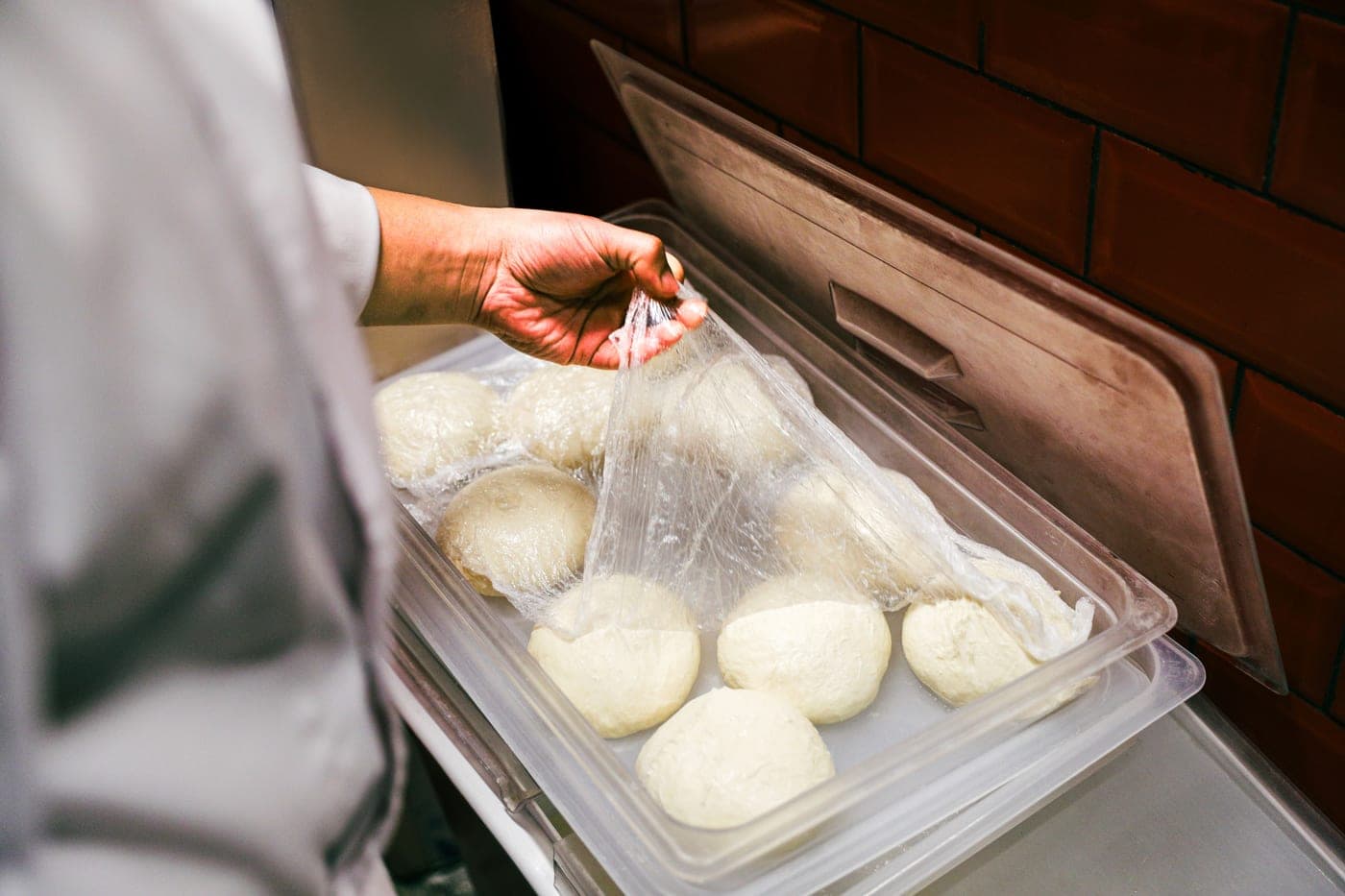
Clear containers let you judge the rise by the bubble structure at the side rather than by the clock.
Judge the dough, not the clock
Every time above is a starting estimate. What you are actually looking for:
Volume. Roughly doubled for a bulk ferment. Not tripled.
The poke test. Press a floured finger half an inch into the ball. If the dent springs back immediately, it needs longer. If it fills in slowly and leaves a shallow mark, it is ready. If it does not come back at all, it is overproofed.
Bubbles at the side wall, which is the whole argument for a clear container - a good ferment shows an even network of small bubbles, not a few large voids.
Do you need a proofing box?
Only if your kitchen genuinely sits below about 65 F for months at a time. Otherwise the oven-light method and warmer mixing water cover it, and the money is better spent on a container that fits your fridge.
The picks
What we would buy
Ooni
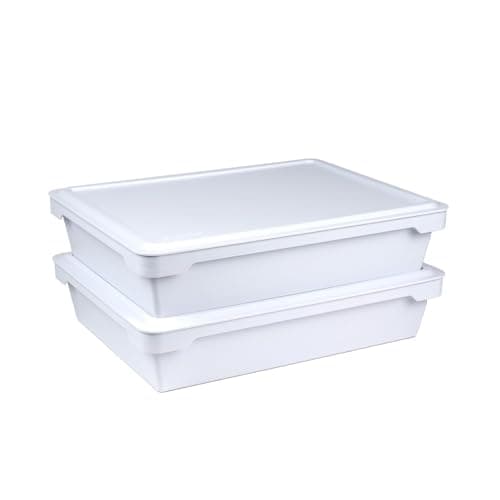
Ooni Pizza Dough Proofing Boxes, Set of 2
Shallow, stackable and 3.7 inches tall, which makes this the only dough box here that clears a domestic fridge shelf. The maker publishes both the dimensions and the dough-ball count, which is more than the restaurant-supply options manage.
#ad We hold no verified live price for this product, so we show none. How this site is funded.
American Weigh Scales
American Weigh AWS-100 Pocket Scale, 100 g x 0.01 g
The cheapest genuine upgrade in the whole dough-tools category. A 1 g kitchen scale cannot weigh 2 g of yeast to better than 50 percent; this resolves it to half a percent.
#ad We hold no verified live price for this product, so we show none. How this site is funded.
Questions
Frequently asked
What temperature should pizza dough proof at?+
72 to 78 F for a bulk ferment, 38 to 42 F for a cold retard, and 60 to 68 F for the rest before baking. Above 85 F the yeast outruns the enzymes and you lose flavor.
How much faster does dough proof if it is warmer?+
Roughly twice as fast for every 10 F. So a four-hour ferment at 75 F is about two hours at 85 F and about eight at 65 F.
How do I proof dough in a cold kitchen?+
Use warmer mixing water rather than trying to heat the room - dough temperature is mostly set at mixing. Failing that, the oven with only the light on usually sits in the mid-70s to low-80s F.
Can pizza dough proof at room temperature all day?+
In a warm kitchen it will overproof: the gluten breaks down, the ball spreads, and it tears when you stretch it. Either use less yeast for a long room-temperature ferment, or move it to the fridge.
Do I need a proofing box for pizza dough?+
Only in a genuinely cold kitchen. The oven with the light on, or the top of the fridge, covers the same range for nothing.
Sources
Every number on this page came from one of these, or from arithmetic on one of these that we showed in full.