Heads up: some links on this page are affiliate links. If you buy through one we may earn a commission at no extra cost to you. It never changes a ranking, and we accept no payment for placement. The full version.
What this review is
We have not proofed a year of dough in these boxes. What follows is the published specification, the arithmetic it supports, and the one claim that needs converting before it means anything to you. The method is on the methodology page.
What we did not do
We have not baked on any of these. Every guide in this category says it tested a dozen stones; we would rather say plainly that we did not. What we did instead is on this page in full: published specs with their sources, thermal arithmetic from material constants with the working shown, and the makers' own manuals read rather than paraphrased.
The published specification
Specification
Published figure
Included
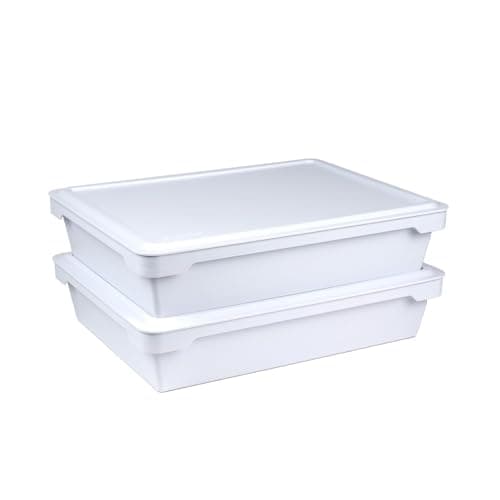
Two stackable boxes and two lids
Box size
16.7" x 12.7" x 3.7" (42.3 x 32.3 x 9.3 cm)
Capacity
6 cups per box, stated as up to six 250 g dough balls
Stated ball size
250 g, described as suiting 12-inch pizzas
Use
Counter, fridge or freezer, lidded to stop the dough drying
Fridge fit
Stated to fit most domestic fridge shelves - the maker advises checking
The capacity claim, converted into your dough
"Six 250 g balls" is only useful if you make 250 g balls. Our own dough ball weight chart is pure geometry - area times a thickness factor - and it puts a 12-inch pizza at 224 g thin, 284 g standard and 337 g thick. So Ooni's 250 g sits between thin and standard for the size they name.
The honest way to read a capacity claim is therefore in grams of dough, not in balls:
If your balls are
That is
Balls per box
250 g
A thin-to-medium 12-inch base
6, as published
284 g
A standard 12-inch base
5
386 g
A standard 14-inch base
3 to 4
1.5 kg
The real capacity of one box, in the only unit that transfers between kitchens
Six 250 g balls is 1,500 g of dough. Read it that way and the box tells you the truth whatever size pizza you make - which is the conversion the listing leaves to you.
The two published figures also cross-check each other. Six cups is 1.42 liters, and 1.5 kg of dough - which is a little denser than water - occupies a little under 1.5 liters. The volume claim and the ball claim agree, which is worth checking whenever a listing gives you only one of the two. Ball weights by pizza diameter are in the dough ball weight chart.
The 3.7 inch depth is the specification to think hardest about
A proofing ball does not stay a ball. It relaxes outward and rises, and in a shallow tray it eventually touches its neighbors - which is fine, and is what commercial dough boxes do all day, as long as you can lift each ball out without tearing the ones beside it.
At 3.7 inches deep this is a shallow tray rather than a deep tub, and that is the correct shape: a wide shallow container lets a ball relax into a disc, which is closer to the shape you want to open. A tall narrow tub constrains it sideways and it rises into a dome instead. That trade is set out in proofing box versus containers.
The other thing a shallow tray does is let balls find each other. A ball spreads as the gluten slackens, and two that meet have to be cut apart, which degasses both. That is why any maker's count is a maximum rather than a plan: leave a gap between balls and a box rated for six comfortably holds four or five, which is the same caveat we put on every tray in the container roundup.
Fridge arithmetic, which is what actually decides this purchase
A standard 36-inch American fridge has roughly 18 inches of usable shelf depth. This box is 12.7 inches deep and 16.7 wide, so it goes in on a clear shelf with room to spare - and the second box stacks on top of the first rather than claiming a second shelf.
That is the whole argument against doing this with round tubs. Twelve balls in 2-quart Cambro rounds, each 8 3/16 inches across, cover more than four square feet of shelf in circles alone, and more again once you count the gaps between them. Twelve balls in two stacked Ooni boxes need a single 16.7 by 12.7 inch footprint - roughly a third of the area before the gaps even count, and it is one shelf instead of two.
It is also the argument against the commercial alternative. The Winco PL-3N dough box most searches surface is 25 5/8 by 18 inches, which is a walk-in shelf rather than a domestic one. The Ooni is the size between the two that a home fridge can actually take.
The purchase is decided on a shelf, not on a counter. Measure the clear width and depth of the shelf you intend to give up before buying any dough box.
What it does not publish
The material. Neither the maker's listing nor the retailer listings we checked name the plastic. For a container that lives in a fridge and sometimes a freezer, that is a gap - the Cambro rounds we rank name their material (Camwear polycarbonate) on the listing, and this does not.
Dishwasher guidance. Not stated in the listings we checked. Treat it as hand-wash until the maker says otherwise.
Whether the lids seal. The published claim is that lids keep dough from drying out, which is the job that matters. No airtight claim is made, and none is needed for a fridge ferment.
Where cheaper options still win
One or two balls at a time. A single 2-quart round holds one ball, costs a fraction of this set, and lets you take one out without disturbing anything else. Below about four balls the tray is mostly empty and still occupies its full footprint.
Different doughs at once. Separate tubs mean separate timelines - a sourdough and a same-day dough can live on the same shelf without sharing a lid.
Published material specs. If you want to know exactly what your dough is sitting in, the commercial round containers publish more than this does. The ranked alternatives are in the container roundup.
Who should buy it
Buy it if you regularly make five to twelve balls at a time, you cold-ferment in a domestic fridge, and shelf space is the constraint - which it usually is. Two stacked boxes on one shelf is the most dough you can store in a home fridge without annoying everyone else in the house.
Buy 2-quart rounds instead if you make one to four balls, or you want each ball independent.
Buy a commercial dough box instead only if you have the shelf for a 25-inch tray, which almost no domestic fridge does.
Do not buy any box expecting it to change the dough. Temperature and time do that, and both are covered in the proofing temperature guide.
The verdict
A well-sized, honestly described pair of trays whose headline number needs one conversion before it is useful: six balls means 1.5 kg of dough, and if your pizzas are bigger than a thin 12-inch, your real capacity is four or five. It publishes less about its material than the restaurant-supply plastic does, and two boxes is more than a two-ball household will ever fill. What you are paying for is a domestic size that genuinely fits a home fridge shelf and stacks - which, for anyone making a batch on Friday for Saturday, is the specification that matters.
The picks
What we would buy
Ooni
Ooni Pizza Dough Proofing Boxes, Set of 2
Shallow, stackable and 3.7 inches tall, which makes this the only dough box here that clears a domestic fridge shelf. The maker publishes both the dimensions and the dough-ball count, which is more than the restaurant-supply options manage.
#ad We hold no verified live price for this product, so we show none. How this site is funded.
Winco
Winco PL-3N Pizza Dough Box, 25 5/8 x 18 x 3 1/4
This is the box every proofing-box guide recommends, and it is 25 5/8 inches wide. That is wider than most domestic fridge shelves are deep. We list it so you can see the trap before you fall into it.
#ad We hold no verified live price for this product, so we show none. How this site is funded.
Questions
Frequently asked
How many dough balls fit in an Ooni dough box?+
Six, if they are 250 g. That is 1.5 kg of dough per box, so at a standard 12-inch weight of 284 g you get five, and at a 14-inch weight of 386 g you get three to four. Convert the claim into grams and it transfers to any pizza size.
Will Ooni dough boxes fit in a normal fridge?+
Usually. Each box is 16.7 by 12.7 inches, against roughly 18 inches of usable shelf depth in a standard 36-inch American fridge. Ooni advises measuring first, which is the right advice for any dough box.
Are they better than round containers?+
Past about four balls, yes - twelve balls in two stacked boxes take roughly a third of the shelf area that twelve round tubs do. Below four balls the round tubs win, because each ball stays independent.
What are they made of?+
The listings we checked do not name the plastic, and no dishwasher guidance is published. If a stated material and temperature range matter to you, the commercial polycarbonate rounds publish both.
Can you freeze dough in them?+
The listing describes counter, fridge and freezer use, but no temperature range is published for the plastic itself, so we will not tell you it is rated for a deep freeze. Either way, frozen dough has to come back up to temperature before it will open.
Sources
Every number on this page came from one of these, or from arithmetic on one of these that we showed in full.