Heads up: some links on this page are affiliate links. If you buy through one we may earn a commission at no extra cost to you. It never changes a ranking, and we accept no payment for placement. The full version.
What each one is genuinely for
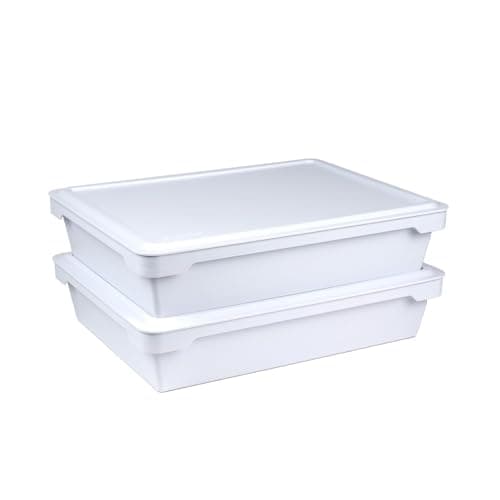
A dough box is a shallow rectangular tray sized so that a row of balls sits in it with a lid on top and another box stacks above. It exists to store many balls in minimum vertical space, and it is very good at that.
Individual containers hold one ball each. They cost more shelf area for the same number of balls and give you complete independence - take one out, leave the rest, different doughs in different tubs.
The crossover, with the numbers
Balls at a time
Better option
Why
1-2
Individual tubs
A tray is mostly empty and still occupies its full footprint
3-4
Either
Four tubs is about the same shelf area as one shallow tray
5-12
Shallow tray
Stacking wins decisively past four
12+
Proper dough box
And check your shelf width first - most are 25 inches or more
3.7 vs 3.25 in
Height of a domestic-sized dough tray against a commercial dough box
Almost identical. The difference that matters is width: 16.7 inches against 25 5/8. One fits a fridge shelf and one does not.
The 16.7-inch tray in that row is the Ooni set, the one domestic-sized option here that publishes both its dimensions and a ball count. Our review of it works out what that count means for pizzas bigger than 12 inches.
The trap
Searching for a dough proofing box returns commercial equipment, because commercial equipment is what the term describes. Those listings publish their dimensions honestly, and the dimensions are for a walk-in.
The Winco PL-3N in most published lists is 25 5/8 by 18 by 3 1/4 inches. A standard 36-inch American fridge has about 18 inches of usable shelf depth, so it goes in one orientation only, on a completely clear shelf. It is a good box. It is not a domestic box.
Whatever you use, it lives in the fridge for 24 to 72 hours. Fit is the first criterion, not the last.
Does the vessel change the dough?
Marginally, and in one specific way: shape. A ball in a tall narrow tub is constrained sideways and rises into a dome. A ball in a wide shallow container relaxes into a disc, which is closer to what you want when you come to stretch it.
Beyond shape, no. Material makes no difference to the ferment - a fridge equalizes everything within an hour or two regardless of what the walls are made of. Clear versus opaque changes what you can see, not what happens.
One genuine advantage to individual tubs: balls proofing in a shared tray grow into each other, and separating two joined balls degasses both. Leave a ball's width between them.
The recommendation
Two balls a week: two 2-quart round tubs. They fit any shelf, you can read the ferment through the wall, and there is nothing to store when they are empty.
Four to eight balls: a shallow stackable tray of domestic width, around 3.5 inches deep.
A dozen or more, regularly: a commercial dough box - and measure the shelf before you order, because the listings are honest and the numbers are large.
What we did not do
We have not baked on any of these. Every guide in this category says it tested a dozen stones; we would rather say plainly that we did not. What we did instead is on this page in full: published specs with their sources, thermal arithmetic from material constants with the working shown, and the makers' own manuals read rather than paraphrased.
The picks
What we would buy
Ooni
Ooni Pizza Dough Proofing Boxes, Set of 2
Shallow, stackable and 3.7 inches tall, which makes this the only dough box here that clears a domestic fridge shelf. The maker publishes both the dimensions and the dough-ball count, which is more than the restaurant-supply options manage.
#ad We hold no verified live price for this product, so we show none. How this site is funded.
Winco
Winco PL-3N Pizza Dough Box, 25 5/8 x 18 x 3 1/4
This is the box every proofing-box guide recommends, and it is 25 5/8 inches wide. That is wider than most domestic fridge shelves are deep. We list it so you can see the trap before you fall into it.
#ad We hold no verified live price for this product, so we show none. How this site is funded.
Questions
Frequently asked
Do I need a dough proofing box?+
Not below about a dozen balls at a time. Individual containers fit a domestic fridge better, cost less to start with, and let you take one ball out without disturbing the rest.
Will a Winco dough box fit in my fridge?+
Probably not usefully. At 25 5/8 by 18 inches it needs a completely clear shelf in a full-width fridge and can only go in one orientation. Measure before you buy.
How deep should a dough proofing container be?+
Roughly twice the height of the seated ball. For a 250 to 300 g ball that seats at about 1.5 inches, 3 to 4 inches of depth is right - enough for the rise, not so much that the ball is lost in a well.
Can dough balls touch each other while proofing?+
They can, and then they fuse, and separating them degasses both. Leave roughly a ball's width between them in a shared tray, which means fewer balls per tray than the maker's stated count.
Sources
Every number on this page came from one of these, or from arithmetic on one of these that we showed in full.