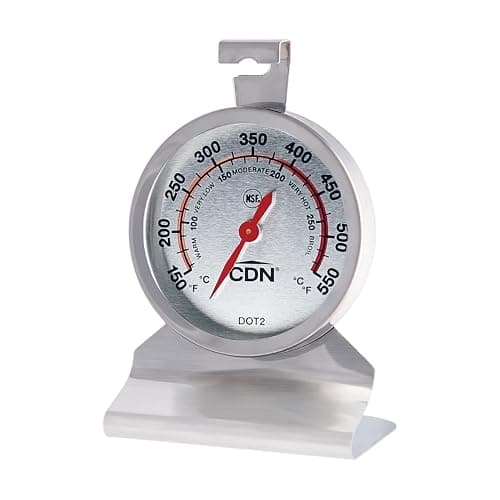
The dial thermometer we have ranked first since launch, reviewed on the one specification that makes it an awkward fit for the thing this site is about.
Heads up: some links on this page are affiliate links. If you buy through one we may earn a commission at no extra cost to you. It never changes a ranking, and we accept no payment for placement. The full version.
What this review is
We have not run this instrument against a laboratory reference. What follows is its published specification, what each figure means in a kitchen, and where its scale does not suit the thing this site exists for. The method is on the methodology page.
What we did not do
We have not baked on any of these. Every guide in this category says it tested a dozen stones; we would rather say plainly that we did not. What we did instead is on this page in full: published specs with their sources, thermal arithmetic from material constants with the working shown, and the makers' own manuals read rather than paraphrased.
The published specification
Specification
Published figure
Range
150 F to 550 F (70 C to 280 C)
Accuracy
Plus or minus 25 F
Dial
2 inch
Mounting
Two-way - stands on a rack or hangs from one
Construction
Stainless steel
Certification
NSF listed
Two of those rows are the review: the accuracy figure, which is honest and often misunderstood, and the top of the range, which is a genuine mismatch with pizza.
Plus or minus 25 F is not a flaw. It is the category.
Twenty-five degrees sounds terrible until you understand what the instrument is for. A bimetallic dial works by two bonded metals bending at different rates; it is cheap, battery-free, survives a 500 F box indefinitely, and it is not a precision device.
What that buys you is still worth having. Domestic oven thermostats drift by 50 to 100 F, and an instrument accurate to 25 F catches that easily. If your oven claims 500 and this reads 430, the 25 F uncertainty does not change the conclusion: your oven is badly wrong, and now you know by roughly how much.
+/- 25 F
The published accuracy of this instrument, and of the dial category generally
Enough to catch a lying oven. Not enough to tell you whether you are at 500 or 520 - and for pizza, where the top 50 degrees of a domestic oven is the whole game, that limit is worth knowing before you buy.
The 550 F problem
Here is the honest awkwardness. This instrument's scale ends at 550 F. A domestic oven at full tilt sits at 500 to 550 F, which is the exact temperature this site tells you to bake pizza at.
So at the one moment you most want a reading, the needle is at the end of its travel. You cannot distinguish 545 from 560, and you cannot see how far past the end it would have gone. For roasting, baking bread or checking a 350 F cake setting, none of this matters. For pizza, it does.
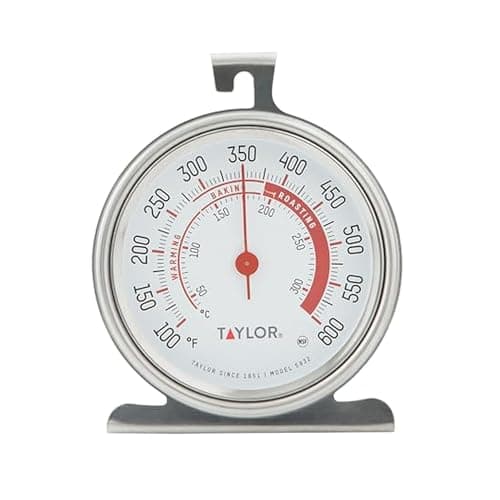
Instruments with a 600 F ceiling - the Taylor 3-inch dial, the AcuRite - give you 50 F of headroom for a few dollars. That comparison, and the other specifications worth checking, is in how to choose an oven thermometer.
What it gets right
Two-way mounting. It hangs from a rack or stands on one. That sounds minor until you try to position an instrument in a cluttered oven around a stone - having both options means you can always put it at the rack height you actually bake at.
NSF listing. Independently assessed for commercial food-service use. It tells you nothing about needle accuracy beyond the published figure, but it is a real credential and most instruments at this price do not carry one.
No battery. Mechanical, so there is nothing to die in a drawer between pizza nights and nothing to replace in five years.
It is cheap enough to be a rounding error next to a stone, a steel or a peel - which is the correct way to think about a diagnostic tool.
The number on the front of the oven is a claim. This is the cheapest way to audit it - and the audit is worth doing before you spend anything on a surface.
What it cannot do, and what to buy for that
It reads air. Your pizza is cooked by conduction from the surface it is sitting on, and during a preheat the cabinet air reaches temperature roughly 25 minutes before a 15 mm stone does - the arithmetic is in the preheat guide.
That gap is the single most common reason a home pizza disappoints, and no dial thermometer can see it. An infrared gun can, and whether you need one is worked through in do you need an infrared thermometer for pizza.
CDN also lists a larger-dial oven thermometer with an easy-read low-light face, also NSF listed. If readability through a closed door is your priority and you want to stay with the brand, that is the one to look at rather than this one.
Who should buy it
Buy it if you want an NSF-listed, battery-free honesty check on an oven you mostly use below 550 F, and you like that it both hangs and stands.
Buy the Taylor instead if pizza is the reason you are buying: bigger dial, 600 F ceiling, same NSF listing.
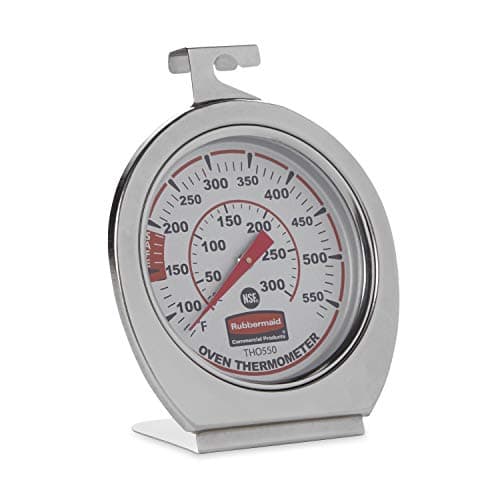
Buy the Rubbermaid instead if you want one instrument that also reads the 70 to 85 F range where dough proofs.
Buy an infrared gun instead if you can only afford one instrument and you care about the base of your pizza rather than the air around it.
The verdict
A good, honest, cheap instrument that publishes its own limits - and whose scale happens to stop exactly where pizza starts. If your oven is the thing you want audited, it does that perfectly well. If the top 50 degrees of your oven is what you are chasing, buy the version with headroom.
The picks
What we would buy
CDN
CDN DOT2 ProAccurate Oven Thermometer
The best of a category whose published accuracy is plus or minus 25 F. That is not a criticism of this unit - it is the honest ceiling of a bimetallic dial, and it is why we would spend the money on infrared instead.
The biggest dial of the cheap ones, NSF listed, and readable from outside the oven door - which is the only specification that decides whether you actually use it.
Is the CDN ProAccurate oven thermometer accurate?+
Its published accuracy is plus or minus 25 F, which is the honest ceiling for a bimetallic dial. That is enough to catch an oven running 50 to 100 F cold, and not enough to distinguish 500 from 520.
Does it go high enough for pizza?+
Just barely. Its scale ends at 550 F and domestic pizza baking happens at 500 to 550, so the needle sits at the end of its travel exactly when you are reading it. A 600 F instrument gives you headroom.
Where do you put it in the oven?+
Hanging from the rack you bake on. Do not stand it on the stone or steel - a dial resting on hot metal reads conduction through its foot as well as air.
What does NSF listed mean here?+
That it has been independently assessed for commercial food-service use. It is a genuine credential and it is not a statement about needle accuracy, which is published separately as plus or minus 25 F.
Will it tell me when my pizza stone is ready?+
No. It reads cabinet air, which reaches temperature about 25 minutes before a 15 mm stone does. Surface temperature needs an infrared thermometer.
Sources
Every number on this page came from one of these, or from arithmetic on one of these that we showed in full.