Heads up: some links on this page are affiliate links. If you buy through one we may earn a commission at no extra cost to you. It never changes a ranking, and we accept no payment for placement. The full version.
The shortlist
Ranked, with the working
Ranked on published manufacturer specifications and, where the numbers exist, our own arithmetic on what each option does thermally. Tap any row for the full write-up, including who should skip it.
#
Product
Best for
Score
Price
01
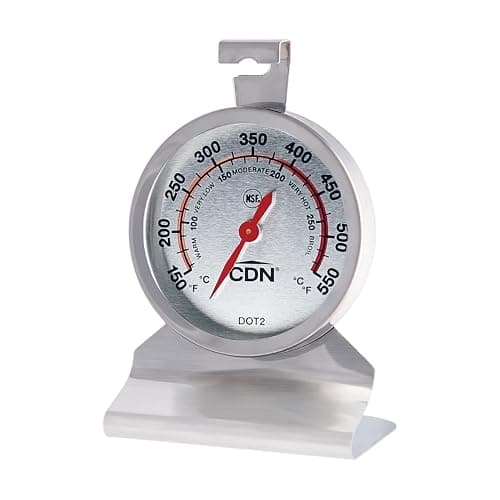
CDN DOT2 ProAccurate Oven ThermometerFinding out whether your oven's dial is lying by 50 F or more
Scores are ours and editorial. They are never published as review or rating markup, because we have not baked on these products - here is how we pick.
Start with what the category publishes about itself
The best-regarded dial oven thermometer we could source publishes an accuracy of plus or minus 25 F. That is not a criticism of the product - it is honest of the maker, and it is close to the ceiling of what a bimetallic coil can do across a 150 to 550 F span.
+/- 25 F
Published accuracy of a good dial oven thermometer
Enough to catch an oven running 75 F cold, which is a common and expensive fault. Not enough to distinguish 475 F from 525 F, which is the distinction that changes a pizza.
What it is genuinely for
Finding a badly calibrated oven. Domestic thermostats drift, and an oven running 50 to 100 F below its dial is common enough that it should be your first suspicion when a bake underperforms. A 25 F instrument catches that easily.
Watching the cycle. An oven does not hold a temperature - it overshoots and undershoots around a setpoint as the element cycles, often by 25 to 50 F. Watching a dial over ten minutes tells you the amplitude of that swing, which is genuinely useful for deciding when to launch.
Finding hot spots. Move it around the cabinet across several bakes and you will find the oven's geography. Most have one.
What it cannot do
Tell you the surface temperature. It reads air. During a preheat, the air reaches setpoint long before the stone does - by 25 to 55 minutes depending on the mass of the surface. A dial reading 500 F while the stone is at 380 F is the single most common reason a first pizza is disappointing, and the dial cannot warn you about it.
Resolve the difference that matters. A pizza at 475 F and a pizza at 525 F are visibly different pizzas. Plus or minus 25 F cannot separate them.
What we did not do
We have not baked on any of these. Every guide in this category says it tested a dozen stones; we would rather say plainly that we did not. What we did instead is on this page in full: published specs with their sources, thermal arithmetic from material constants with the working shown, and the makers' own manuals read rather than paraphrased.
So what should you actually buy?
If you are buying one instrument, buy an infrared thermometer. It reads the thing that bakes your base, it resolves to a few degrees rather than 25, and it costs a similar amount to a good dial thermometer.
A dial thermometer is a reasonable second instrument - it lives in the oven, needs no batteries and never gets lost in a drawer. Just be clear about which question each one answers. Full comparison in infrared versus probe thermometers.
The dial is a setpoint, not a measurement. Everything in this hub is about the gap between the two.
What to look for in a dial thermometer
A range that goes past your oven's maximum. Many stop at 550 F, which is the top of a domestic oven with no headroom. A needle pinned at the end of its travel tells you nothing. Which instruments have that headroom, and the one that also reads a proofing shelf, is worked through in how to choose an oven thermometer.
Stainless and glass, not plastic. If it lives in the oven it will eventually see a self-clean cycle.
Two-way mounting. Standing on a rack it reads near the surface; hanging it reads mid-cabinet. Being able to do both is how you map the oven.
A dial big enough to read through the door glass, because the whole point is not opening the oven to check.
In full
Every pick, with the specs and the sources
01 / Best dial thermometer
CDN
6.8/10
CDN DOT2 ProAccurate Oven Thermometer
The best of a category whose published accuracy is plus or minus 25 F. That is not a criticism of this unit - it is the honest ceiling of a bimetallic dial, and it is why we would spend the money on infrared instead.
What it does well
Lives in the oven permanently, needs no batteries and never needs charging
Reads the air, which is the thing your oven's thermostat is actually controlling
Stainless and glass, so it survives a self-clean cycle better than plastic-lensed units
What it does not
Published accuracy of +/- 25 F cannot resolve 475 F from 525 F, which is the distinction that matters
550 F ceiling is below where many pizza bakes sit
Tells you nothing about the surface the pizza actually touches
Skip it if
You want to know your stone's surface temperature. A dial thermometer reads cabinet air, and the two can differ by well over 100 F during a preheat.
Stock photo of the product type, not this model. We publish no product photography we cannot source.
ThermoWorks
9.3/10
ThermoWorks Industrial IR Gun (IR-GUN-S)
The adjustable emissivity is the reason to buy this rather than a cheap gun. Fixed-emissivity instruments read a seasoned steel 40 to 80 F low, and that is the difference between a good bake and a pale one.
What it does well
Adjustable emissivity, which is the single spec that decides whether the reading means anything on metal
Published +/- 2.7 F accuracy, roughly ten times tighter than a dial oven thermometer
12:1 optics let you read a small area from outside the oven mouth
Max/min tracking while you sweep across the surface
What it does not
Costs several times what a fixed-emissivity gun costs
It reads surfaces, not air, so it will not tell you the oven's cabinet temperature
1022 F ceiling is below what a wood-fired oven floor can reach
Skip it if
You only ever bake on cordierite. A fired ceramic sits close enough to the 0.95 a cheap gun assumes that the error is around 13 F, which mostly does not change what you do.
What a fixed 0.95 emissivity setting costs you on a seasoned steel.
An infrared thermometer infers temperature from radiance, assuming an emissivity. Where the real emissivity is lower than the assumed one, the reading comes out low by a factor of (real/assumed) to the power 1/4, in kelvin. Oxidized or rolled steel is published at 0.66 to 0.80. At a true 500 F (533 K) with the instrument fixed at 0.95: at emissivity 0.80 the gun reads 460 F, at 0.66 it reads 417 F. On a ceramic body, closer to the 0.90 to 0.95 published for common brick, the same gun reads about 487 F. That is the whole argument for adjustable emissivity, and no competitor guide we found mentions it.
#ad We hold no verified live price for this product, so we show none. How this site is funded.
03 / The budget version of that
Stock photo of the product type, not this model. We publish no product photography we cannot source.
ThermoPro
8.6/10
ThermoPro TP30 Infrared Thermometer
Adjustable emissivity at a budget-gun price, which is the combination that matters. Accuracy is looser than the ThermoWorks, but a correctable reading beats a precise wrong one.
What it does well
Adjustable emissivity, which is the one spec that decides whether a reading on steel means anything
Same 12:1 optics and 1022 F ceiling as instruments costing far more
Manual published openly, which is more than most budget instruments manage
What it does not
1.5 percent at 500 F is about 7 F of uncertainty
Reads surfaces only, so it tells you nothing about cabinet air
No max/min tracking while you sweep
Skip it if
You need tight absolute accuracy. Plus or minus 1.5 percent at 500 F is around 7 F, against 2.7 F for the ThermoWorks.
#ad We hold no verified live price for this product, so we show none. How this site is funded.
Questions
Frequently asked
How accurate are oven thermometers?+
A good dial thermometer publishes plus or minus 25 F. That is a property of bimetallic coils rather than a fault, and it is enough to catch a badly calibrated oven and not enough to fine-tune a bake.
Is my oven running cold?+
Quite possibly. Put a thermometer in the middle of the cabinet, set 450 F, and read it after 20 minutes. If it settles more than 25 F away from the dial, your oven is miscalibrated - and many can be corrected in the control panel settings.
Where should I put an oven thermometer?+
Middle of the rack you bake on, away from the walls. Then move it around across several bakes to find the hot spots - every oven has geography and knowing yours is worth more than any single number.
Do I need an oven thermometer if I have an infrared one?+
Not really. The infrared reads the surface, which is the number that bakes your base. A dial thermometer is a useful second instrument for watching the cabinet cycle, but it is not the one to buy first.
Sources
Every number on this page came from one of these, or from arithmetic on one of these that we showed in full.