Five dollars settles whether your oven is lying to you. Which five dollars depends on two numbers most buyers never look at: the top of the scale and the bottom of it.
Heads up: some links on this page are affiliate links. If you buy through one we may earn a commission at no extra cost to you. It never changes a ranking, and we accept no payment for placement. The full version.
Buy one with a 600 F top end, not 550. Pizza bakes at 500 to 550 F, and an instrument whose scale ends at 550 is being read at the very edge of its range exactly when you need it. Beyond that, the specification worth paying attention to is the bottom of the scale - because one of these can also tell you whether your dough is proofing at the right temperature.
First, what this instrument is for
A dial oven thermometer answers one question: is the cabinet actually at the temperature the oven claims? Domestic thermostats drift by 50 F and more, and no amount of technique compensates for an oven that reads 500 and delivers 430.
What it cannot tell you is the temperature of the surface your base lands on, which is the number that actually decides your crust. That is an infrared thermometer's job, and the case for owning one is in do you need an infrared thermometer. The ranked comparison of dials against guns is in the oven thermometer roundup, which also covers the category's published accuracy ceiling of plus or minus 25 F.
Everything below assumes you have accepted that: a dial is a cheap, coarse, battery-free honesty check on your oven, and it is worth owning for that alone.
What we did not do
We have not baked on any of these. Every guide in this category says it tested a dozen stones; we would rather say plainly that we did not. What we did instead is on this page in full: published specs with their sources, thermal arithmetic from material constants with the working shown, and the makers' own manuals read rather than paraphrased.
1. The top of the scale, which is the pizza-specific trap
Here is the same specification across four instruments, taken from each maker's published figures.
Thermometer
Published range
Headroom above a 550 F bake
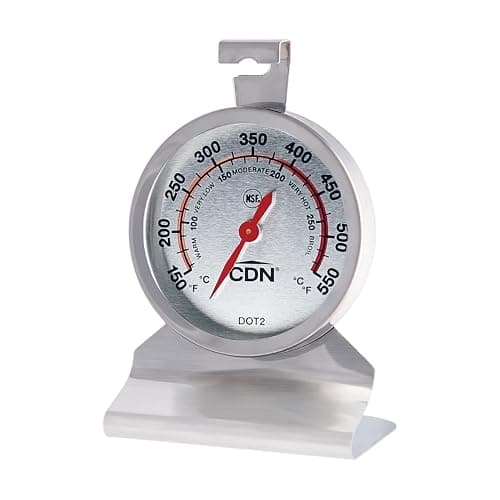
CDN DOT2 ProAccurate
150 F to 550 F
None - 550 is the end of the scale
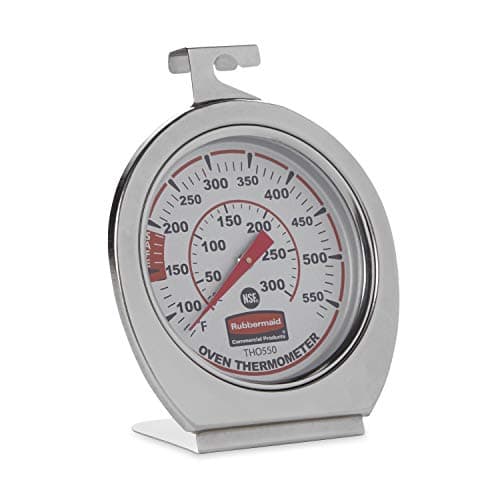
Rubbermaid Commercial
60 F to 580 F
30 F
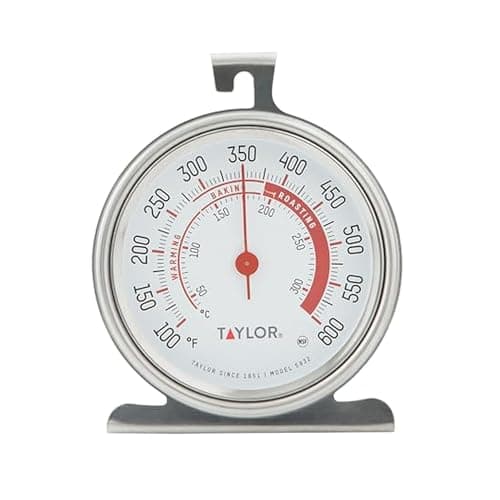
Taylor 3-inch dial
100 F to 600 F
50 F
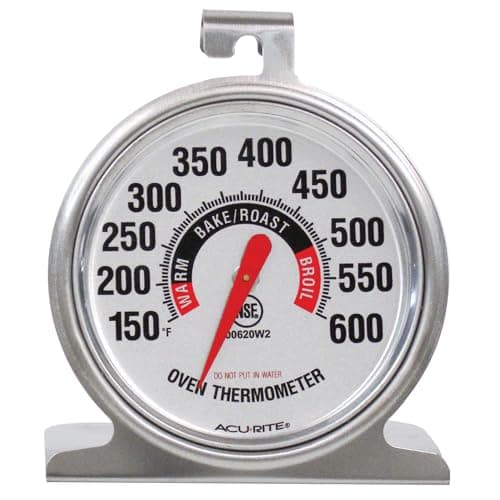
AcuRite 00620A2
150 F to 600 F
50 F
550 F
Where a domestic oven bakes pizza, and where the most commonly recommended dial thermometer's scale ends
A needle pinned at the end of its travel cannot tell you whether the oven is at 550 or 575. For roasting that is irrelevant. For pizza it is the one temperature you care about.
This is not a reason to avoid the CDN, which is a good instrument and the one we have ranked first for years. It is a reason to prefer 600 F if pizza is the reason you are buying.
2. The bottom of the scale, which buys you a second tool
Almost nobody checks this, and for a pizza kitchen it is the most interesting number on the page. Dough proofs between roughly 70 and 85 F, and the temperature where your dough actually sits is the variable that decides whether a bulk ferment takes four hours or nine - the full picture is in the proofing temperature guide.
Of the four instruments above, exactly one starts low enough to read that: the Rubbermaid, at 60 F. The Taylor starts at 100 F and the other two at 150 F, which means they are blind to every temperature dough ever experiences. If you were going to buy a thermometer for the oven and another for the proofing shelf, one of these does both.
3. Dial size, because an unreadable instrument gets ignored
The practical failure of cheap oven thermometers is not accuracy. It is that the face is too small to read through a closed oven door, so you open the door to look - which drops the cabinet temperature and changes the thing you were measuring.
A 3-inch dial is readable through glass from a step away. A 2-inch dial generally is not. That is the entire argument for the Taylor over the cheaper options, and it matters more than a few degrees of published accuracy.
4. How it mounts, and where to put it
All four hang from a rack or stand on one, which is the flexibility you want. Two rules for placement:
Put it at the height you bake at. A domestic oven is not one temperature - the top is hotter than the bottom. Measuring at the wrong rack tells you about a part of the oven you are not using.
Do not rest it on the stone or steel. Sitting on a hot slab, a dial reads conduction from the metal foot as much as air, and you get a number that is neither one thing nor the other. Hang it from the rack beside the surface, not on it.
5. Certification, and what it is worth
The CDN and the Taylor publish NSF listings; the AcuRite does not. NSF listing means the instrument has been independently assessed for commercial food-service use - it is a real credential, and it says nothing about whether the needle is accurate at 550 F. Treat it as a tiebreaker rather than a reason.
All four are mechanical bimetallic dials with no battery, which is the correct design for something that lives in a 500 F box. There is nothing to die between bakes and nothing to replace.
The thermometer tells you about the air at one rack height. The stone below it can be 100 F away from that number during a preheat - which is the job of a different instrument.
How to actually use it, in four steps
1. Hang it at your baking rack. Not the top, not the floor - the level the pizza will occupy.
2. Set the oven to 500 F and wait 20 minutes past the beep. The beep is the thermostat reporting air at a sensor, and the cabinet keeps changing after it.
3. Read the needle and write down the difference. That difference is your oven's offset. If the dial says 500 and the needle says 440, your oven runs 60 F cold and every recipe you follow needs that correction.
4. Decide what to do about it. Many ovens can be recalibrated from the control panel - check the manual. If not, set the dial 60 F higher and carry on, which works perfectly well once you know the number. Temperature targets for pizza are in the oven temperature guide.
What not to buy one for
A portable pizza oven. Those run to 900 F and up. Every dial here stops at 600, so the needle simply pins and tells you nothing. That is infrared territory.
Knowing when the stone is ready. Air reaches temperature long before a slab does - roughly 25 minutes before, for a 15 mm stone - which is the whole subject of the preheat guide.
Precision. The published accuracy of this category is plus or minus 25 F. It is a tool for catching a 50 to 100 F lie, not for splitting hairs.
Which one we would buy
For pizza specifically: the Taylor. A 3-inch face you can read through the door, a 600 F ceiling with headroom above a maxed-out oven, and an NSF listing.
If you also want to check dough: the Rubbermaid, for the 60 F floor. It is the only instrument here that covers both ends of a pizza kitchen.
If you already own the CDN: keep it. It is a good instrument, and knowing that its scale ends at your baking temperature is most of the value of this page.
If you want to spend as little as possible: the AcuRite. It answers the only question that matters at the lowest price, and publishes less about itself than the others.
The picks
What we would buy
Taylor
Taylor Analog Oven Thermometer, 3-Inch Dial
The biggest dial of the cheap ones, NSF listed, and readable from outside the oven door - which is the only specification that decides whether you actually use it.
The best of a category whose published accuracy is plus or minus 25 F. That is not a criticism of this unit - it is the honest ceiling of a bimetallic dial, and it is why we would spend the money on infrared instead.
The cheapest way to find out whether your oven is lying to you. It does one job, it publishes the range it does it over, and it costs less than a pizza.
What temperature range should an oven thermometer cover for pizza?+
Look for a 600 F top end. Pizza bakes at 500 to 550 F, so a thermometer whose scale stops at 550 is being read at the very end of its travel exactly when it matters.
Can I use an oven thermometer to check dough proofing?+
Only if it reads low enough. Dough proofs at roughly 70 to 85 F, and most oven thermometers start at 100 or 150 F. The Rubbermaid Commercial starts at 60 F, which makes it the one instrument here that covers both jobs.
Where should I put an oven thermometer?+
Hanging from the rack you actually bake on, not resting on your stone or steel. A dial sitting on hot metal reads conduction through its foot as much as it reads air.
How accurate are dial oven thermometers?+
The published figure for the category is plus or minus 25 F. That is enough to catch an oven running 75 F cold and not enough for anything finer, which is why we treat them as honesty checks rather than instruments.
Do I need one if I have an infrared thermometer?+
They answer different questions - the dial reads cabinet air over time, the gun reads a surface right now. If you can only have one for pizza, the gun is more useful, because the surface is what cooks the base.
Sources
Every number on this page came from one of these, or from arithmetic on one of these that we showed in full.