Heads up: some links on this page are affiliate links. If you buy through one we may earn a commission at no extra cost to you. It never changes a ranking, and we accept no payment for placement. The full version.
If you bake on a steel or on a portable oven, yes - it is the cheapest instrument that changes outcomes, because surface temperature is the variable that decides your base and nothing else in the kitchen reports it. If you bake on a cordierite stone in a domestic oven and you already preheat properly, it is a nice-to-have and an oven thermometer is the better first purchase.
The one question it answers
Your oven tells you about air. Its beep is a thermostat reporting cabinet temperature, and cabinet temperature has almost nothing to do with the state of the slab you are about to launch onto. A base is cooked by conduction from the surface it is touching, so the number that matters is that surface's temperature - and an infrared gun is the only household instrument that reads it.
That is a genuinely different question from the one a probe answers (the inside of something) or a dial oven thermometer answers (the air). Which instrument answers which question is laid out in infrared versus probe thermometers.
What we did not do
We have not baked on any of these. Every guide in this category says it tested a dozen stones; we would rather say plainly that we did not. What we did instead is on this page in full: published specs with their sources, thermal arithmetic from material constants with the working shown, and the makers' own manuals read rather than paraphrased.
What it changes, in practice
It ends the preheat argument. Our model puts a 15 mm stone at 95 percent of oven temperature about 25 minutes past the beep and a quarter-inch steel at about 27. Those are predictions from published mass and material constants - defensible, and still predictions. Two seconds with a gun replaces them with your oven's actual number, and the full method is in the preheat guide.
It catches an oven that is lying. Domestic thermostats drift by 50 F and more. If the surface sits at 430 F when the dial says 500, no technique and no surface rescues the bake, and you will spend months blaming your dough.
It tells you when to launch the second pizza. The surface drops when a cold base lands and recovers on a time constant of roughly eight to nine minutes - covered in how long a stone stays hot. A gun turns that from arithmetic into an observation.
The trap: what emissivity does to the reading
This is the part that decides which gun to buy, and it is the reason a cheap instrument can be worse than none on the wrong surface.
An infrared thermometer infers temperature from radiated energy, and how much a surface radiates for a given temperature is its emissivity. Cheap guns assume 0.95 and cannot be changed. Fired ceramic sits close enough to that assumption that the error is around 13 F - irrelevant in practice. A seasoned steel does not: a fixed-0.95 instrument reads it roughly 40 to 83 F low, which is the difference between launching onto a ready surface and launching onto one you think is 80 degrees hotter than it is.
40-83 F
How far a fixed-emissivity gun reads low on a seasoned steel
On cordierite the same instrument is out by about 13 F. If you bake on ceramic, a cheap gun is fine. If you bake on metal, buy adjustable emissivity or know your instrument's error and add it every time.
The instruments, and which specifications separate them, are ranked in the thermometer roundup. The other specification worth reading is distance-to-spot: 12:1 means a one-inch circle from twelve inches, and standing further back averages away the variation you were trying to find.
When it is genuinely worth buying
You bake on a steel or cast iron. Metal is exactly where guessing fails and where a fixed-emissivity reading misleads. Buy one with adjustable emissivity.
You run a portable oven. A floor at 750 to 900 F cannot be judged by eye or by a kitchen thermometer, and the gap between a good bake and a burned base is 60 seconds wide. Note the ceiling on your instrument - many stop at 1022 F, which covers a gas portable oven only just.
Your results are inconsistent and you do not know why. Measurement before purchases - it is the whole logic of what to upgrade next, where three of the five fixes cost nothing.
You bake on a grill. Our preheat arithmetic describes an oven cabinet and does not transfer to a grill, so there the instrument is not a convenience - it is the only honest way to know the surface is ready.
When to buy something else instead
If you have never checked whether your oven is honest, a dial oven thermometer costs a fraction of a gun and answers the more fundamental question: is the cabinet reaching the temperature it claims? Those are ranked in the oven thermometer roundup. Plenty of pale-base problems are a thermostat problem, not a surface problem.
If you bake on cordierite in a kitchen oven and preheat for 45 minutes, you are already doing the thing the gun would tell you to do. The reading will confirm you were right. That is reassuring rather than useful.
If the money is coming out of the surface budget, buy the surface. A steel with no thermometer beats a thermometer with no steel, and it is not close.
The oven's beep is about air. Everything that decides your base happens on a slab the thermostat never measures.
What it will not do
It will not read through the oven door, so you are opening the oven and losing heat to take the measurement - take it quickly and accept that the first reading after opening is the honest one.
It will not read air temperature, which is what people most often try to use it for. Point it at an empty oven cavity and you are measuring the far wall, not the atmosphere.
And it will not fix a dough problem, a launch problem or a topping problem. It is a diagnostic tool. What it buys you is the end of guessing about one specific variable, which - if that variable was your problem - is worth more than most of what you could spend the money on instead.
The picks
What we would buy
ThermoWorks
ThermoWorks Industrial IR Gun (IR-GUN-S)
The adjustable emissivity is the reason to buy this rather than a cheap gun. Fixed-emissivity instruments read a seasoned steel 40 to 80 F low, and that is the difference between a good bake and a pale one.
#ad We hold no verified live price for this product, so we show none. How this site is funded.
Etekcity
Etekcity Lasergrip 1080 Infrared Thermometer
Right range, right optics, fixed emissivity. On a stone that is fine. On a seasoned steel it reads low, predictably - and predictable error is something you can correct for once you know the number.
#ad We hold no verified live price for this product, so we show none. How this site is funded.
CDN
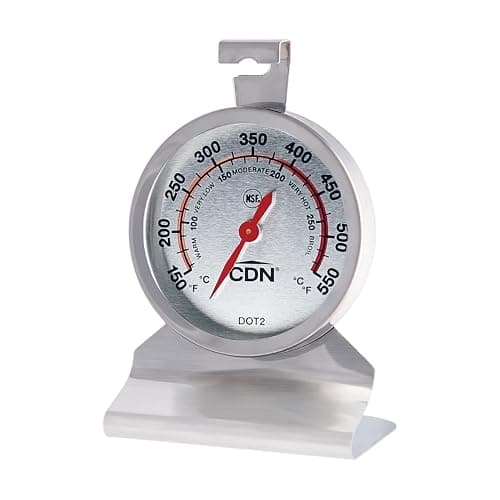
CDN DOT2 ProAccurate Oven Thermometer
The best of a category whose published accuracy is plus or minus 25 F. That is not a criticism of this unit - it is the honest ceiling of a bimetallic dial, and it is why we would spend the money on infrared instead.
Do I really need an infrared thermometer for pizza?+
Need, no. It becomes close to essential if you bake on a steel, on cast iron, on a grill or in a portable oven, because those are the cases where surface temperature cannot be inferred reliably from time and the oven dial.
Are cheap infrared thermometers accurate enough for pizza?+
On a stone, yes - a fixed-0.95 instrument is out by about 13 F on fired ceramic. On a seasoned steel the same gun reads roughly 40 to 83 F low, so either buy adjustable emissivity or learn your instrument's offset and apply it.
Infrared gun or oven thermometer first?+
Oven thermometer, if you have never verified that your oven reaches the temperature it claims. It is far cheaper and it answers the more basic question. The gun is the next step, not the first one.
What temperature should the stone read before I launch?+
500 to 550 F on the surface for a domestic-oven pizza. If your oven cannot get the surface past about 450 F no matter how long you wait, the oven is the problem and no surface will compensate.
Can I use it to measure the air in the oven?+
No. It reads surfaces only, so pointing it into an empty cavity measures the far wall. Air temperature is the dial thermometer's job.
Sources
Every number on this page came from one of these, or from arithmetic on one of these that we showed in full.