Heads up: some links on this page are affiliate links. If you buy through one we may earn a commission at no extra cost to you. It never changes a ranking, and we accept no payment for placement. The full version.
The short answer
As hot as your oven goes, which for a domestic oven is 500 to 550 F, with the surface given enough time to actually get there. There is no domestic pizza style that benefits from a lower setting.
By style
Style
Surface temperature
Bake time
Notes
New York, thin
500-550 F
6-9 min
The domestic sweet spot
Neapolitan-style at home
550 F plus broiler
4-6 min
A true Neapolitan needs 800 F plus; this is an approximation
Pan, Detroit, Sicilian
450-500 F
12-18 min
Lower and longer, because the dough is thick
Deep dish
425-450 F
25-35 min
Needs time for the middle, not heat for the base
Frozen pizza on a preheated surface
Box temperature, plus a hot surface
Per the box, minus 2-3 min
A preheated surface cooks it faster than the box assumes
500-550 F
Surface temperature, not dial setting
Those are different numbers, and during a preheat they can be 150 F apart. The dial is a setpoint for the air; the surface is what bakes the base.
When 500 F is the ceiling
Most domestic ovens stop at 500 or 550 F. That is genuinely limiting compared with a pizzeria deck at 700 F or a Neapolitan oven at 900. Four things get you closer:
A higher-effusivity surface. A steel at 500 F puts more heat into the base in the first thirty seconds than a stone at 550 does. This is the biggest single lever and it is covered in stone versus steel.
The broiler, after the launch. Bake on the surface for three or four minutes, then switch to broil for the last 60 to 90 seconds to finish the top. This is the standard workaround for the top-versus-base mismatch a fast base creates.
Rack position. Higher is hotter on top, lower is hotter underneath. If your base is done before the cheese, move up. If the reverse, move down.
A longer preheat. Free, and the thing most people are actually missing.
Check whether your oven is telling the truth
Domestic thermostats drift, and an oven running 50 to 100 F below its dial is common. It is also the cheapest possible explanation for a disappointing pizza, so rule it out first.
Put a thermometer in the middle of the cabinet, set 450 F, wait 20 minutes and read it. More than 25 F off and your oven is miscalibrated - many can be corrected in the control panel settings, and the manual will say how.
An oven does not hold a temperature, it cycles around one. Watching a dial for ten minutes tells you the amplitude of the swing.
Convection: yes for the top, no for the base
A convection fan moves air, which speeds up everything that is cooked by air - the top, the cheese, the cornicione. It does nothing for the base, which is cooked by conduction from the surface.
Which makes it useful when your base is running ahead of your top, and unhelpful when it is the other way around. Many ovens also drop the setpoint by 25 F automatically in convection mode, and for pizza you do not want that - set it back up.
The self-clean trick, and why we would not
A self-clean cycle reaches 800 to 900 F, and there is a well-known technique that involves starting a clean cycle, letting the oven reach temperature, then defeating the door lock to bake in it.
It does produce a genuinely better pizza. It also defeats a safety interlock on an appliance at 900 F, will void any warranty, and can damage the oven's controls. We are not going to recommend it, and we would rather say why than pretend it does not work.
The picks
What we would buy
ThermoWorks
ThermoWorks Industrial IR Gun (IR-GUN-S)
The adjustable emissivity is the reason to buy this rather than a cheap gun. Fixed-emissivity instruments read a seasoned steel 40 to 80 F low, and that is the difference between a good bake and a pale one.
#ad We hold no verified live price for this product, so we show none. How this site is funded.
CDN
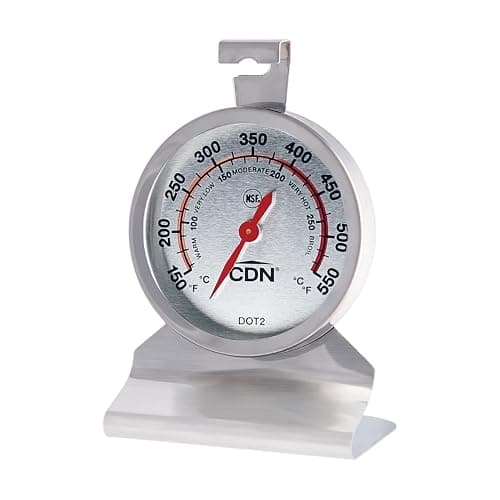
CDN DOT2 ProAccurate Oven Thermometer
The best of a category whose published accuracy is plus or minus 25 F. That is not a criticism of this unit - it is the honest ceiling of a bimetallic dial, and it is why we would spend the money on infrared instead.
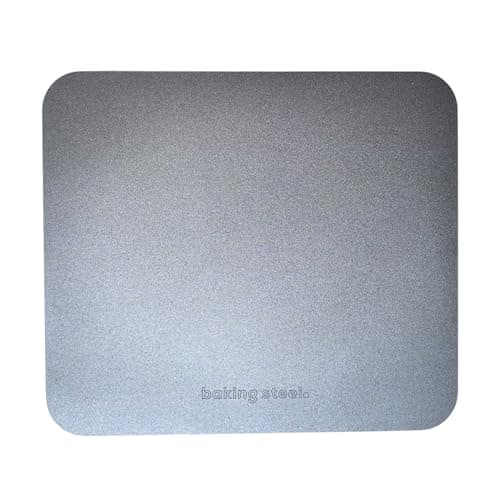
A quarter inch is the thickness where a steel stops being a novelty and stays a thing you can still lift. Its advantage over a stone is not preheat speed - it is what happens one second after the base lands.
What temperature should a home oven be for pizza?+
As hot as it goes - 500 to 550 F for most domestic ovens - with the baking surface given 25 to 45 minutes past the beep to actually get there. Lower settings only make sense for thick pan and deep-dish styles.
Can you cook pizza at 400 F?+
You can, and it will take 15 to 20 minutes and come out dry rather than crisp. The base sets slowly, moisture leaves rather than steaming out fast, and the top overcooks waiting for it.
Should I use convection for pizza?+
Only if the top is lagging behind the base. Convection speeds up air-driven cooking and does nothing for the base. Watch out for ovens that automatically drop the setpoint 25 F in convection mode.
What rack should pizza go on?+
Lower-middle for most home ovens. If the base browns before the cheese melts, move up one. If the top is done first, move down or finish under the broiler.
Is 550 F much better than 500 F?+
It helps, but less than a better surface does. Going from a stone to a steel at the same temperature changes the base more than 50 F of oven setting will.
Sources
Every number on this page came from one of these, or from arithmetic on one of these that we showed in full.