Skip to content
Peel & Flame
Head to head

Infrared vs Probe Thermometers

These measure three different things, and pizza only really cares about one of them.

By Scooter M./Published September 1, 2026

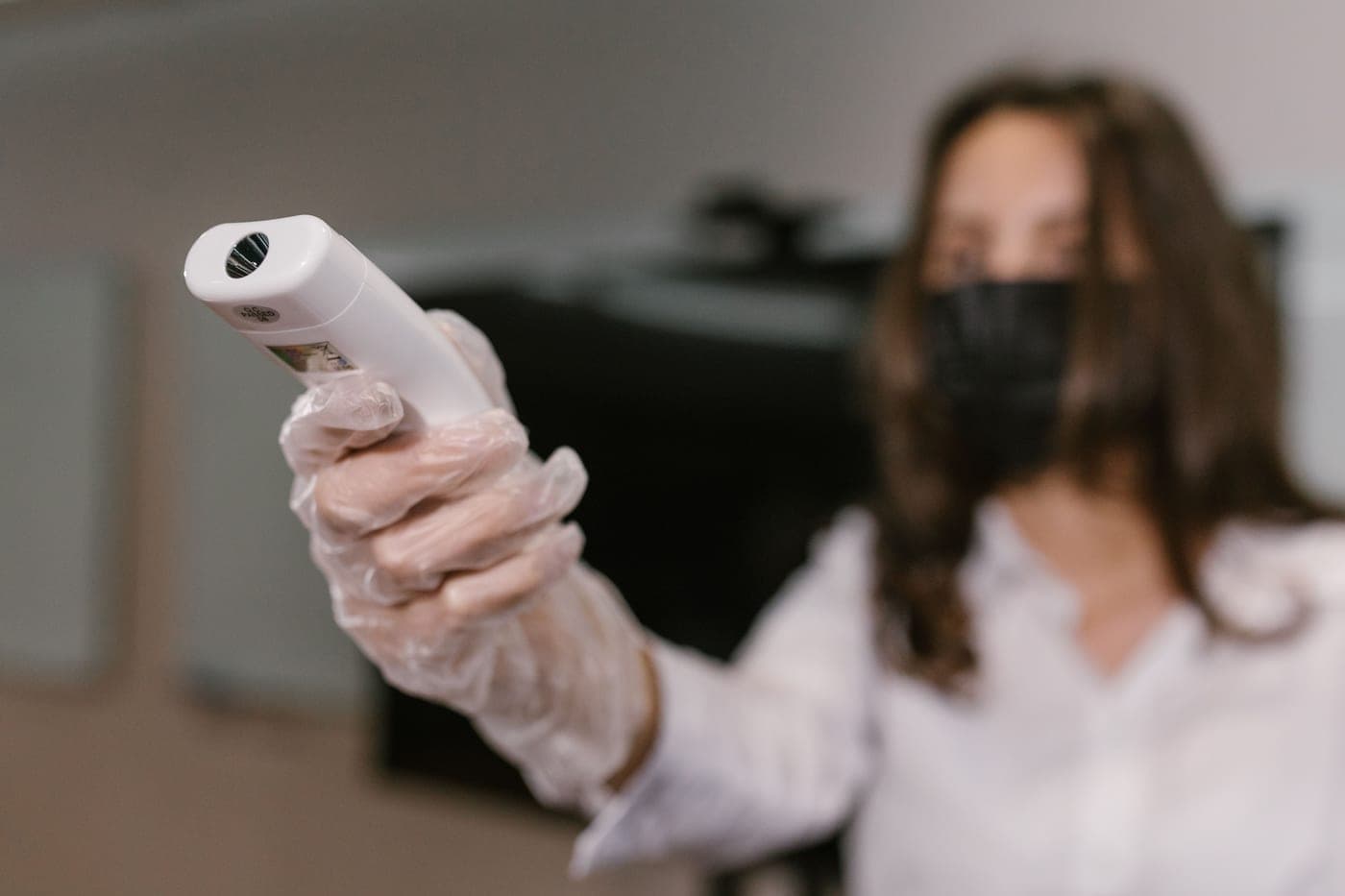
A hand-held infrared thermometer

Heads up: some links on this page are affiliate links. If you buy through one we may earn a commission at no extra cost to you. It never changes a ranking, and we accept no payment for placement. The full version.

Three instruments, three questions

InstrumentMeasuresTypical accuracyAnswers
InfraredSurface temperature, without contact+/- 2.7 F to +/- 2 percentIs my stone actually ready?
ProbeThe inside of something you can stick it into+/- 0.5 to 1.8 FWhat temperature is my dough?
Dial ovenCabinet air+/- 25 FIs my oven lying to me?

Surface

The only temperature that bakes your base

Air heats the top of the pizza and sets the cornicione. The base is a conduction problem between the dough and whatever it is sitting on, and only an infrared instrument reads that.

Why pizza is a surface problem

The base is cooked by conduction from the surface it is touching. How well that works is governed by the surface's temperature and by its thermal effusivity - the property covered in stone versus steel. Neither air temperature nor internal dough temperature has much to do with it.

Which is why the single most useful measurement in home pizza is an infrared reading of the surface, taken in the first two seconds after the door opens.

Where a probe still earns its place

Dough temperature at mixing. Final dough temperature is the variable that actually controls fermentation speed, and you set it mostly by choosing your water temperature. A probe closes that loop.

Proofing environment. Knowing that your oven-with-the-light-on sits at 82 F rather than 75 F changes your schedule by hours - see the proofing temperature guide.

Everything else you cook. A probe is the most generally useful thermometer in a kitchen. It just is not the pizza one.

The emissivity caveat, restated

A probe touches the thing and reads it directly. An infrared instrument infers a temperature from radiance, assuming an emissivity, and gets it wrong when that assumption is wrong.

On a seasoned steel - published emissivity 0.66 to 0.80 - an instrument fixed at 0.95 reads 40 to 83 F low. On ceramic, close to the 0.90 to 0.95 published for common brick, the same instrument is out by about 13 F. That is the argument for adjustable emissivity, and it is the only real weakness infrared has against contact measurement.

What we did not do

We have not baked on any of these. Every guide in this category says it tested a dozen stones; we would rather say plainly that we did not. What we did instead is on this page in full: published specs with their sources, thermal arithmetic from material constants with the working shown, and the makers' own manuals read rather than paraphrased.

What to buy, in order

First: an infrared thermometer with adjustable emissivity. It answers the question pizza is asking.

Second: an instant-read probe, if you do not already have one. Useful for dough temperature and for everything else you cook.

Third, optionally: a dial oven thermometer that lives in the oven, to watch the cabinet cycle without opening the door.
The picks

What we would buy

An infrared thermometer gun - a stand-in for the ThermoWorks Industrial IR Gun (IR-GUN-S), not a photograph of this model

ThermoWorks

ThermoWorks Industrial IR Gun (IR-GUN-S)

The adjustable emissivity is the reason to buy this rather than a cheap gun. Fixed-emissivity instruments read a seasoned steel 40 to 80 F low, and that is the difference between a good bake and a pale one.

Check price on Amazon

#ad We hold no verified live price for this product, so we show none. How this site is funded.

An infrared thermometer gun - a stand-in for the ThermoPro TP30 Infrared Thermometer, not a photograph of this model

ThermoPro

ThermoPro TP30 Infrared Thermometer

Adjustable emissivity at a budget-gun price, which is the combination that matters. Accuracy is looser than the ThermoWorks, but a correctable reading beats a precise wrong one.

Check price on Amazon

#ad We hold no verified live price for this product, so we show none. How this site is funded.

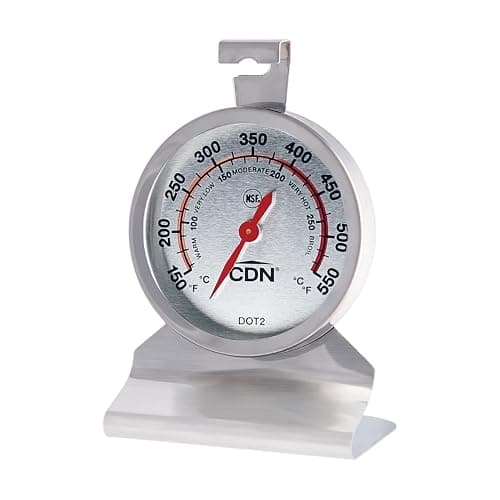
A dial thermometer - a stand-in for the CDN DOT2 ProAccurate Oven Thermometer, not a photograph of this model

CDN

CDN DOT2 ProAccurate Oven Thermometer

The best of a category whose published accuracy is plus or minus 25 F. That is not a criticism of this unit - it is the honest ceiling of a bimetallic dial, and it is why we would spend the money on infrared instead.

Check price on Amazon

#ad We hold no verified live price for this product, so we show none. How this site is funded.

Questions

Frequently asked

Do I need an infrared or a probe thermometer for pizza?
Infrared. The base is cooked by contact with the surface, and only an infrared instrument reads a surface without touching it. A probe is more useful for dough temperature and for the rest of your cooking.
Can a probe thermometer measure a pizza stone?
Not well. Pressing a probe tip against a flat hot surface gives you a reading dominated by the air around the tip, and you cannot insert it into a stone. It is the wrong tool for the shape.
What is the most accurate way to measure oven temperature?
For cabinet air, a good probe thermometer with a leave-in cable, which will beat any dial by an order of magnitude. For the surface the pizza sits on, infrared with the emissivity set correctly.
Should I measure the dough temperature?
If you want a repeatable schedule, yes. Final dough temperature after mixing sets how fast it ferments, and it is largely determined by your water temperature - so measuring it once or twice teaches you what water to use in your kitchen.

Sources

Every number on this page came from one of these, or from arithmetic on one of these that we showed in full.