Heads up: some links on this page are affiliate links. If you buy through one we may earn a commission at no extra cost to you. It never changes a ranking, and we accept no payment for placement. The full version.
The shortlist
Ranked, with the working
Ranked on published manufacturer specifications and, where the numbers exist, our own arithmetic on what each option does thermally. Tap any row for the full write-up, including who should skip it.
#
Product
Best for
Score
Price
01
Escali Primo P115 Digital Kitchen ScaleWeighing flour, water and finished dough balls
Scores are ours and editorial. They are never published as review or rating markup, because we have not baked on these products - here is how we pick.
Why we do not rank boxed kits
A typical boxed pizza kit contains a thin stone, a stamped peel and a wheel cutter. The stone is the part that determines whether the pizza is any good, and it is the part the price was taken out of - because a thicker stone costs more to make and far more to ship, while a shinier cutter costs almost nothing and makes the box look fuller.
So instead of ranking boxes, here is a five-item kit assembled from things we can source published specifications for, ordered by which item removes an actual failure first.
What we did not do
We have not baked on any of these. Every guide in this category says it tested a dozen stones; we would rather say plainly that we did not. What we did instead is on this page in full: published specs with their sources, thermal arithmetic from material constants with the working shown, and the makers' own manuals read rather than paraphrased.
The order, and why it is not the obvious one
1. A scale. Not exciting. It is first because it is the only way to make the same pizza twice, and until you can do that you cannot tell whether anything else you change helped. Weighing in baker's percentages turns cooking into an experiment you can learn from.
2. A bench scraper. The cheapest item here and the one that changes the most about handling dough - dividing a batch without deflating it, and lifting a stuck ball off the counter in one piece.
3. A peel. This is where most home pizzas are actually lost. A base that arrives folded is not a baking problem. A light perforated blade at your pizza's diameter, and the launching routine to go with it.
4. A baking surface. The biggest single upgrade to the pizza itself, and fourth on the list because it is the most expensive and the most size-dependent. Measure the rack before you buy.
5. An infrared thermometer. Last on the list and the most likely to produce an immediate visible improvement, because almost everybody discovers they have been baking 60 to 100 F cooler than they believed.
Scale, scraper, peel, surface, thermometer
The order in which each item stops being frustrating
It is close to the reverse of the order a boxed kit implies, which leads with the stone and the cutter.
What we deliberately left out
A cutter. Anyone making pizza owns something that cuts. A better cutter is a nice upgrade and it is not a kit item.
A dough mixer. Domestic pizza dough at 60 to 65 percent hydration is comfortably hand-mixable, and a long rest does most of the work kneading would.
A proofing box. Only earns its shelf above about a dozen balls at a time - the comparison.
A turning peel. Genuinely optional in a domestic oven, which heats evenly enough that most pizzas do not need turning.
A dough docker, a pizza saver, branded flour tins, and anything with a timer built into it.
Five items. Two of them cost very little, and those two are the ones we would not go without.
Building it in stages
Nobody has to buy all five at once, and buying them in the order above means each purchase is informed by what the previous one revealed.
Stage one - scale and scraper. Now your dough is repeatable and handles properly.
Stage two - peel. Now the pizza reliably reaches the oven in the shape you made it.
Stage three - surface and thermometer, together. The thermometer tells you whether the surface is doing what you paid for, so they belong in the same stage.
If you are choosing where to stop, stop after stage two. Stages one and two remove failures; stage three raises a ceiling.
In full
Every pick, with the specs and the sources
01 / Buy this first
Escali
8.6/10
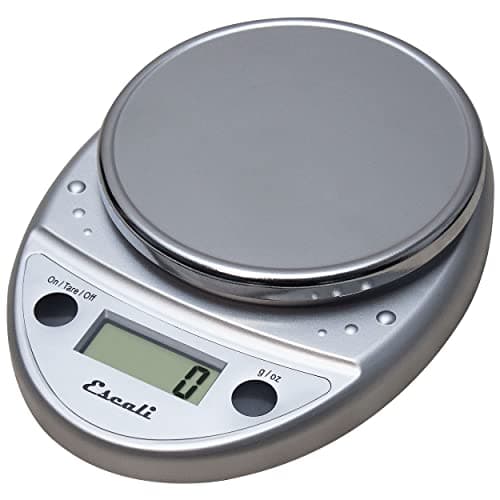
Escali Primo P115 Digital Kitchen Scale
Eleven pounds of capacity at one-gram resolution, which is exactly right for flour and dough balls and exactly wrong for yeast. Know which half of your recipe it is for.
What it does well
Five kilos of capacity means you can weigh flour straight into a mixing bowl and tare
One-gram steps are 0.36 percent of a 280 g dough ball - far finer than you can portion by hand
Four-minute auto shut-off is long enough not to die mid-recipe
Flat platform with nothing to trap flour
What it does not
1 g resolution is useless for yeast and marginal for salt
AA batteries rather than USB
The 8 by 6 inch footprint takes real counter space
Skip it if
You are scaling 2 grams of instant yeast. At 1 g resolution that is a 50 percent uncertainty, and no amount of care fixes it - you need a 0.1 g scale or a bigger batch.
One gram is precise for dough and useless for yeast. Here is where the line falls.
Resolution as a percentage of what you are weighing: a 280 g dough ball, 1 g = 0.36 percent. 500 g of flour, 1 g = 0.2 percent. 10 g of salt, 1 g = 10 percent. 2 g of instant yeast, 1 g = 50 percent. Anything under about 20 g is out of this scale's useful range, which is why a 1 kg by 0.1 g pocket scale is the cheapest genuine upgrade in the whole dough-tools category.
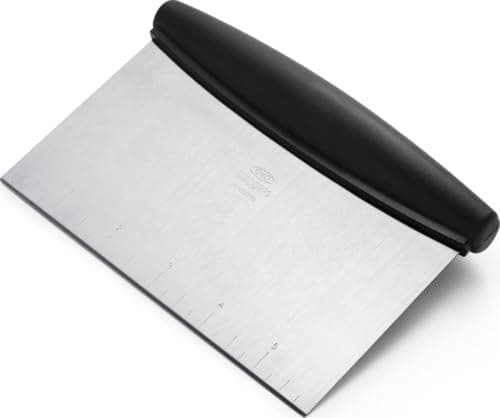
Six inches of stainless with inch markings etched into it. It divides dough, it lifts dough, and it measures the divisions - which is more than most single-purpose dough tools manage.
What it does well
Inch markings on the blade, so you can cut evenly without a ruler
Rigid enough to lift a whole ball off the counter cleanly
Non-slip handle stays usable with wet hands
Dishwasher safe
What it does not
Too rigid to scrape a bowl
Steel will scratch a soft counter finish
A six-inch blade is short for dividing a large bulk batch in one pass
Skip it if
You want a flexible bowl scraper. A rigid steel blade cannot follow the curve of a bowl, and that is a different tool.
Stock photo of the product type, not this model. We publish no product photography we cannot source.
Ooni
9.0/10
Ooni 14-Inch Perforated Pizza Peel
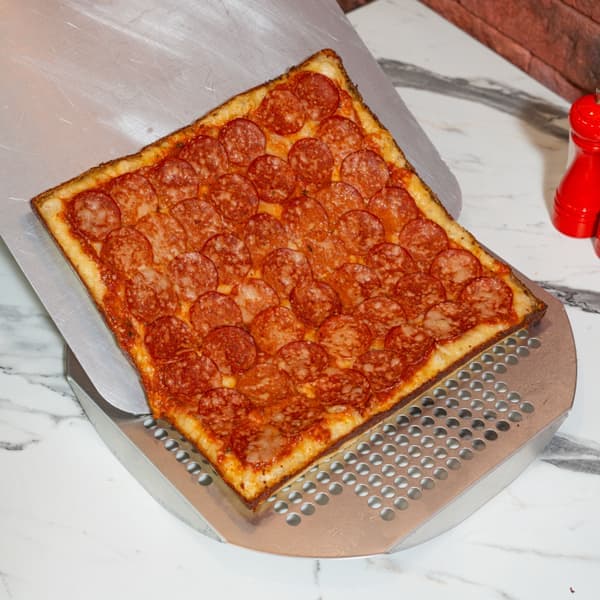
Perforations let flour fall off before the pizza does, and 610 grams across 14 inches is light enough to keep the launch steady. The best single peel for a home oven if you are only buying one.
What it does well
Perforations shed loose flour, which is what burns and smokes on the stone
610 g is light enough for a controlled launch
Fourteen inches handles anything a domestic oven will bake
Tapered edge genuinely does slide under a base rather than shoving it
What it does not
Aluminum is the wrong surface to build a pizza on - dress it and launch within a minute
The 27.5-inch overall length is awkward to store
Perforations trap dough scraps and want a brush
Skip it if
You build slow. Metal is a poor place to leave a dressed base sitting - the dough sweats onto it and welds itself down within a couple of minutes.
#ad We hold no verified live price for this product, so we show none. How this site is funded.
04 / The surface, sized to a home oven
Unicook
8.1/10
Unicook Heavy Duty Cordierite Pizza Stone, 15 x 12
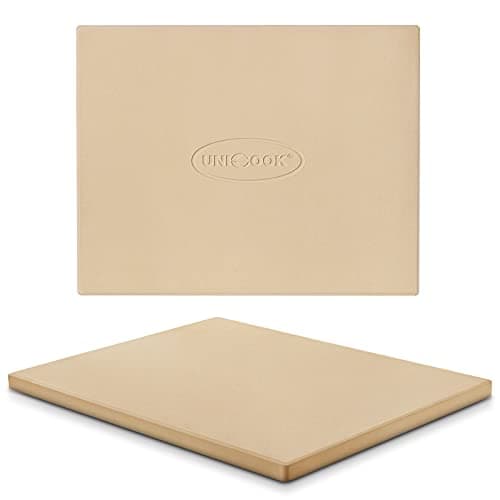
A rectangle uses an oven rack better than a circle does, and at 6.6 published pounds this is the lightest surface here that still holds a useful amount of heat.
What it does well
Rectangular, so it uses the whole rack
6.6 lb is genuinely easy to handle
Published thickness and weight
Rated for a grill as well as an oven
What it does not
Twelve inches of width is the real ceiling on pizza size, not fifteen
The same 6.6 lb figure appears against more than one size in the maker's own listings, so check the box you receive
Thin enough that a heavy bake pulls the surface temperature down noticeably
Skip it if
You want a 14-inch pizza. Twelve inches of usable width means a 12-inch pie with nothing to spare, and a base overhanging the stone bakes pale at the edge.
Stock photo of the product type, not this model. We publish no product photography we cannot source.
ThermoPro
8.6/10
ThermoPro TP30 Infrared Thermometer
Adjustable emissivity at a budget-gun price, which is the combination that matters. Accuracy is looser than the ThermoWorks, but a correctable reading beats a precise wrong one.
What it does well
Adjustable emissivity, which is the one spec that decides whether a reading on steel means anything
Same 12:1 optics and 1022 F ceiling as instruments costing far more
Manual published openly, which is more than most budget instruments manage
What it does not
1.5 percent at 500 F is about 7 F of uncertainty
Reads surfaces only, so it tells you nothing about cabinet air
No max/min tracking while you sweep
Skip it if
You need tight absolute accuracy. Plus or minus 1.5 percent at 500 F is around 7 F, against 2.7 F for the ThermoWorks.
#ad We hold no verified live price for this product, so we show none. How this site is funded.
Questions
Frequently asked
Are pizza making kits worth it?+
Rarely, because they economize on the baking surface - the item that decides whether the pizza is good - to pay for accessories that do not. Assembling the same budget yourself gets a much better result.
What do I need to start making pizza at home?+
A scale and a bench scraper, then a peel, then a baking surface and a thermometer. In that order, because the cheap items remove failures and the expensive ones raise a ceiling.
Do I need a pizza oven?+
No. A domestic oven at 550 F with a properly preheated surface makes an excellent New York-style pizza. It cannot make a true Neapolitan, which needs 800 F plus, and no accessory changes that.
What is the most important item to get right?+
The baking surface, for the pizza itself. The peel, for whether the pizza survives the trip to the oven. Which of those is your priority depends on which one is currently failing.
Sources
Every number on this page came from one of these, or from arithmetic on one of these that we showed in full.