Ranked on the three numbers that decide whether a launch works: blade width, blade weight and edge thickness. Two of these publish a temperature limit, which is two more than usual.
Heads up: some links on this page are affiliate links. If you buy through one we may earn a commission at no extra cost to you. It never changes a ranking, and we accept no payment for placement. The full version.
The shortlist
Ranked, with the working
Ranked on published manufacturer specifications and, where the numbers exist, our own arithmetic on what each option does thermally. Tap any row for the full write-up, including who should skip it.
#
Product
Best for
Score
Price
01
Ooni 14-Inch Perforated Pizza PeelLaunching, when you are only buying one peel
Scores are ours and editorial. They are never published as review or rating markup, because we have not baked on these products - here is how we pick.
Three numbers, and only three
Blade width has to be at least the diameter of the pizza. A 14-inch base on a 12-inch blade overhangs, catches on the way in, and folds. There is no technique that rescues this.
Blade weight decides whether you can keep it level at arm's length with a loaded pizza on it. Published weights across the peels here run from 530 g to 2.1 lb - a fourfold spread at comparable sizes. Under a kilo is the band to be in.
Edge thickness decides whether the peel slides under a base or shoves it. The Epicurean is an eighth of an inch; an Ooni turning peel is 0.6 inches at the head but tapers; a 12 mm bamboo board does not really taper at all. This is the number almost no listing gives you and the one that separates a launching peel from a serving board.
610 g
Published weight of the lightest 14-inch blade here
Against 2.1 lb - about 950 g - for the heaviest at a similar size. That is the difference between a wrist you can keep steady over a hot oven and one you cannot.
The two-peel system, and the honest one-peel compromise
Kitchens use two peels for one pizza because the two jobs need opposite properties. Raw dough sticks to metal and slides off wood, so wood launches. A baked base is rigid and needs a thin edge to get underneath it, and wood cannot be made thin enough at the tip, so metal retrieves.
If you buy one, buy a light perforated aluminum blade and change your habit: build fast, launch within about a minute, and give the peel a small shake every 20 seconds while you dress so the base never settles. If you build slowly - and anyone assembling a good pizza does - buy the wood one as well. It is the cheaper half of the pair.
What we did not do
We have not baked on any of these. Every guide in this category says it tested a dozen stones; we would rather say plainly that we did not. What we did instead is on this page in full: published specs with their sources, thermal arithmetic from material constants with the working shown, and the makers' own manuals read rather than paraphrased.
Perforations: what they are actually for
Not for the pizza. For the flour. Whatever you launch on ends up on the stone, where plain flour scorches within a minute and fills the kitchen with smoke. A perforated blade drops most of the excess before the pizza leaves the peel.
The costs are real and small: holes catch dough scraps and want a brush, and a perforated blade is marginally less rigid under a fully loaded 14-inch pizza. Neither outweighs not having a smoking oven. Longer version in perforated versus solid.
The launch is a single decisive movement: in at a shallow angle, tip down, then pull straight back. Hesitation is what folds pizzas.
The specification nobody publishes
A temperature limit. You hold this thing over a 500 F surface, and almost no maker tells you what it can take. Two here do, and both numbers are lower than people assume.
The Epicurean Richlite board is rated to 350 F. The 3003-H14 aluminum alloy most pressed metal blades are made from publishes a maximum mechanical service temperature of 360 F - the point at which the work-hardened temper begins to anneal out.
Neither number makes either a bad peel. Both mean the same thing: a peel is a transfer tool, not an oven tool. Seconds of contact with a hot surface are fine; parking it on the stone edge while you fetch the oregano is not.
What we would skip
Peels under 12 inches wide. They cap your pizza before you have started.
Very thick wooden boards sold as peels. If the leading edge is more than about 5 mm, it will shove a raw base instead of sliding under it and it certainly will not retrieve a baked one.
Peels with a fixed short handle. Your hand should stay outside the oven mouth. Around 24 inches of overall length is the working minimum for a domestic oven.
Silicone-coated blades. Silicone is not slippier than bare aluminum to wet dough and it adds thickness exactly where you want none.
In full
Every pick, with the specs and the sources
01 / Best overall
Stock photo of the product type, not this model. We publish no product photography we cannot source.
Ooni
9.0/10
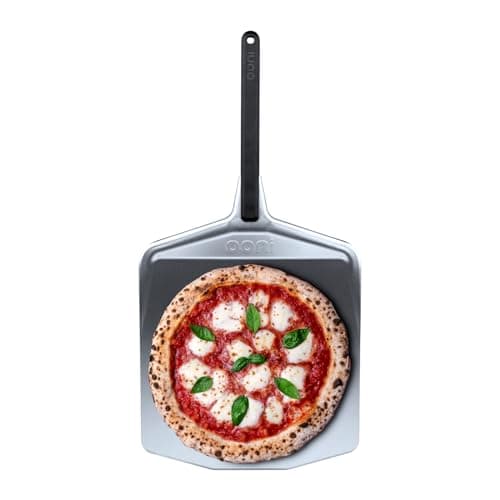
Ooni 14-Inch Perforated Pizza Peel
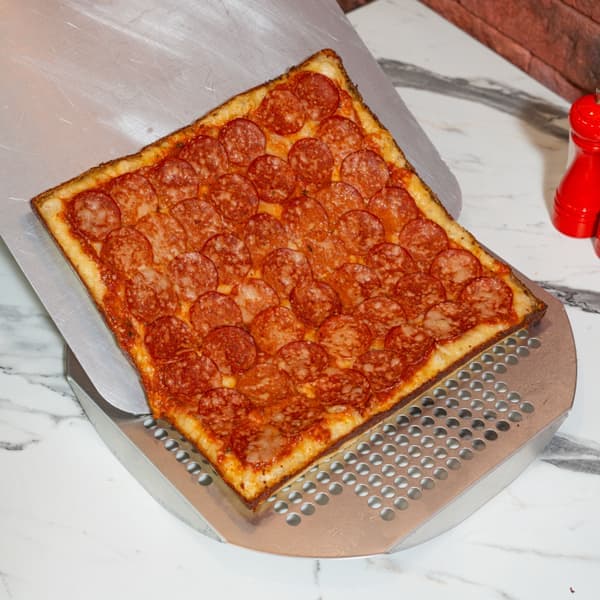
Perforations let flour fall off before the pizza does, and 610 grams across 14 inches is light enough to keep the launch steady. The best single peel for a home oven if you are only buying one.
What it does well
Perforations shed loose flour, which is what burns and smokes on the stone
610 g is light enough for a controlled launch
Fourteen inches handles anything a domestic oven will bake
Tapered edge genuinely does slide under a base rather than shoving it
What it does not
Aluminum is the wrong surface to build a pizza on - dress it and launch within a minute
The 27.5-inch overall length is awkward to store
Perforations trap dough scraps and want a brush
Skip it if
You build slow. Metal is a poor place to leave a dressed base sitting - the dough sweats onto it and welds itself down within a couple of minutes.
#ad We hold no verified live price for this product, so we show none. How this site is funded.
02 / Best to build on
Epicurean
8.0/10
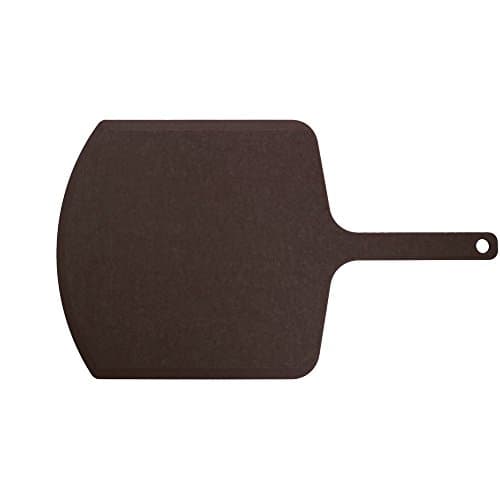
Epicurean Richlite Pizza Peel, 14 x 24
A pressed wood-fiber board that behaves like wood for launching and like a cutting board afterwards. The number that matters is the one nobody quotes: it is rated to 350 F, so it is a transfer tool, not an oven tool.
What it does well
An eighth of an inch of edge slides under a base far better than a 12 mm bamboo board
Dishwasher-safe composite that does not warp like solid wood
Publishes a temperature limit, which almost no peel maker does
What it does not
350 F limit means it never lives in the oven
2.1 lb is heavy for its size
The dark composite shows flour badly, which is cosmetic but noticeable
Skip it if
You expect to reach into the oven with it. At an eighth of an inch thick and rated to 350 F, this is not something to hold over a 500 F stone.
Stock photo of the product type, not this model. We publish no product photography we cannot source.
Ooni
8.2/10
Ooni 14-Inch Pizza Peel
The solid version of the same 14-inch blade. Slightly heavier than the perforated one, and slightly worse at shedding flour, but there is nothing for a scrap of dough to hook into.
What it does well
Nothing to clean out of holes
Stiff enough to lift a fully loaded 14-inch pizza
Same tapered edge as the perforated blade
What it does not
Carries loose flour straight onto the stone
Heavier than the perforated version at the same size
Same storage problem: it is 27.6 inches long
Skip it if
Excess flour is your problem. A solid blade carries every bit of it onto the stone, where it burns and makes the kitchen smell like a bonfire.
#ad We hold no verified live price for this product, so we show none. How this site is funded.
05 / Best peel that is also a board
Ooni
8.4/10
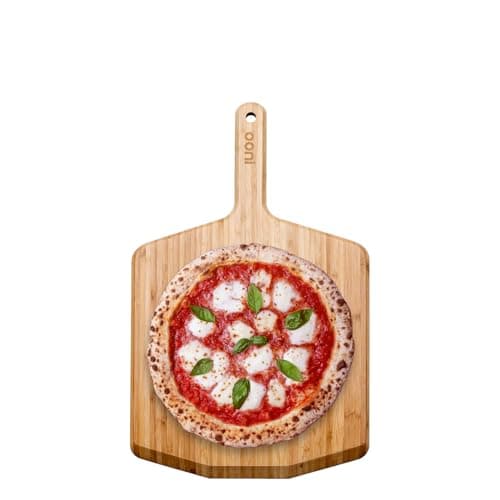
Ooni 12-Inch Bamboo Pizza Peel and Serving Board
Wood is the surface a raw base does not stick to, which makes this the thing you build on. It is also a serving board, which is the only honest reason a peel should be pretty.
What it does well
Raw dough does not weld itself to wood the way it does to metal
Doubles as the board you cut and serve on
12 mm of bamboo is stiff enough not to flex mid-launch
What it does not
Useless for retrieving or turning
Twelve inches caps your pizza size
Wood needs drying properly or it warps and splits
Skip it if
You want to retrieve with it. A 12 mm bamboo edge will not slide under a baked pizza without lifting the whole thing off the stone.
Wood to launch, thin metal to turn and retrieve. Raw dough releases from a porous wooden surface and welds itself to a smooth metal one within a couple of minutes, while a baked base needs a thin edge to get underneath - which wood cannot provide.
What size pizza peel do I need?+
At least the diameter of your pizza, and no wider than your baking surface. For a 14-inch pizza on a 16-inch stone, a 14-inch blade. The full sizing logic is in the size guide.
What can I use instead of a pizza peel?+
The back of a rimless baking sheet, an upturned rimmed sheet, or a stiff piece of cardboard covered in parchment. All three work and all three are worse: they are thicker at the edge, so they need more flour and a more confident launch.
How do you stop dough sticking to a wooden peel?+
Semolina or fine cornmeal rather than plain flour - coarser grains roll under the base like bearings. Then launch within a minute of dressing, and shake the peel every 20 seconds while you work so the base never settles into one position.
Is a perforated peel better?+
For launching, yes: it sheds the excess flour that would otherwise burn on your stone. For retrieving, a solid blade supports the whole base better. If you only buy one, perforated.
Sources
Every number on this page came from one of these, or from arithmetic on one of these that we showed in full.