Heads up: some links on this page are affiliate links. If you buy through one we may earn a commission at no extra cost to you. It never changes a ranking, and we accept no payment for placement. The full version.
What this review is
We have not turned pizzas with this peel. What follows is Ooni's published specification, what each figure means at the mouth of a very hot oven, and the honest case that most readers of this site do not need one. The method is on the methodology page.
What we did not do
We have not baked on any of these. Every guide in this category says it tested a dozen stones; we would rather say plainly that we did not. What we did instead is on this page in full: published specs with their sources, thermal arithmetic from material constants with the working shown, and the makers' own manuals read rather than paraphrased.
In a domestic oven a pizza bakes for six to nine minutes in fairly even heat, and if one side runs ahead you open the door and spin it with whatever you have. In a portable oven the bake is 60 to 90 seconds with a flame up one wall: the near edge chars while the far edge is still pale, and there is no time to fetch anything.
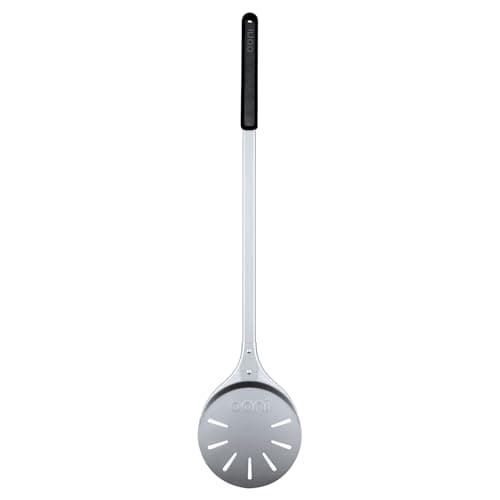
A launching peel is the wrong shape for that. A 14-inch blade lifts the entire pizza, drags it out of position and interrupts the bake. A 7-inch head slides under part of the base, lifts it a few millimeters and lets you spin it in place.
31.5 in
Overall length - the specification that keeps your forearm outside the oven mouth
At 900 F the reach is not a convenience feature. It is the difference between turning a pizza and reaching into a fire with a short tool.
The three numbers that matter
One pound. Light enough to use one-handed at the end of a 31.5-inch lever, which is what you need when the other hand is holding the oven door or a plate. A heavier turning peel would be unusable at this length.
Thirty-one and a half inches. Reach. Compare with the Gozney acacia placement peel at 25 inches overall - fine for placing, short for working inside a live oven.
Nought point eight inches of blade. This is the figure to weigh against the 9-inch version, which publishes 0.6. A thinner blade slides under a cooking base more easily; a smaller head disturbs less of the pizza. They pull in opposite directions, which is the whole 7-versus-9 decision.
7 or 9?
Take the 7 if your oven mouth is narrow, or if what you want is a quarter turn every twenty seconds. A smaller head under part of the pizza is the precise tool for that.
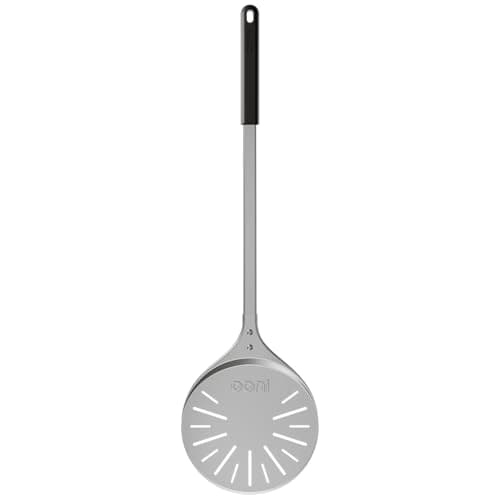
Take the 9 if you also want to lift a whole 12-inch pizza clear - to check the base, to reposition it, or to bring it forward before retrieving. Its 0.6-inch blade gets under a set base more easily, at the cost of needing more width through the opening.
Both weigh the same pound, so this is not a strength question. It is about what you do in the last thirty seconds of a bake. The pair are ranked against each other in the turning peel roundup.
Indoors this tool solves a problem you do not have. Outdoors it is the difference between an evenly baked pizza and a black edge.
What it cannot do
It cannot launch. Seven inches of head will not carry a 12-inch dressed base, and nothing about the shape is designed to.
It cannot retrieve. You can drag a pizza forward with it, but taking a finished pizza out wants a full blade - the perforated 14 we review separately is the tool for that.
It does not store conveniently. Thirty-one and a half inches goes on a hook or leans in a corner. It does not go in a drawer.
It is genuinely optional in a kitchen oven. We say this on every page where it comes up, including the portable oven accessories guide, because it is the most common way to waste money in this category.
On the price, honestly
This is an expensive tool for a single job, and cheaper turning peels exist from several brands. If you buy one of those, the two specifications to check are the blade thickness - thin enough to get under a cooking base - and the handle material, because a bare metal handle at a 900 F oven mouth is a burn waiting to happen. Ooni publishes both figures; most budget listings publish neither, which is the real difference you are paying for.
Who should buy it
Buy it if you own a portable gas or wood-fired oven. It stops being optional the moment the bake drops under two minutes.
Buy the 9-inch instead if you want one tool that also lifts a whole pizza clear, and your oven mouth is wide enough.
Do not buy either for a domestic oven. Buy a better launching peel and a thermometer, both of which change more - the ranked options are in the peel roundup.
The verdict
A well-specified, single-purpose tool that is essential in exactly one context and useless outside it. Ooni publishes the reach, the weight and the blade thickness, which is more than its cheaper rivals do, and those three numbers are the entire reason to choose one turning peel over another.
The picks
What we would buy
Ooni
Ooni 7-Inch Pizza Turning Peel
A pound of aluminum on a 31.5-inch shaft. Its whole job is to lift and spin a pizza that is already cooking, and nothing else here can do that.
Two inches more head and a slimmer blade than the 7-inch, at the same one pound. Better for lifting a whole 12-inch pizza clear; slightly clumsier for a quarter turn.
Perforations let flour fall off before the pizza does, and 610 grams across 14 inches is light enough to keep the launch steady. The best single peel for a home oven if you are only buying one.
#ad We hold no verified live price for this product, so we show none. How this site is funded.
Questions
Frequently asked
Do I need a turning peel?+
Only if you cook in a portable or wood-fired oven, where a 60 to 90 second bake with one-sided heat has to be turned. In a domestic oven you can spin a pizza with the peel you already own.
Ooni 7-inch or 9-inch turning peel?+
The 7 for precise quarter turns and narrow oven mouths; the 9 if you also want to lift a whole 12-inch pizza clear. Both weigh a pound; the 9 has the thinner blade at 0.6 inches against 0.8.
Can a turning peel launch a pizza?+
No. The head is far too small to carry a dressed base. It is a mid-bake tool only, and you still need a launching peel.
Is it worth the money over a cheaper turning peel?+
What you are paying for is published specification - blade thickness and a heat-resistant handle material, both of which Ooni states and most budget listings do not. If a cheaper peel publishes both, it is a reasonable substitute.
How long is the Ooni turning peel?+
31.5 inches overall for the 7-inch head, 32.2 for the 9-inch. That length is a safety specification at a 900 F oven mouth, not a convenience.
Sources
Every number on this page came from one of these, or from arithmetic on one of these that we showed in full.