Heads up: some links on this page are affiliate links. If you buy through one we may earn a commission at no extra cost to you. It never changes a ranking, and we accept no payment for placement. The full version.
The shortlist
Ranked, with the working
Ranked on published manufacturer specifications and, where the numbers exist, our own arithmetic on what each option does thermally. Tap any row for the full write-up, including who should skip it.
#
Product
Best for
Score
Price
01
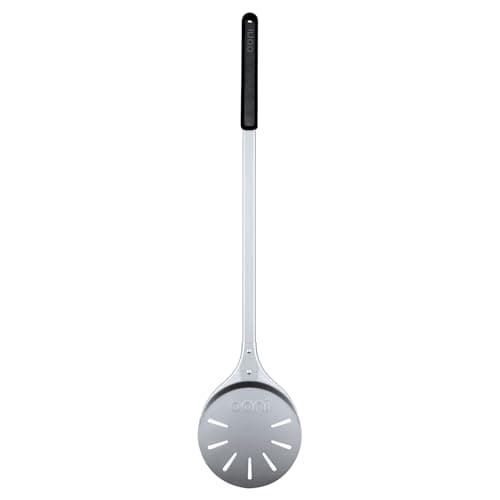
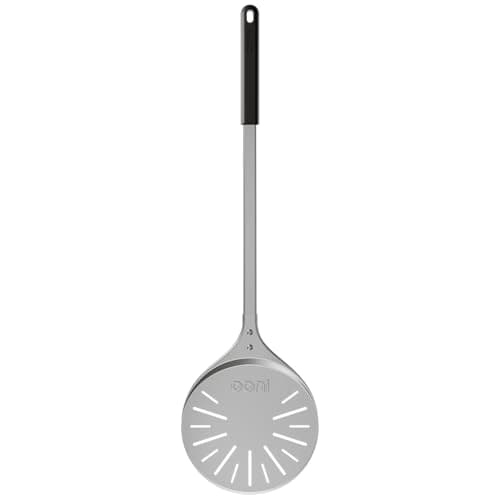
Ooni 14-Inch Perforated Pizza PeelLaunching, when you are only buying one peel
Scores are ours and editorial. They are never published as review or rating markup, because we have not baked on these products - here is how we pick.
What changes when the oven runs at 900 F
A domestic oven bakes a pizza in six to nine minutes at 500 to 550 F, through a wide door, with your hand a comfortable distance from anything. A portable gas or wood-fired oven bakes the same pizza in 60 to 90 seconds at up to 950 F, through a mouth barely taller than the pizza, with a flame at the back. Three consequences reorder the peel criteria completely.
Reach becomes a safety spec. Indoors, handle length is about leverage. Outdoors it is what keeps your hand outside the mouth. Ooni's peels run 26 to 32 inches overall; that length is the point, not a storage inconvenience.
Loose flour becomes smoke immediately. Flour that survives a 550 F oven for six minutes carbonizes on a 900 F floor in seconds. A perforated blade sheds it before the pizza lands.
You need two peels, not one. This is the part nobody says out loud when selling a single peel. A 60-second bake with one-sided heat has to be turned, and a launching peel is the wrong shape to turn with - the full case is in the portable oven accessories guide.
What we did not do
We have not baked on any of these. Every guide in this category says it tested a dozen stones; we would rather say plainly that we did not. What we did instead is on this page in full: published specs with their sources, thermal arithmetic from material constants with the working shown, and the makers' own manuals read rather than paraphrased.
What we ranked on
Blade width against the oven mouth, not against the pizza. Indoors the rule is simple: the blade must be at least as wide as the base. Outdoors there is a second ceiling - the opening. A 14-inch blade entering a 12-inch oven is not a peel, it is a doorstop. Measure the mouth before you buy, because the pizza size the oven is sold on is not the same number.
Overall length. Published, and worth reading: 26 inches for the Ooni 12, 27.5 for the perforated 14, 31.5 and 32.2 for the two turning peels. The longer shafts are what let you reach the back of a hot chamber without leaning your forearm over the mouth.
Weight, which matters more here than indoors. A launch you are making quickly, at arm's length, through a small opening, is a controlled movement. The perforated 14 is 610 g. The solid 14 is 680 g. That difference is small on paper and noticeable at the end of a 27-inch lever.
Handle material at the mouth. Every peel here uses glass-reinforced nylon rather than bare metal, which is the correct choice for a tool whose handle sits by an opening radiating serious heat. Bare aluminum handles exist and we would not buy one for this job.
The two-peel setup, and why it is not an upsell
A wooden or bamboo board to build on, a perforated metal blade to launch with, and a turning peel to work the bake. Three tools sounds like a lot until you look at what each one is doing in a 90-second window.
Job
Right tool
Why not the others
Building and dressing
Wood or bamboo board
Dough sweats onto aluminum and welds down within a couple of minutes
Launching
Perforated aluminum, 12 or 14 inch
Wood is thicker at the edge and carries flour straight onto a 900 F floor
Turning mid-bake
7 or 9 inch turning peel
A full-size blade lifts the whole pizza and drags it off position
Retrieving
Either metal peel
Bamboo scorches against a hot floor and a stone edge
60-90 s
A bake at 900 F, against six to nine minutes in a kitchen oven
Everything on this page follows from that number. There is no time to fetch a different tool, no time to correct a bad launch, and no time to think about which end of the peel you are holding.
Sizing to your oven, model by model
12-inch ovens (Koda 12, Karu 12, Fyra 12, Volt 12) take a 12-inch blade. A 14 will not clear the opening comfortably, and you will be launching a 10 to 11 inch pizza in practice once you allow margin on the stone. The Ooni 12 peel is 1.19 lb and 26 inches long.
16-inch ovens (Koda 16, Karu 16) take the 14-inch blades happily and reward the extra reach, because the chamber is deeper as well as wider.
Turning peel size is the opposite decision from launching. The 7-inch head lifts part of the pizza, which is what a quarter turn wants. The 9-inch lifts the whole thing clear, which is what you want for a final rotation or to pull a pizza toward the mouth - and its 0.6 inch blade is thinner, so it slides under a cooking base more easily. Narrow mouth: take the 7.
The tool that does nothing indoors and everything outdoors. A 60-second bake with a flame up one wall has to be turned, and a launching peel is the wrong shape for it.
Honest downsides, on every pick
The perforated 14 is the best launcher here and a poor place to build a pizza. Dress it and launch inside a minute, or the base sweats onto the aluminum and tears on the way out. It is also 27.5 inches to store and the holes trap dough scraps.
The 7-inch turning peel cannot launch and cannot retrieve. It does one job and is genuinely optional in a domestic oven - it earns its place only because a portable oven demands turning.
The 12-inch peel is a hard ceiling on pizza size. If you later move to a 16-inch oven it does not come with you.
The 9-inch turning peel is a lot of width through a small mouth, and at 32.2 inches it is the longest thing in this list to store.
The bamboo board is for building and serving. Do not put it against a hot stone to retrieve with - it will scorch, and the thickness that makes it a good board makes it a poor launcher.
What we would actually buy
For a 16-inch oven: the perforated 14 and the 7-inch turning peel. Two tools, both used every bake, and the bamboo board only if you do not already own a board you like.
For a 12-inch oven: the Ooni 12 peel and the 7-inch turning peel, for the same reasons at a smaller scale.
And if you are launching badly rather than turning badly, the fix is technique before hardware - how to launch a pizza costs nothing and solves more than any peel purchase does.
In full
Every pick, with the specs and the sources
01 / Best launcher
Stock photo of the product type, not this model. We publish no product photography we cannot source.
Ooni
9.0/10
Ooni 14-Inch Perforated Pizza Peel
Perforations let flour fall off before the pizza does, and 610 grams across 14 inches is light enough to keep the launch steady. The best single peel for a home oven if you are only buying one.
What it does well
Perforations shed loose flour, which is what burns and smokes on the stone
610 g is light enough for a controlled launch
Fourteen inches handles anything a domestic oven will bake
Tapered edge genuinely does slide under a base rather than shoving it
What it does not
Aluminum is the wrong surface to build a pizza on - dress it and launch within a minute
The 27.5-inch overall length is awkward to store
Perforations trap dough scraps and want a brush
Skip it if
You build slow. Metal is a poor place to leave a dressed base sitting - the dough sweats onto it and welds itself down within a couple of minutes.
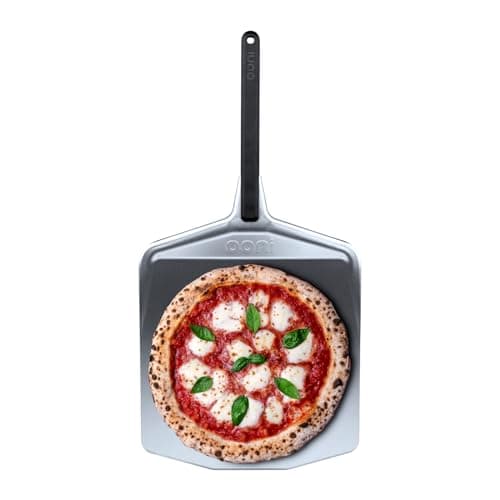
Two inches more head and a slimmer blade than the 7-inch, at the same one pound. Better for lifting a whole 12-inch pizza clear; slightly clumsier for a quarter turn.
What it does well
Thinner blade at 0.6 inches slides under a cooking base more easily
Wide enough to lift a 12-inch pizza clear of the stone
Same weight as the 7-inch despite the extra area
What it does not
Nine inches is a lot of width through a small oven mouth
Still only does one job
Longer overall than the 7-inch, which does not help storage
Skip it if
Your oven mouth is narrow. Nine inches of head plus your hand angle is a lot of width to get through a small opening.
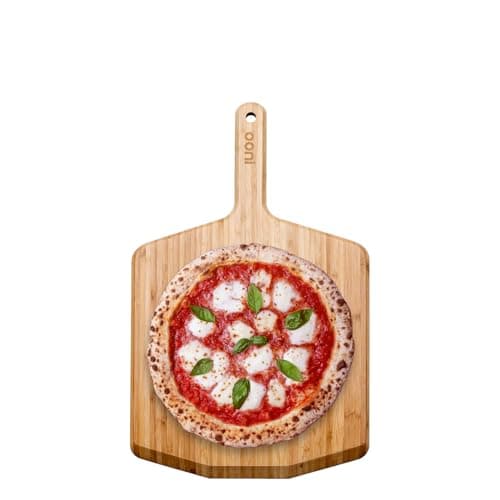
Wood is the surface a raw base does not stick to, which makes this the thing you build on. It is also a serving board, which is the only honest reason a peel should be pretty.
What it does well
Raw dough does not weld itself to wood the way it does to metal
Doubles as the board you cut and serve on
12 mm of bamboo is stiff enough not to flex mid-launch
What it does not
Useless for retrieving or turning
Twelve inches caps your pizza size
Wood needs drying properly or it warps and splits
Skip it if
You want to retrieve with it. A 12 mm bamboo edge will not slide under a baked pizza without lifting the whole thing off the stone.
Match the blade to the oven mouth, not to the pizza: 12 inches for the 12-inch models, 14 for the Koda 16 and Karu 16. A blade wider than the opening cannot be angled in cleanly no matter how good your technique is.
Do I really need a turning peel for a portable oven?+
Yes, effectively. A 60 to 90 second bake with a flame up one wall chars the near edge while the far edge is still pale, and a full-size launching blade lifts and drags the whole pizza instead of rotating it.
Perforated or solid for an outdoor oven?+
Perforated. Loose flour that merely toasts in a 550 F kitchen oven carbonizes and smokes within seconds on a 900 F floor, and the holes drop most of it before the pizza lands.
Can I use my kitchen pizza peel outdoors?+
If it fits the mouth and has a heat-tolerant handle, yes. The two things that catch people out are a blade wider than the opening and a wooden peel used to retrieve, which scorches against a hot floor.
How long should the handle be?+
Long enough that your hand stays outside the mouth. Ooni publishes 26 to 32 inches overall across these peels, and that is the range to shop in for an oven this hot.
Sources
Every number on this page came from one of these, or from arithmetic on one of these that we showed in full.