What this review is
We have not baked a year of pizza on this stone. What follows is its published specification, the arithmetic that specification supports, and one measurement from an oven maker that decides it against the bigger stone people usually compare it to. The method is on the methodology page.
What we did not do
We have not baked on any of these. Every guide in this category says it tested a dozen stones; we would rather say plainly that we did not. What we did instead is on this page in full: published specs with their sources, thermal arithmetic from material constants with the working shown, and the makers' own manuals read rather than paraphrased.
The published specification
| Specification | Published figure |
|---|
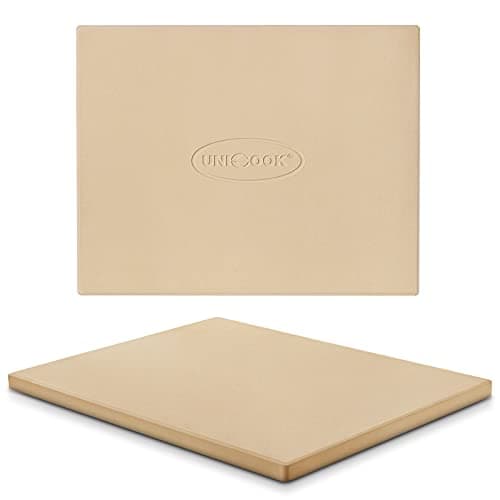
| Dimensions | 15" x 12" x 0.6" (15 mm) |
| Weight | 6.6 lb per the Walmart listing, 6.8 lb in the Amazon listing title |
| Material | Cordierite, kiln-sintered |
| Heat resistance | 1450 F (787 C) |
| Rated for | Oven and grill |
Two published weights for one stone is a small thing, and we flag it for the same reason we flagged three weights for one Emile Henry: a maker that cannot state its own mass consistently has not measured what it is selling as carefully as its listing implies. We use the lower figure throughout, because it is the one on the retailer page with a full spec table rather than in a title.
What 0.6 inches actually stores
Run the published dimensions and the published weight through the cordierite constants and the stone stops being adjectives:
| Figure | This stone | Old Stone 16" round |
|---|
| Baking surface | 180 sq in | 201 sq in |
| Published weight | 6.6 lb | 7.3 lb |
| Mass per unit area | 25.8 kg/m2 | 25.5 kg/m2 |
| Energy stored, 68 to 500 F | 0.165 kWh | 0.182 kWh |
| 95% of oven temperature | 24 min | 25 min |
The two stones are the same stone per square inch. Mass per unit area differs by one percent, and that number - not the diameter on the box - is what sets how much heat the base of your pizza can draw. The 16-inch round holds 10 percent more energy because it is 10 percent bigger, not because it is better built.
Its derived density lands at about 1,692 kg/m3, roughly a fifth below the textbook 2,100 for a dense cordierite body. That is not a defect. It is porosity, it is what lets an unglazed stone wick moisture out of the base, and it is the finding that reordered our cordierite versus ceramic comparison.
The measurement that decides it: your oven rack
Here is the case for this stone that no listing makes. GE publishes rack dimensions for its wall ovens, and a 30-inch convection oven's rack is 23.78 inches wide by 14.81 inches deep. A 16-inch round stone needs 16 inches of depth. It does not fit inside that rack's footprint - it overhangs, front to back, unsupported at the very edges where a heavy ceramic slab least wants to be unsupported.
14.81 in
Rack depth in a 30-inch GE convection wall oven
A 15 by 12 rectangle lays across it with two inches to spare. A 16-inch round does not fit it at all. Convection racks are shallower than non-convection ones - 14.81 inches against 17.25 - so the oven most people buy for pizza is the one least able to take a big round stone.
That is why a rectangle is the right shape for a home oven and why 15 by 12 is close to the sweet spot: it uses the width a rack actually has and stays inside the depth it actually has. Our stone size guide works through the same arithmetic for every oven size.
The real ceiling is 12 inches, not 15
The number on the box is the long edge. The number that limits your pizza is the short one. Twelve inches of usable width means a 12-inch pizza with nothing to spare, and a base that overhangs the stone bakes pale at the edge because there is no hot surface under it.
If you want a 14-inch pizza, this is the wrong stone and no amount of preheating fixes it. If you want 12-inch pizzas - which by our dough ball weight chart is a 284-gram ball at standard thickness - it is sized correctly with the margin a launch needs.
What it does not publish
A thermal shock rating. The 1450 F figure is a heat-resistance number, not a statement about how fast a temperature change it survives, and thermal shock is what actually breaks stones. The failure modes are in why pizza stones crack.
A consistent weight. Covered above, and the reason our arithmetic shows its working rather than asking you to trust a number.
Any figure for the body itself. No density, no conductivity, no specific heat - which is normal for bakeware and is why we compute from the material constants and label every derived figure as ours.
Living with it
At 6.6 lb this is genuinely easy to handle, which matters more than enthusiasts admit: a stone you can lift with one hand gets used, and a 25-pound slab gets left in the oven until it is in the way. Preheat from cold with the stone already on the rack and give it the full 24 minutes from the table - the arithmetic behind that number is in how long to preheat a pizza stone.
It will stain on the first bake and stay stained. That is what unglazed means, it is not damage, and soap makes it worse rather than better - the cleaning guide has the method.
Who should buy it
Buy it if you bake 12-inch pizzas in a domestic oven and want the most surface that reliably fits a real rack, at a price that is a fraction of the premium stones. It is the default recommendation for a reason.
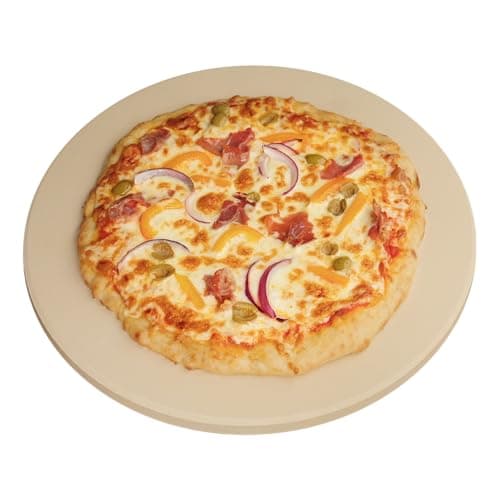
Buy the 16-inch round instead if you have measured your rack depth and know it takes 16 inches, and you want 14-inch pizzas. Per square inch it is the same stone.
Buy a steel instead if your complaint is that the base is not browning fast enough. That is a conductivity problem, not a size problem, and it is settled in stone versus steel.
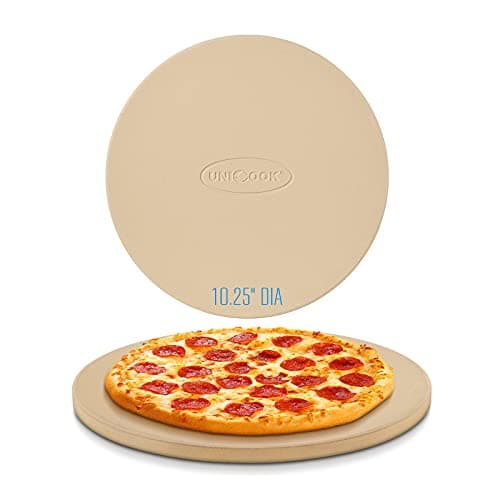
Buy the 10.25-inch round instead if your oven is a countertop one - the small-oven roundup covers what fits and what it costs you.
The verdict
An unglamorous rectangle that gets the two decisions right: enough mass per square inch to match stones costing several times more, and a footprint that fits the oven rack most people actually own rather than the one on the box photo. Its sins are administrative - two published weights, no thermal shock figure - rather than structural. The 12-inch usable width is the thing to check against your ambitions before you buy, because it is the one limit no technique gets around.