Heads up: some links on this page are affiliate links. If you buy through one we may earn a commission at no extra cost to you. It never changes a ranking, and we accept no payment for placement. The full version.
What this review is
We have not baked on this stone. What follows is every figure the listing publishes, the arithmetic those figures allow, and how it lands against two cordierite stones we already rank. The unusual thing about the ROCKSHEAT is that it publishes enough to be checked at all - most stones at this price publish a footprint and the word cordierite.
What we did not do
We have not baked on any of these. Every guide in this category says it tested a dozen stones; we would rather say plainly that we did not. What we did instead is on this page in full: published specs with their sources, thermal arithmetic from material constants with the working shown, and the makers' own manuals read rather than paraphrased.
The published specification
Specification
Published figure
Size
15" round
Stone thickness
0.63"
Overall height
0.67"
Weight
7 lb
Material
Cordierite, fired in a 2200 F kiln
Heat resistance
1400 F in normal use
Handles
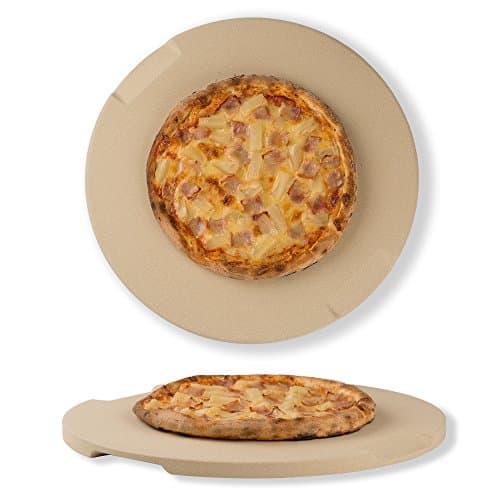
Built-in grooves on both faces
A thickness AND a weight in the same listing is rare enough to be worth saying twice, because together they let a reader check the maker's arithmetic instead of trusting it.
The numbers check out, and here is the check
Run the published 15-inch diameter and 0.63-inch thickness and you get a volume of 1.82 liters. Divide the published 7 lb into that and the effective density comes out at 1,740 kg/m3.
1,740 kg/m3
Derived density of the ROCKSHEAT, from its own published size and weight
The Old Stone 16-inch derives 1,703, the Unicook 15 by 12 derives 1,692 and Ooni's published weight for the Karu 12 stone derives 1,696. Four unrelated stones, all within about 3 percent. The published figures here are consistent with a real cordierite body.
That matters for two reasons. It tells you the listing is not quoting a weight from a different product, which happens more than it should in this category. And it confirms that bakeware cordierite really does run about a fifth below the textbook 2,000 to 2,200 kg/m3 for a dense body - the porosity finding that the stone roundup is built on.
From the same figures our preheat model gives a time constant of about 8.8 minutes, so roughly 26 minutes to reach 95 percent of oven temperature and about 41 to reach 99. It holds around 0.175 kWh at 500 F. Those are ordinary numbers for a stone this size, which is the correct result - a stone with handles is still a stone.
The handles are the product
Cut into both faces, so the stone works either way up. What they buy is the one thing no other stone here offers: you can get hold of it. Moving a 7 lb slab at 500 F normally means two oven gloves, a peel, and a plan. With grooves you can get gloved fingertips under it.
The cost is usable area, and this is the part the listing does not draw attention to. The grooves are taken out of the baking surface, so a 15-inch stone is not 15 inches of usable round. In practice you are placing a 12 to 13 inch pizza on it comfortably, which is the same working size as a 14-inch plain round.
Whether that trade is worth it depends entirely on one question: do you take the stone out of the oven? If it lives on the middle rack permanently - which is what we recommend for any heavy stone, and why is covered in how long a stone stays hot - the handles are dead weight and you should buy the extra area instead. If you move it, they are the best feature on any stone on this site.
Handles change one thing that matters and nothing else: whether a hot stone is something you can pick up at all.
About that 1400 F
It is the most prominent number in the listing and it decides nothing. Published material data puts cordierite's maximum service temperature at 1150 C, which is 2102 F, and a domestic oven runs to roughly 550 F. Every cordierite stone sold clears an oven by a factor of two or more.
What actually breaks stones is a temperature difference across the body, not an absolute temperature - the mechanism is in why pizza stones crack, and the property that governs it is thermal expansion, which nobody in this category publishes. The useful part of the ROCKSHEAT listing is not the 1400 F. It is the word cordierite, for the reasons set out in cordierite versus ceramic.
Against the two stones we already rank
ROCKSHEAT 15" round
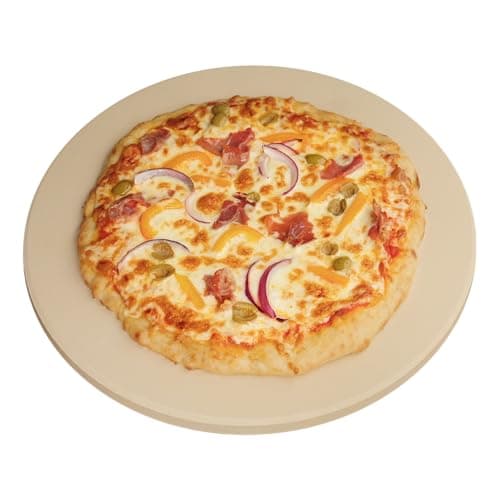
Old Stone 16" round
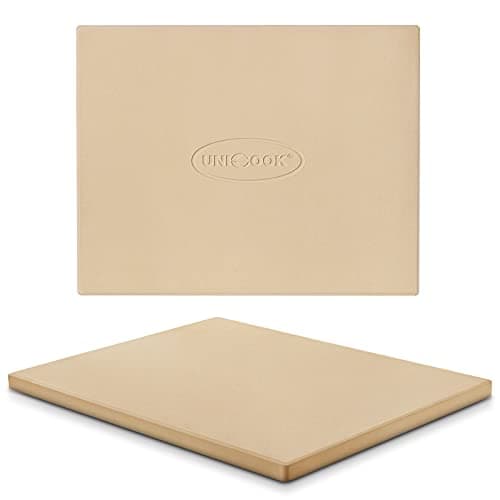
Unicook 15 x 12
Published thickness
0.63"
0.59"
0.6"
Published weight
7 lb
7.3 lb
6.6 lb
95% of oven temperature
about 26 min
about 25 min
about 24 min
Handles
Yes, both faces
No
No
Shape
Round
Round
Rectangular
They are, thermally, the same product. That is not a criticism of any of them - it is what cordierite bakeware is. The decision between them is shape, usable area and whether you want handles, and there is no crust difference hiding behind those three.
Who should buy it
Buy it if you take the stone out of the oven - to clean it, to store it, to use the rack for something else - and you have ever tried to do that with a plain slab. The grooves solve a real, weekly annoyance.
Buy the Old Stone instead if the stone lives in the oven. You get an inch more diameter and the full round is usable.
Buy the Unicook instead if your rack is rectangular and you want the corners. A rectangle uses an oven rack better than any round does.
Buy a steel instead if the complaint that brought you here is a pale base rather than a handling one. No cordierite stone fixes that - stone versus steel has the numbers.
The verdict
An honest stone with an unusually honest listing. The handles are genuinely useful and genuinely cost you baking area, the published figures survive being checked, and the thermal performance is exactly what every other cordierite stone offers. Buy it for the handling, not for the crust.
The picks
What we would buy
ROCKSHEAT
ROCKSHEAT 15-Inch Round Cordierite Pizza Stone
The only stone here with handles cut into the body, and the only one whose listing publishes a thickness AND a weight - which is how we know it is ordinary bakeware cordierite priced sensibly.
The most useful stone shape for a home oven, at a weight one hand can manage, and one of the very few whose retailer publishes both a thickness and a weight.
Unicook Heavy Duty Cordierite Pizza Stone, 15 x 12
A rectangle uses an oven rack better than a circle does, and at 6.6 published pounds this is the lightest surface here that still holds a useful amount of heat.
Yes, with one caveat. Its published size and weight derive to 1,740 kg/m3, within about 3 percent of three unrelated cordierite stones we have checked, so the listing is consistent. The caveat is that the handle grooves come out of the usable baking area.
How long does it take to preheat?+
About 26 minutes to reach 95 percent of oven temperature on our model, and about 41 to reach 99 - past the oven's beep either way. That is normal for a 7 lb stone and it is not a fault.
Do the built-in handles actually work?+
They give gloved fingertips somewhere to go on a 7 lb slab, which is the difference between moving a hot stone and not attempting it. They are cut out of the baking surface, so you lose area to gain that.
Is the 1400 F rating important?+
No. Published material data puts cordierite at 1150 C (2102 F) and a home oven runs to about 550 F. Stones fail from temperature differences across the body, not from absolute heat.
ROCKSHEAT or a plain cordierite stone?+
Handles if you move the stone, area if you do not. Thermally they are the same thing, and no stone in this material bakes a meaningfully different base from another.
Sources
Every number on this page came from one of these, or from arithmetic on one of these that we showed in full.