The Best Pizza Stone for a Kamado or Big Green Egg
Get a round stone 2 to 4 inches smaller than your cooking grid - the ROCKSHEAT 15-inch round on a Large EGG - and run it on a heat deflector. Fitment decides this purchase, not material.
Heads up: some links on this page are affiliate links. If you buy through one we may earn a commission at no extra cost to you. It never changes a ranking, and we accept no payment for placement. The full version.
The answer, and why this page exists separately
A kamado is not the grill our grill-stone roundup is written for. That page ranks stones for a gas, charcoal or pellet grill: a wide flat grate, a lid that lifts, and a fire you can bank to one side. A ceramic kamado is a closed dome with a round grid, a fire directly beneath it, and almost no room to move anything sideways. The purchase it drives is therefore a fitment decision before it is a material decision, and getting the diameter wrong is the one mistake that cannot be corrected with technique.
The rule, from the maker's own product line: buy a round stone 2 to 4 inches smaller than your cooking grid, and run it on a heat deflector. On a Large Big Green Egg that means a 14 to 16-inch round. On a MiniMax or Small it means a 10-inch round.
The published grid diameters, which are the whole specification
Big Green Egg publish the grid diameter for every size, and it is the only number you need before buying:
EGG size
Published grid diameter
Big Green Egg's own stone for it
Gap, per side
2XL
29 in (74 cm)
18 in
5.5 in
XL
24 in (61 cm)
18 in
3.0 in
Large
18.25 in (46 cm)
14 in
2.1 in
Medium
15 in (38 cm)
12 in
1.5 in
Small / MiniMax
13 in (33 cm)
12 in
0.5 in
Mini
10 in (25 cm)
none offered
-
Read the fourth column, because it is the thing nobody says out loud. Big Green Egg sell three flat stones - 12, 14 and 18 inches - and every one of them is smaller than the grid it is sold for. On a Large the maker's own stone leaves a two-inch gap all the way round.
2.1 in
The gap Big Green Egg's own 14-inch stone leaves around a Large EGG's 18.25-inch grid
Their 12-inch stone is sold from the MiniMax upward and their 18-inch one for the XL and 2XL. The maker never sells a stone that fills the grid, on any size.
That gap is not wasted space. A kamado cooks by convection in a closed dome: air has to get up past the stone, round the dome and back down onto the top of the pizza. A stone cut to the full grid diameter chokes that path, and the result is a base that cooks and a top that does not. It is the same reason the maker's stone sits on a stainless grid above a deflector rather than straight on the ceramic.
What we did not do
We have not baked on any of these. Every guide in this category says it tested a dozen stones; we would rather say plainly that we did not. What we did instead is on this page in full: published specs with their sources, thermal arithmetic from material constants with the working shown, and the makers' own manuals read rather than paraphrased.
The diagonal trap: why a square stone is the wrong shape here
Most cheap baking stones are rectangular, because most ovens are. On a round grid the number that decides whether a square stone fits is not its side length - it is its diagonal, which is 1.41 times the side.
Square stone
Diagonal
Smallest grid it sits fully inside
13.2 x 13.2 in
18.7 in
XL (24 in) - it will not sit inside a Large
15 x 12 in
19.2 in
XL (24 in)
10 x 10.4 in
14.4 in
Large (18.25 in)
So the perfectly sensible 15 x 12 rectangle that is the right answer for a domestic oven cannot be used on a Large EGG without its corners riding on the grid's outer rim, with nothing under them. A round stone of the same usable area sits flat on the bars. Buy the round one; this is the one category where the shape is not a matter of taste.
The setup, including a contradiction in the maker's own instructions
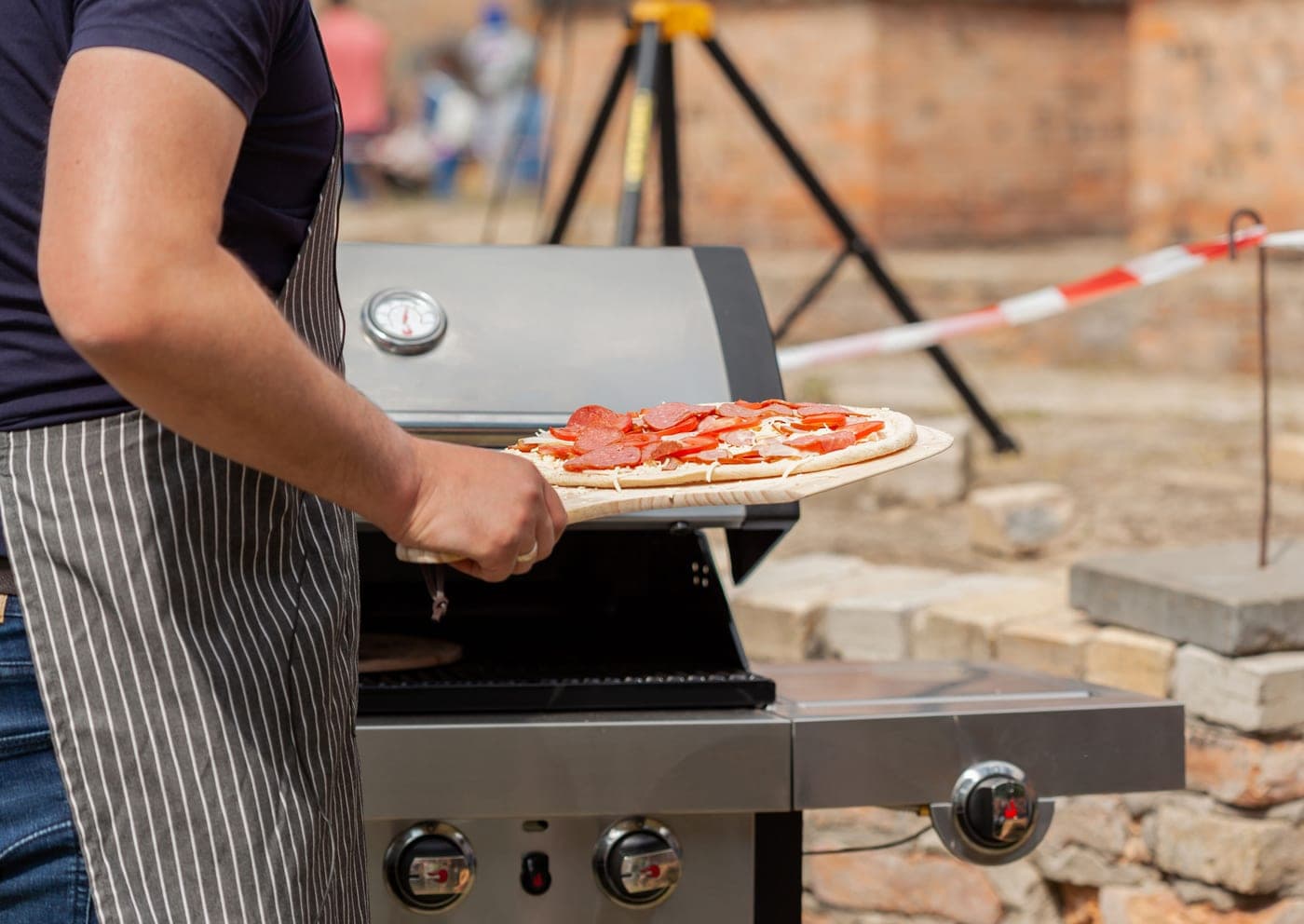
Big Green Egg's published pizza procedure is: aim for 600 F "even if the recipe calls for slightly less", insert the convEGGtor legs down, add the stainless steel grid on top of it, then the baking stone, and close the dome. Once it is back at temperature, adjust the rEGGulator and draft door by half and make small tweaks from there. They warn that "the frequent opening and closing of the lid will cause the heat to fluctuate".
That how-to page puts the stone in after the EGG is up to temperature. Their own stone product page says the opposite: "Place the pizza stone directly on the grid (in combination with the convEGGtor) when you light the EGG" so that it "warms up gradually".
Follow the product page. A cold ceramic stone lowered onto a grid in a 600 F dome is a textbook thermal-shock event, and thermal shock is how stones die - the mechanism is in why pizza stones crack. The cost of the cautious reading is that you light the EGG a little earlier. The cost of the other one is a stone.
The deflector is not optional either. Without it the stone has a charcoal fire radiating straight at its underside while its top face is in 600 F air, which puts a steep gradient through a brittle body - the same failure that kills stones on a charcoal grill, covered in the grill-stone roundup.
Two rules prevent this in a kamado: a deflector between the fire and the stone, and a stone that went in cold. Neither is about which stone you bought.
What 600 F does and does not ask of the stone
A kamado at 600 F is hotter than a domestic oven and a long way below a wood-fired oven. Every cordierite stone we rank publishes a heat resistance well clear of it - typically 1400 F in normal use - so the temperature itself is not the constraint, and you do not need a specialist high-temperature body here. Where that stops being true is the Ooni and Gozney class of oven running at 850 to 950 F, which is a different question handled in stones for Ooni and portable ovens.
What 600 F does ask for is patience on the warm-up. On our model a 15-inch round of the published 7 lb needs a little over half an hour to close 95 percent of the gap to the air temperature around it, and a kamado takes its own time to stabilize. The honest version of the published procedure is: light it, put the deflector, grid and stone in straight away, and go and make the dough.
The three to buy
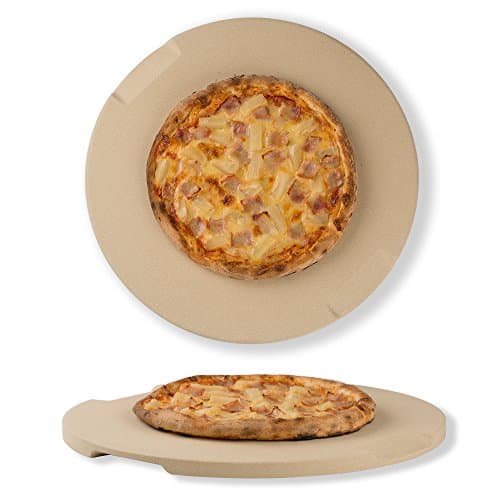
Best for a Large Big Green Egg or a comparable kamado: the ROCKSHEAT 15-inch round. A 15-inch round on an 18.25-inch grid leaves 1.6 inches a side, which is inside the band the maker's own stones use. It is also the only stone we rank with handle grooves cut into both faces, which on a kamado matters more than it does in a kitchen - you are reaching into a dome, not sliding something off a rack. The published 7 lb and 0.63-inch thickness are both real figures, which is rarer than it should be; our full look at it is in the ROCKSHEAT review. The trade is that the grooves come out of the usable baking area.
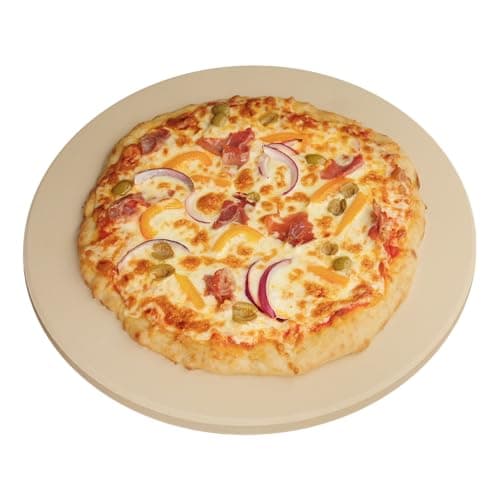
Best for an XL or 2XL: the Old Stone 16-inch round. A published 10 lb of cordierite and 201 square inches of usable round. On a 24-inch XL grid it leaves four inches a side, and on a 29-inch 2XL more than six - generous airflow, and the biggest pizza of the three. On a Large it technically fits with 1.1 inches a side, which is tighter than we would choose but not wrong.
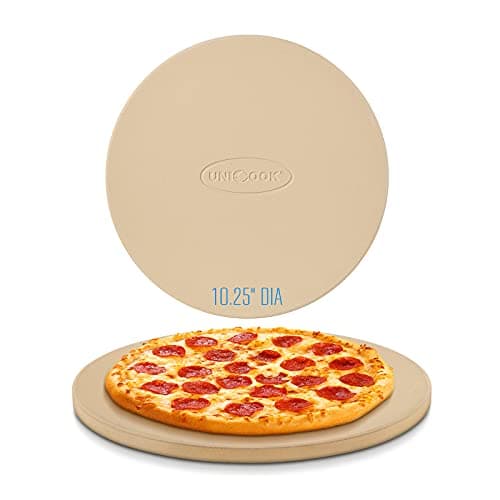
Best for a MiniMax, Small or Mini: the Unicook 10.25-inch round. On a 13-inch grid a 10.25-inch round leaves about 1.4 inches a side, which is the only sensible answer for a small EGG - note that the maker's own 12-inch stone leaves half an inch on that grid, which is less than we would want. It is also the quickest of the three to come up to temperature, at about 20 minutes on our model. The limit is obvious: 83 square inches is a personal pizza.
What we would skip: any rectangular stone, for the diagonal reason above; cast iron, because a kamado's problem is never getting the base hot enough; and a steel, which will take the heat but whose seasoning a charcoal dome strips faster than a kitchen oven does - that case is made in the best pizza steel for a grill.
The picks
What we would buy
ROCKSHEAT
ROCKSHEAT 15-Inch Round Cordierite Pizza Stone
The only stone here with handles cut into the body, and the only one whose listing publishes a thickness AND a weight - which is how we know it is ordinary bakeware cordierite priced sensibly.
The most useful stone shape for a home oven, at a weight one hand can manage, and one of the very few whose retailer publishes both a thickness and a weight.
The best-documented small stone here: the maker publishes the thickness, the kiln temperature and a 1450 F limit, and throws in the scraper. A third thicker than the toaster-oven stones, which is the compromise worth making if your cavity allows it.
What size pizza stone fits a Large Big Green Egg?+
A round stone of 14 to 16 inches. The published grid diameter is 18.25 inches and Big Green Egg's own stone for that size is 14 inches, so a 14 to 16-inch round keeps you inside the gap the maker designs for. A stone cut to the full 18.25 inches blocks the airflow the dome needs to cook the top of the pizza.
Do you need a convEGGtor or heat deflector for pizza?+
Yes. Big Green Egg's published procedure is convEGGtor in with the legs down, stainless grid on top, then the baking stone. Without a deflector the fire radiates directly onto the underside of the stone while the top face sits in 600 F air, and that gradient is what cracks ceramic.
What temperature should a kamado be for pizza?+
Big Green Egg say to aim for 600 F "even if the recipe calls for slightly less", because opening the dome makes the temperature fluctuate. Every cordierite stone we rank publishes a heat resistance far above that, so the stone is not the limiting factor at kamado temperatures.
When should the stone go into the kamado - cold or hot?+
Cold, with the deflector and grid, before you light it. Big Green Egg's own stone listing says to place it on the grid "when you light the EGG" so it "warms up gradually", while their pizza how-to describes adding it once the EGG is up to temperature. The two pages disagree; the gradual version is the one that does not risk thermal shock, and it is the one we would follow.
Can I use a rectangular pizza stone on a Big Green Egg?+
Not well. A square or rectangular stone has to fit by its diagonal, which is 1.41 times its side - a 13.2-inch square needs an 18.7-inch circle, so it will not sit fully inside a Large EGG's 18.25-inch grid. The corners end up on the grid's outer rim with nothing beneath them. Use a round stone.
Will my kitchen pizza stone work on a kamado?+
If it is round and 2 to 4 inches smaller than your grid, yes, on a deflector, from cold. If it is a rectangle - which most kitchen stones are - the diagonal arithmetic above usually rules it out. A stone that has already done a hundred bakes in an oven is also a stone that has already absorbed oil and been through a hundred heat cycles, which is not where you want to discover the limits of a brittle body.
Sources
Every number on this page came from one of these, or from arithmetic on one of these that we showed in full.