Heads up: some links on this page are affiliate links. If you buy through one we may earn a commission at no extra cost to you. It never changes a ranking, and we accept no payment for placement. The full version.
What 00 actually means
It is an Italian milling grade describing how finely the flour is ground and how much bran and germ have been removed. The scale runs 2, 1, 0, 00, with 00 the finest and most refined.
It says nothing about protein. A 00 flour can be 9 percent protein or 13 percent depending on the wheat and the mill, which is why "00 versus bread flour" is not comparing like with like - one term describes a grind, the other describes a strength.
A grind, not a strength
What the 00 designation actually tells you
Which is why the useful question is not '00 or bread flour' but 'what protein, and at what oven temperature'. Read the protein figure on the bag.
Why 00 exists, and what it was designed around
Neapolitan pizza is baked at 800 to 900 F for 60 to 90 seconds. In that window, a very finely milled, highly refined flour behaves in a specific way: it hydrates fast, it stretches very thin, and its low damaged-starch content means it browns slowly enough not to scorch in those 90 seconds while the interior sets.
That is a flour matched to an oven. Take the oven away and the match goes with it.
Why it underperforms in a domestic oven
At 500 to 550 F your bake is six to nine minutes rather than 90 seconds. The property 00 was selected for - browning slowly - is now working against you, because you have plenty of time and you want color.
The common experience is exactly that: a 00 dough in a home oven comes out paler, softer and less flavorful than the same recipe in bread flour, and people conclude they did something wrong. They did not. They used a flour designed for an oven three hundred degrees hotter than theirs.
The comparison, honestly
00 flour
Bread flour
What the label describes
Fineness of the grind
Protein content, typically 12-14%
Texture of the dough
Silky, extensible, very smooth
Slightly coarser, more elastic
Stretches thin
Excellent
Good
Browning in a 550 F oven
Slow - often too slow
Good
Suited to
800 F plus, 60-90 second bakes
450-550 F, 6-10 minute bakes
Chew
Tender, soft cornicione
Chewier, more structured
What to use
Domestic oven, 500 to 550 F: bread flour. Or all-purpose, honestly - it is closer to the right answer here than 00 is.
Portable or wood-fired oven, 800 F plus: 00, and this is where it earns everything claimed for it.
Grill at 650 to 700 F: either. A blend of half and half is a reasonable compromise and it is what a lot of people settle on.
Pan, Detroit and Sicilian: bread flour. Those styles want structure to support a thick, open crumb.
The difference in handling is real - a 00 dough is noticeably silkier. The difference in the finished pizza depends almost entirely on how hot your oven gets.
Read the protein number, not the grade
The genuinely useful figure is on the nutrition panel: grams of protein per 100 g. Around 11 to 12 percent is all-purpose territory, 12 to 14 is bread flour. Some 00 flours are milled specifically for high-temperature pizza and land at 12.5 percent or more; others are soft and land near 9.
Two 00 flours can behave completely differently. The grade on the front of the bag will not tell you which one you have; the protein figure on the back will.
What we did not do
We have not baked on any of these. Every guide in this category says it tested a dozen stones; we would rather say plainly that we did not. What we did instead is on this page in full: published specs with their sources, thermal arithmetic from material constants with the working shown, and the makers' own manuals read rather than paraphrased.
The honest summary
If your pizza is disappointing, flour is a long way down the list. Surface temperature, preheat length and topping moisture all matter more, and all three are covered in what to upgrade next. Change the flour when you have run out of bigger levers, not before.
The picks
What we would buy
Baking Steel
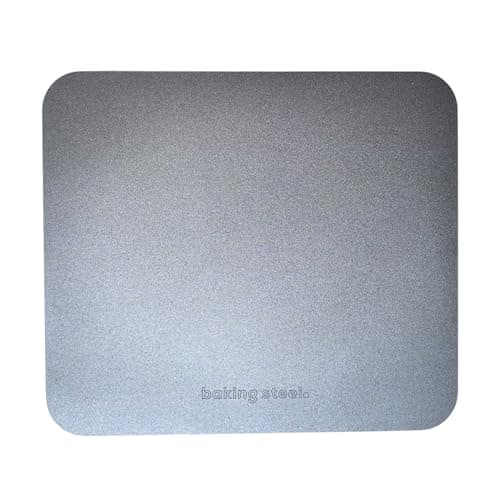
Baking Steel Original, 16 x 14 x 1/4
A quarter inch is the thickness where a steel stops being a novelty and stays a thing you can still lift. Its advantage over a stone is not preheat speed - it is what happens one second after the base lands.
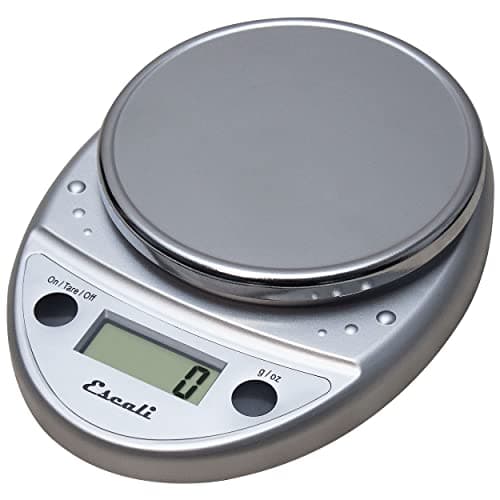
Eleven pounds of capacity at one-gram resolution, which is exactly right for flour and dough balls and exactly wrong for yeast. Know which half of your recipe it is for.
Only in a very hot oven. 00 is a milling grade optimized for 800 F, 90-second Neapolitan bakes. In a 550 F domestic oven it browns too slowly and bread flour usually gives a better result.
What does 00 mean in flour?+
How finely it is milled and how much bran and germ have been removed, on an Italian scale running 2, 1, 0, 00. It says nothing about protein content, which is the property that actually decides how the dough behaves.
Can I use all-purpose flour for pizza?+
Yes, and in a domestic oven it is closer to the right answer than 00 is. You get slightly less chew than bread flour and a base that is a little easier to stretch.
What protein content is best for pizza dough?+
Around 12 to 14 percent for a domestic oven, which is standard bread flour. Lower protein gives a more tender, less chewy result and less tolerance for a long ferment.
Do I need Italian flour to make good pizza?+
No. The flour is a long way down the list behind surface temperature, preheat length and how wet your toppings are. Fix those first.
Sources
Every number on this page came from one of these, or from arithmetic on one of these that we showed in full.