Heads up: some links on this page are affiliate links. If you buy through one we may earn a commission at no extra cost to you. It never changes a ranking, and we accept no payment for placement. The full version.
Two methods, two pizzas
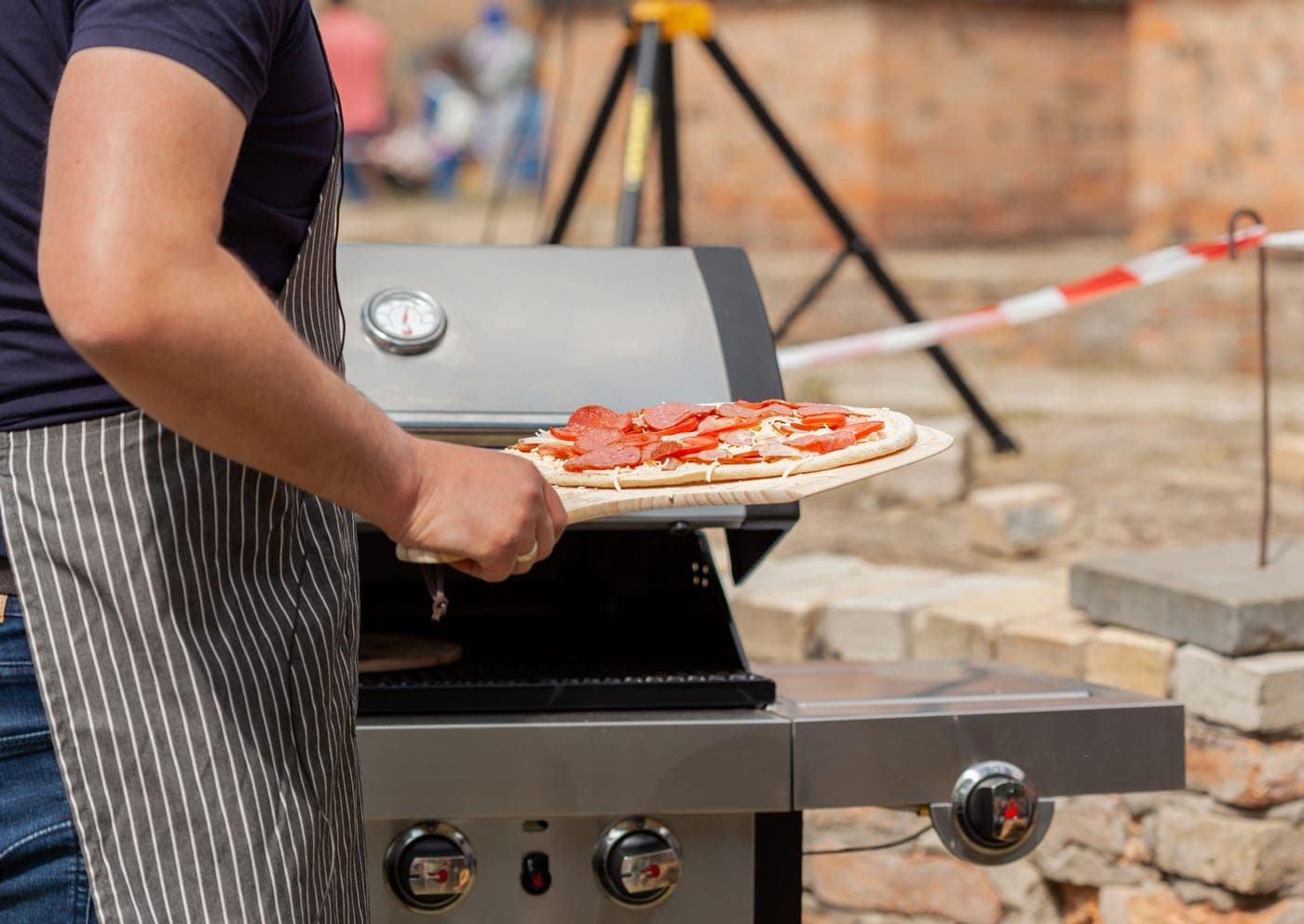
Indirect, on a stone or steel, lid down. You are making an oven. Coals banked to the sides or only the outer burners lit, the surface over the unlit middle, lid closed. This produces a pizza much like an oven pizza, only hotter - most grills will hold a surface at 600 to 700 F, which is well past what a domestic oven can do.
Direct, on the grate, no stone. A completely different technique and a completely different result. The dough goes straight onto oiled bars, cooks on one side in about 90 seconds, gets flipped, and is topped on the already-cooked face. Grill-marked, thin, smoky, closer to a flatbread. Genuinely good, and not a substitute for the first method.
600-700 F
Surface temperature a covered grill will hold, against 500-550 in a domestic oven
Which is the real argument for grill pizza: it is the cheapest way to get past what a domestic oven can do, and you may already own the equipment.
Method one: indirect, with a stone
Put the stone on a cold grate, over the part of the grill that will not be lit. Never onto a hot grate - that gradient is how stones crack.
Light the outer burners, or bank the coals to the sides. Nothing directly under the stone.
Close the lid and give it 25 to 30 minutes. Both grill and stone come up together.
Check the surface with an infrared thermometer, not the lid gauge - which reads air at the top of the dome and runs well above the stone.
Launch, close the lid, and check at three minutes. At 650 F a pizza is done in four to six minutes, and it will need turning because a grill is far less even than an oven.
Leave the stone on the grate to cool. A hot stone onto a cold worktop is the second-commonest way to break one.
Method two: direct on the grate
Get the grill hot and the bars clean. Medium-high on gas, coals ashed over on charcoal.
Stretch the dough thin, and brush one side with oil.
Lay it oiled-side down straight onto the bars. It will not stick if the bars are hot and clean.
Sixty to ninety seconds, until the underside is marked and it lifts freely.
Flip it. Top the cooked side, working fast - everything goes on a base that is already half-done.
Close the lid for two to three minutes to melt the cheese, and watch it. It goes from done to burned quickly.
Keep the toppings light and pre-cooked. There is no time for anything raw to cook, and no bottom heat left to drive off water.
Direct flame under a stone is what cracks it. Bank the coals to the sides or run only the outer burners.
Cast iron, on a grill
A cast iron pizza pan is arguably the better grill surface, for one reason: it cannot crack. A grill is a harsher thermal environment than an oven, it lives outdoors, and it gets moved around while hot. Cast iron does not care about any of that, and thermally it sits within about 5 percent of carbon steel.
The cost is the same as it is indoors: a rim, which makes launching from a peel awkward.
The mistakes
Lid up. Without the lid you have a griddle, not an oven - the base burns and the top never cooks. Lid down for the indirect method, always.
Trusting the lid gauge. It reads air at the top of the dome. The stone can be 150 F cooler.
Too much topping. A grill runs hotter and faster than an oven, so there is less time for anything to cook or dry out.
What we did not do
We have not baked on any of these. Every guide in this category says it tested a dozen stones; we would rather say plainly that we did not. What we did instead is on this page in full: published specs with their sources, thermal arithmetic from material constants with the working shown, and the makers' own manuals read rather than paraphrased.
The picks
What we would buy
Unicook
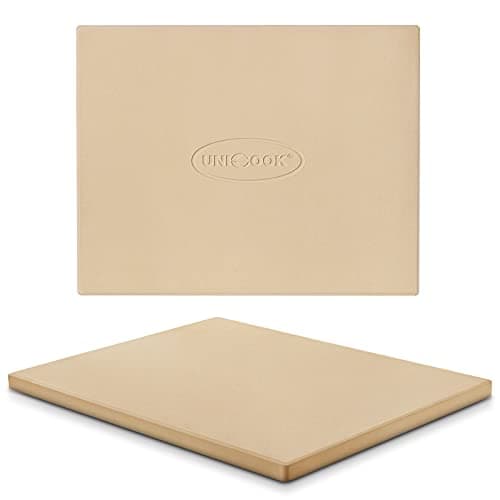
Unicook Heavy Duty Cordierite Pizza Stone, 15 x 12
A rectangle uses an oven rack better than a circle does, and at 6.6 published pounds this is the lightest surface here that still holds a useful amount of heat.
Cast iron sits within about 5 percent of carbon steel on every thermal number that matters, costs a fraction of a steel, and has handles. The catch is that this is a pan with a rim, not a flat plate you can slide a pizza onto.
#ad We hold no verified live price for this product, so we show none. How this site is funded.
ThermoWorks
ThermoWorks Industrial IR Gun (IR-GUN-S)
The adjustable emissivity is the reason to buy this rather than a cheap gun. Fixed-emissivity instruments read a seasoned steel 40 to 80 F low, and that is the difference between a good bake and a pale one.
#ad We hold no verified live price for this product, so we show none. How this site is funded.
Questions
Frequently asked
Can you cook pizza on a grill without a stone?+
Yes, directly on the grate - oil one side, lay it down, 60 to 90 seconds, flip, top the cooked side, close the lid to melt. It makes a thin, grill-marked, smoky pizza rather than an oven-style one.
What temperature for pizza on a grill?+
600 to 700 F on the surface for the indirect method, giving a four to six minute bake. Measure the surface, not the lid gauge - the gauge reads air at the top of the dome and runs well above the stone.
How do you stop a pizza stone cracking on a grill?+
Indirect heat only, start the stone on a cold grate, bring it up with the lid down, and let it cool on the grate afterwards. Never over a lit burner and never onto a cold worktop.
Is grill pizza better than oven pizza?+
It can be hotter, which helps - a covered grill will hold 600 to 700 F against a domestic oven's 550. It is also far less even, so it needs turning, and it is harder to control.
Do I need a pizza stone for the grill?+
For oven-style pizza, yes - or cast iron, which cannot crack and is arguably the better outdoor choice. For direct grate-cooked flatbread-style pizza, no surface at all.
Sources
Every number on this page came from one of these, or from arithmetic on one of these that we showed in full.