Heads up: some links on this page are affiliate links. If you buy through one we may earn a commission at no extra cost to you. It never changes a ranking, and we accept no payment for placement. The full version.
The shortlist
Ranked, with the working
Ranked on published manufacturer specifications and, where the numbers exist, our own arithmetic on what each option does thermally. Tap any row for the full write-up, including who should skip it.
#
Product
Best for
Score
Price
01
NerdChef Steel Stone Standard, 16 x 14.25 x 1/4Buyers who want the spec sheet to be honest before they buy
Scores are ours and editorial. They are never published as review or rating markup, because we have not baked on these products - here is how we pick.
Why a steel is the safer outdoor surface
Everything that breaks a stone on a grill is a temperature difference across the body: a burner beneath one corner, a cold slab lowered onto a hot grate, a flare-up under one edge. Cordierite survives that better than other ceramics because its published expansion figure is low - 2.9 to 4.8 micrometers per meter per kelvin - but low is not zero, and stones do crack on grills.
Metal does not have that failure mode at all. A steel plate exposed to fierce uneven heat expands, conducts the difference away quickly, and carries on. You can put a room-temperature steel onto a hot grate - which you should never do with a stone - and the only thing you have hurt is the preheat.
That is the entire case, and it is a durability case rather than a crust case. On crust, steel is better than stone everywhere, indoors and out, for reasons covered in stone versus steel.
What we did not do
We have not baked on any of these. Every guide in this category says it tested a dozen stones; we would rather say plainly that we did not. What we did instead is on this page in full: published specs with their sources, thermal arithmetic from material constants with the working shown, and the makers' own manuals read rather than paraphrased.
What we ranked on for grill use
A published temperature ceiling. A domestic oven tops out around 550 F. A covered gas grill runs hotter, and a charcoal bed directly beneath a plate hotter still. NerdChef publishes 1000 F for its plates. Most steel makers publish nothing at all, which is worth knowing before you put one over live fire.
Mass against your grate. This is the constraint people forget. A quarter-inch 16 by 14 plate is 15 published pounds and a half-inch is 32. Thin or worn grill grates are not designed for a 32 lb point load, and a plate that sits proud of the grate rocks.
Footprint against the cooking area. A plate that covers the whole grate leaves nowhere for heat to circulate and turns a convection setup into a hotplate. You want gaps at the sides with the lid down.
Thickness, which cuts the opposite way outdoors. In an oven, thicker is better. On a grill the heat is fiercer and one-sided, so a thinner plate reaching temperature sooner and running closer to the fire is usually the better tool. The mass-versus-time table is in the thickness guide.
Seasoning tolerance. Seasoning is a polymerized oil film, and a grill runs far above what a kitchen oven asks of it. Expect a grill steel to lose its seasoning faster than an indoor one and to need re-oiling more often. That is maintenance, not damage.
Why we do not publish a preheat time for a grill
Every preheat figure on this site comes from a lumped-capacitance model with a surface heat transfer coefficient of 20 W/m2.K, which describes an oven cabinet: radiant walls, still air, no flame. A grill is a different thermal environment entirely - direct radiant heat from below, convection under a closed lid, and a coefficient nobody publishes.
So the arithmetic that gives 27 minutes for a quarter-inch plate indoors does not transfer, and we will not pretend it does. Use an infrared thermometer instead: bring the grill up with the plate on it, lid down, and read the surface. That is the only honest number, and the instruments are ranked in the thermometer roundup.
1000 F
The only published temperature ceiling among the steels here
NerdChef states it on both plates. Baking Steel publishes preheat guidance but no ceiling, which for indoor use is irrelevant and for a charcoal grill is a real gap.
Matching the plate to the grill
Gas grill. The easiest case and the one most people have. Burners off directly under the plate, burners on at the sides, lid down. Even, controllable, and the plate is never over direct flame. Any of the picks here work; the quarter-inch plates are the sensible default.
Charcoal grill. The hottest and least even. Bank the coals to one side and put the plate over the cool side, or use a raised grate. This is where a published temperature ceiling stops being a technicality - a plate sitting directly over a full chimney of coals is in a different regime from an oven.
Pellet grill. Convection-driven and usually capped well below a charcoal bed, so the plate is safe and the limiting factor is the grill's maximum temperature rather than the steel. If your pellet grill tops out around 450 to 500 F you are baking at domestic-oven temperatures outdoors, and the long preheat rules apply exactly as they do in a kitchen.
The reason to take metal outdoors: you can set a cold plate on a hot grate and lose nothing but time. Do that with a stone and you own two stones.
Cast iron is the cheap way into the same physics
A cast iron pizza pan sits within about 5 percent of carbon steel on effusivity, weighs under 10 pounds, and has handles - which on a grill, where you are reaching across heat, is worth more than it is in a kitchen. The rim makes launching awkward, so build on the pan or use a screen. Full comparison in cast iron versus pizza steel.
When a stone is still the better outdoor buy
Two cases, and they are common enough to state plainly. If you are cooking on a portable pizza oven rather than a grill, the floor is a fitted part and you should buy the stone the oven was designed around - the model-by-model sizes are here. And if your grill grate is light, a 15 lb plate is a genuine problem where a 6.6 lb stone is not - the grill stone roundup ranks those.
The handling routine for either surface outdoors - cold start, indirect heat, lid down - is in pizza on the grill.
In full
Every pick, with the specs and the sources
01 / Best published temperature rating
NerdChef
8.8/10
NerdChef Steel Stone Standard, 16 x 14.25 x 1/4
The same quarter-inch plate, from the one maker in this category that states conductivity and heat capacity as two separate numbers instead of mashing them into one slogan.
What it does well
Publishes conductivity and heat capacity separately, which is the physically correct way to state them
Their 'twice the heat capacity' claim matches our independently derived 2.1x almost exactly
Published weight lands within 2 percent of the mass its own dimensions imply
What it does not
Rectangular rather than square
No published preheat guidance, unlike Baking Steel
Seasoning is on you
Skip it if
You want a square surface. At 14.25 inches deep this is a rectangle, so a 14-inch pizza has almost no margin front to back.
A quarter inch is the thickness where a steel stops being a novelty and stays a thing you can still lift. Its advantage over a stone is not preheat speed - it is what happens one second after the base lands.
What it does well
Thermal effusivity about 8.5 times a cordierite stone's, which is the number that decides bottom crust
Cannot crack, cannot be thermally shocked, will outlive the oven
Published weight, thickness and preheat guidance, all from the maker
Doubles as a griddle and a searing surface
What it does not
Fifteen pounds at arm's length into a 500 F oven is a real consideration
Needs seasoning maintained or it rusts
It will not preheat faster than a stone - it is heavier, so if anything it takes slightly longer
Skip it if
You cannot comfortably lift 15 pounds into a hot oven at chest height, or you bake more bread than pizza and want the forgiveness of a stone.
The maker's published preheat guidance and our model agree.
Lumped-capacitance model, h = 20 W/m2.K: tau = 8.9 minutes, so 95 percent of the way to oven temperature at 27 minutes and 99 percent at 41 minutes. Baking Steel publishes 45-60 minutes at 500-550 F. Two independent routes to the same answer is the closest thing to validation we can offer without owning one.
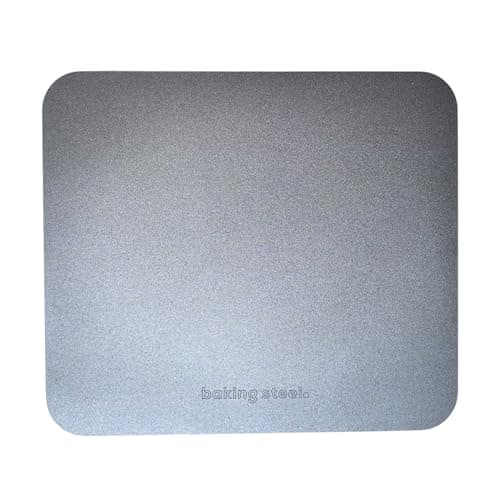
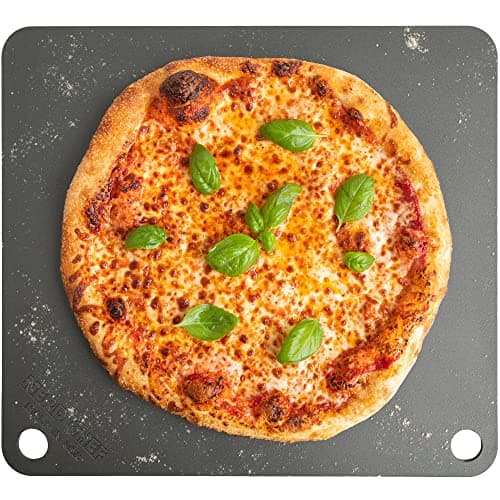
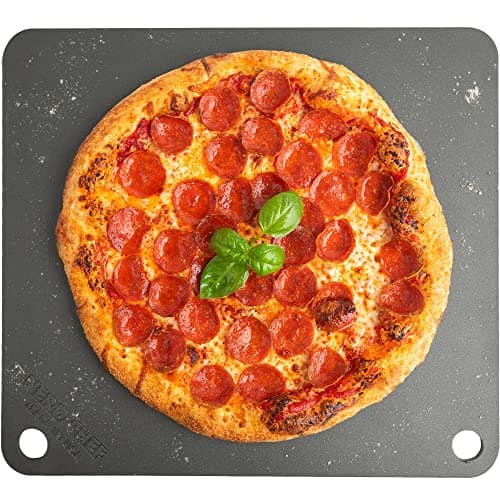
Stock photo of the product type, not this model. We publish no product photography we cannot source.
Lodge
8.3/10
Lodge 15-Inch Cast Iron Pizza Pan
Cast iron sits within about 5 percent of carbon steel on every thermal number that matters, costs a fraction of a steel, and has handles. The catch is that this is a pan with a rim, not a flat plate you can slide a pizza onto.
What it does well
Effusivity within about 5 percent of carbon steel, so the crust barely knows the difference
Handles, which no steel or stone has
Under 10 pounds
Published weight and dimensions from the maker
What it does not
A rim, so peel launching is awkward at best
Seasoning to maintain
Cast iron is brittle - drop it on a tile floor and it is done
Skip it if
You want to launch off a peel. The raised rim means you build the pizza on the pan or transfer it awkwardly - which changes how you make pizza, not just what you make it on.
#ad We hold no verified live price for this product, so we show none. How this site is funded.
04 / Most heat held, most weight
NerdChef
7.6/10
NerdChef Steel Stone Ultimate, 16 x 14.25 x 1/2
Thirty-two pounds of carbon steel. Genuinely the most thermally capable surface here, and genuinely the one most likely to sit in a cupboard because you cannot face lifting it.
What it does well
Nothing recovers faster between bakes
Effectively indestructible
Published weight matches the derived mass to within 2 percent
What it does not
32 lb is a two-hand, both-feet-planted lift
55 minutes to 95 percent of oven temperature, and about 0.45 kWh just to heat the plate
The thermal gain over a quarter-inch is invisible on a single pizza
Skip it if
You will ever need to take it out. Half an inch takes 55 minutes to reach 95 percent of oven temperature, and no domestic bake needs the extra mass over a quarter-inch.
Yes, and it is the best surface for it. Set the plate over burners that are off, with the lit burners at the sides and the lid down. Unlike a stone, a steel cannot be thermally shocked, so an uneven grill is not a risk to it.
Will a pizza steel warp on a grill?+
A solid plate of the thicknesses sold for pizza - quarter inch and up - is stiff enough that this is not the usual failure mode. What you will lose is seasoning: a polymerized oil film on a grill sees temperatures well above anything a kitchen oven produces, so expect to re-oil more often.
Steel or stone on a grill?+
Steel, unless weight is a problem. Everything that cracks a stone is a temperature difference across the body, and a grill produces those by design. Metal has no such failure mode.
How long do you preheat a steel on a grill?+
We do not publish a figure, because our preheat model describes an oven cabinet and a grill is not one. Bring the grill up with the plate in place, lid down, and read the surface with an infrared thermometer.
Is a thicker steel better outdoors?+
Usually not. Outdoor heat is fiercer and one-sided, so the extra mass mostly buys a longer wait and a heavier load on the grate. A quarter-inch plate is the sensible default for a grill.
Sources
Every number on this page came from one of these, or from arithmetic on one of these that we showed in full.